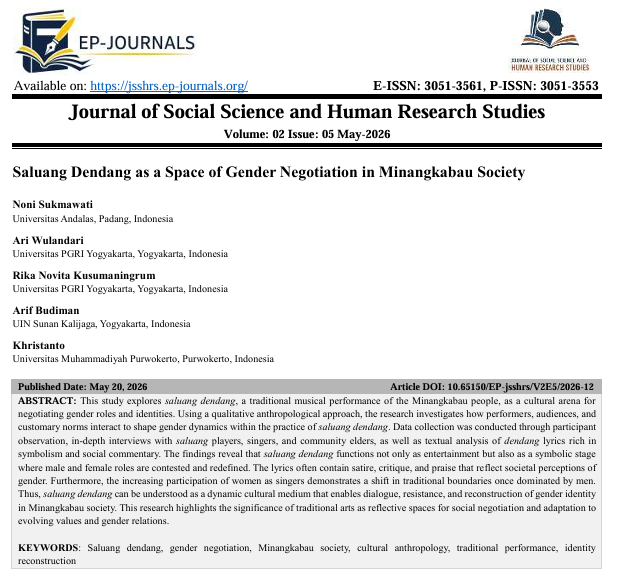
Saluang Dendang as a Space of Gender Negotiation in Minangkabau Society
DOI:
https://doi.org/10.65150/EP-jsshrs/V2E5/2026-12Keywords:
Saluang dendang, gender negotiation, Minangkabau society, cultural anthropology, traditional performance, identity reconstructionAbstract
This study explores saluang dendang, a traditional musical performance of the Minangkabau people, as a cultural arena for negotiating gender roles and identities. Using a qualitative anthropological approach, the research investigates how performers, audiences, and customary norms interact to shape gender dynamics within the practice of saluang dendang. Data collection was conducted through participant observation, in-depth interviews with saluang players, singers, and community elders, as well as textual analysis of dendang lyrics rich in symbolism and social commentary. The findings reveal that saluang dendang functions not only as entertainment but also as a symbolic stage where male and female roles are contested and redefined. The lyrics often contain satire, critique, and praise that reflect societal perceptions of gender. Furthermore, the increasing participation of women as singers demonstrates a shift in traditional boundaries once dominated by men. Thus, saluang dendang can be understood as a dynamic cultural medium that enables dialogue, resistance, and reconstruction of gender identity in Minangkabau society. This research highlights the significance of traditional arts as reflective spaces for social negotiation and adaptation to evolving values and gender relations.
References
1) Alexander, B., Rafiloza, R., and Asril, A. (2021). Bahoyak: Pengaruh postmodern di dalam pertunjukan saluang dendang di Minangkabau. Besaung: Jurnal Seni Desain dan Budaya, 4(2). https://doi.org/10.36982/jsdb.v4i2.595
2) Barendregt, B., and van Zanten, W. (2021). Popular music and cultural identity in Indonesia. Asian Music, 52(1), 45–67. https://doi.org/10.1353/amu.2021.0003
3) Braun, V., and Clarke, V. (2022). Thematic analysis: A practical guide. SAGE Publications. https://doi.org/10.4135/9781529798719
4) Butler, J. (2021). Gender trouble: Feminism and the subversion of identity (2nd ed.). Routledge. https://doi.org/10.4324/9780429500480
5) Creswell, J. W., and Poth, C. N. (2023). Qualitative inquiry and research design: Choosing among five approaches (5th ed.). SAGE Publications. https://doi.org/10.4135/9781071899330
6) Denzin, N. K., and Lincoln, Y. S. (2023). The SAGE handbook of qualitative research (6th ed.). SAGE Publications. https://doi.org/10.4135/9781071920560
7) Diamond, B., and Moisala, P. (2021). Gender and music in cross-cultural perspective. Ethnomusicology Forum, 30(2), 115–132. https://doi.org/10.1080/17411912.2021.1901234
8) Fairclough, N. (2022). Language and power (4th ed.). Routledge. https://doi.org/10.4324/9781003158769
9) Fitriani, N., Sari, D., and Mulyadi, A. (2024). Women representation in Malay traditional performances: Gender and cultural negotiation. Humaniora, 36(1), 15–29. https://doi.org/10.22146/jh.v36i1.89211
10) Heryanto, A. (2021). Cultural identity and popular culture in contemporary Indonesia. Indonesia and the Malay World, 49(145), 123–140. https://doi.org/10.1080/13639811.2021.1876804
11) Jonni, J., Asril, A., and Yensharti, Y. (2021). Aesthetic elements in the structure of bagurau saluang-dendang performance in Minangkabau. Arts and Design Studies, 94, 26–33. https://doi.org/10.7176/ADS/94-03
12) Lincoln, Y. S., and Guba, E. G. (2021). Naturalistic inquiry. SAGE Publications. https://doi.org/10.4135/9781412985438
13) Nasir, P. E., Putra, H. S. A., and Mutolib, A. (2021). Minangkabau matriliny and gender equality: Cultural contribution to sustainable development goals. Andalas Journal of International Studies, 10(1), 16–33. https://doi.org/10.25077/ajis.10.1.16-33.2021
14) Novita, U., and Asril, A. (2023). Interaksi pendendang dengan penonton dalam pertunjukan saluang dendang. In Laboratory Journal: Jurnal Seni Pertunjukan dan Seni Rupa, 2(1). https://doi.org/10.24114/ilj.v2i1.57542
15) Patton, M. Q. (2021). Qualitative research & evaluation methods (5th ed.). SAGE Publications. https://doi.org/10.4135/9781071878588
16) Rahmawati, E., and Prasetyo, A. (2023). Traditional performing arts as cultural communication in Indonesia. Cogent Arts & Humanities, 10(1), 1–14. https://doi.org/10.1080/23311983.2023.2187654
17) Rustim, R., Nugraha, W. N. C. R., and Simatupang, G. R. L. (2019). Interaksi sosial tradisi bagurau saluang dendang Minangkabau di Sumatera Barat. Resital: Jurnal Seni Pertunjukan, 20(1). https://doi.org/10.24821/resital.v20i1.3509
18) Saraswati, L. A. (2022). Women and identity reconstruction in Indonesian traditional arts. Journal of Southeast Asian Studies, 53(3), 421–438. https://doi.org/10.1017/S0022463422000321
19) Schechner, R. (2021). Performance studies: An introduction (4th ed.). Routledge. https://doi.org/10.4324/9781003090984
20) Spradley, J. P. (2022). Participant observation. Waveland Press. https://doi.org/10.4324/9781003448709
21) Sugarman, J. (2022). Folk songs and gender narratives in Balkan societies. Ethnomusicology, 66(1), 75–94. https://doi.org/10.5406/ethnomusicology.66.1.0075
22) Sukmawati, N. (2008). Bagurau saluang dan dendang dalam perspektif perubahan budaya Minangkabau. Forum Ilmu Sosial, 35(2). https://doi.org/10.15294/fis.v35i2.1293
23) Suryadi, S. (2023). Oral literature and symbolic communication in Minangkabau culture. Wacana, 24(2), 201–219. https://doi.org/10.17510/wacana.v24i2.1256
24) Turner, V. (2021). Ritual, performance, and social transformation. Performing Ethos, 11(1), 9–21. https://doi.org/10.1386/peet_00032_1
Downloads
Published
Issue
Section
License
Copyright (c) 2026 Noni Sukmawati, Ari Wulandari, Rika Novita Kusumaningrum, Arif Budiman, Khristanto (Author)

This work is licensed under a Creative Commons Attribution 4.0 International License.