Decision Legitimacy in AI-Enabled Organizations: A Multilevel Framework of Algorithmic Authority and Human Judgment
DOI:
https://doi.org/10.65150/EP-jsshrs/V2E5/2026-14Keywords:
Decision Legitimacy, Algorithmic Authority, Human Judgment, AI-Enabled Organizations, Theoretical FrameworkAbstract
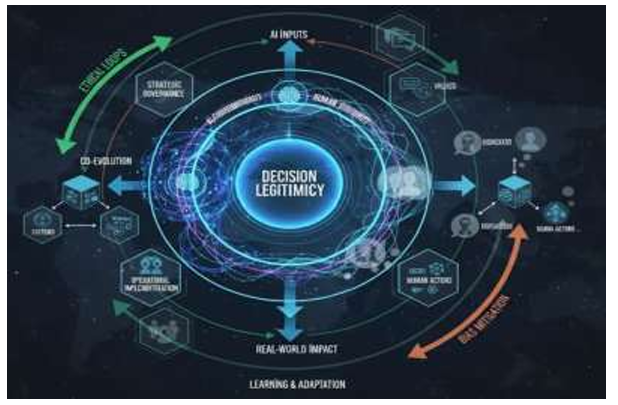
This study develops a theoretical framework explaining decision legitimacy in AI-enabled organizations as an emergent outcome of the interplay between algorithmic authority and human judgment. Drawing on institutional theory, socio-technical systems, and behavioral decision-making, it identifies procedural, distributive, and cognitive legitimacy as key dimensions. While AI enhances efficiency and consistency, legitimacy depends on transparency, explainability, and perceived fairness. Algorithmic authority may both strengthen and undermine legitimacy, whereas human judgment remains essential for contextual interpretation and accountability. The study advances multilevel propositions and outlines a research agenda for examining legitimacy in hybrid human–AI decision systems.
References
1) Ahmed, I. (2025). Navigating ethics and risk in artificial intelligence applications within information technology: A systematic review [Review of Navigating ethics and risk in artificial intelligence applications within information technology: A systematic review]. American Journal of Advanced Technology and Engineering Solutions, 1(1), 579–601. https://doi.org/10.63125/590d7098Akbarighatar, P. (2024). Operationalizing responsible AI principles through responsible AI capabilities. AI and Ethics.
https://doi.org/10.1007/s43681-024-00524-4
2) Alhosani, K., & Alhashmi, S. M. (2024). Opportunities, challenges, and benefits of AI innovation in government services: a review [Review of Opportunities, challenges, and benefits of AI innovation in government services: a review]. Discover Artificial Intelligence, 4(1). Springer Nature. https://doi.org/10.1007/s44163-024-00111-w
3) Ananny, M., & Crawford, K. (2018). Seeing without knowing: Limitations of the transparency ideal and its application to algorithmic accountability. New Media & Society, 20(3), 973–989. https://doi.org/10.1177/1461444816676645
4) Asatiani, A., Malo, P., Nagbøl, P. R., Penttinen, E., Rinta-Kahila, T., & Salovaara, A. (2021). Sociotechnical Envelopment of Artificial Intelligence: An Approach to Organizational Deployment of Inscrutable Artificial Intelligence Systems. Journal of the Association for Information Systems, 22(2), 325–352. https://doi.org/10.17705/1jais.00664
5) Ashforth, B. E., & Gibbs, B. W. (1990). The double-edge of organizational legitimation. Organization Science, 1(2), 177–194.
https://doi.org/10.1287/orsc.1.2.177
6) Badgami, R. K. (2025). AI as a Shadow Executive: Modelling Non-Human Influence in Organizational Decision-Making. International Journal of Innovative Science and Research Technology (IJISRT), 1626–1626. https://doi.org/10.38124/ijisrt/25dec1016
7) Barocas, S., & Selbst, A. D. (2016). Big data’s disparate impact. California Law Review, 104(3), 671–732.
8) Batool, A., Zowghi, D., & Bano, M. (2025). AI governance: a systematic literature review. AI and Ethics, 5(3), 3265–3279.
https://doi.org/10.1007/s43681-024-00653-w
9) Beckert, J. (1999). Agency, entrepreneurs, and institutional change. Organization Studies, 20(5), 777–799.
https://doi.org/10.1177/0170840699205004
10) Beer, D. (2017). The social power of algorithms. Information, Communication & Society, 20(1), 1–13.
https://doi.org/10.1080/1369118X.2016.1216147
Binns, R. (2018). Fairness in machine learning:Lessons from political philosophy. Proceedings of Machine Learning Research,81,1–11.
11) Binns, R., Veale, M., Van Kleek, M., & Shadbolt, N. (2018). ‘It’s reducing a human being to a percentage’: Perceptions of justice in algorithmic decisions. Proceedings of the 2018 CHI Conference on Human Factors in Computing Systems, 1–14.
https://doi.org/10.1145/3173574.3173951
12) Bitektine, A., & Haack, P. (2015). The “macro” and the “micro” of legitimacy: Toward a multilevel theory of the legitimacy process. Academy of Management Review, 40(1), 49–75. https://doi.org/10.5465/amr.2013.0318
13) Brynjolfsson, E., & McAfee, A. (2017). Machine, platform, crowd. W. W. Norton.
14) Burrell, J. (2016). How the machine ‘thinks’: Understanding opacity in machine learning algorithms. Big Data & Society, 3(1). https://doi.org/10.1177/2053951715622512
15) Burrell, J. (2016). How the machine ‘thinks’: Understanding opacity in machine learning algorithms. Big Data & Society, 3(1). https://doi.org/10.1177/2053951715622512
16) Cabiddu, F., Moi, L., Patriotta, G., & Allen, D. G. (2022). Why do users trust algorithms? A review and conceptualization of initial trust and trust over time [Review of Why do users trust algorithms? A review and conceptualization of initial trust and trust over time]. European Management Journal, 40(5), 685–706. Elsevier BV. https://doi.org/10.1016/j.emj.2022.06.001
17) Cahyani, R. R., & Musslifah, A. R. (2025). Balancing bytes and biases: A case study of AI adoption in academic human resource management. Journal of Educational Management and Instruction (JEMIN), 5(2), 437–450. https://doi.org/10.22515/jemin.v5i2.11679
18) Castelo, N., Bos, M. W., & Lehmann, D. R. (2019). Task-dependent algorithm aversion. Journal of Marketing Research, 56(5), 809–825. https://doi.org/10.1177/0022243719851788
19) Chiu, Y.-T., Zhu, Y., & Corbett, J. (2021). In the hearts and minds of employees: A model of pre-adoptive appraisal toward artificial intelligence in organizations. International Journal of Information Management, 60, 102379–102379.
https://doi.org/10.1016/j.ijinfomgt.2021.102379
20) Choung, H., David, P., & Seberger, J. S. (2023). A multilevel framework for AI governance. arXiv (Cornell University).
https://doi.org/10.48550/arxiv.2307.03198
21) Colquitt, J. A., Conlon, D. E., Wesson, M. J., Porter, C. O., & Ng, K. Y. (2001). Justice at the millennium. Journal of Applied Psychology, 86(3), 425–445. https://doi.org/10.1037/0021-9010.86.3.425
22) Danaher, J., Hogan, M. J., Noone, C., Kennedy, R., Behan, A., De Paor, A., ... & Shankar, K. (2017). Algorithmic governance. Big Data & Society, 4(2). https://doi.org/10.1177/2053951717718855
23) Davenport, T. H., & Kirby, J. (2016). Only humans need apply. Harper Business.
24) Davenport, T. H., & Ronanki, R. (2018). Artificial intelligence for the real world. Harvard Business Review, 96(1), 108–116.
25) De Cremer, D., & Kasparov, G. (2021). The future of work: AI and human collaboration in organizations. Harvard Business Review Press.
26) Deephouse, D. L., Bundy, J., Tost, L. P., & Suchman, M. C. (2017). Organizational legitimacy. Academy of Management Annals, 11(1), 451–478. https://doi.org/10.5465/annals.2015.0101
27) Demirsoy, S. (2025). Business management in algorithmic environments: Redefining accountability, governance, and performance. Zenodo (CERN European Organization for Nuclear Research). https://doi.org/10.5281/zenodo.18501845
28) Dietvorst, B. J., Simmons, J. P., & Massey, C. (2015). Algorithm aversion. Journal of Experimental Psychology: General, 144(1), 114–126. https://doi.org/10.1037/xge0000033
29) Dima, J., Gilbert, M., Dextras-Gauthier, J., & Giraud, L. (2024). The effects of artificial intelligence on human resource activities and the roles of the human resource triad: opportunities and challenges. Frontiers in Psychology, 15.
https://doi.org/10.3389/fpsyg.2024.1360401
30) DiMaggio, P. J., & Powell, W. W. (1983). The iron cage revisited. American Sociological Review, 48(2), 147–160.
31) Dwivedi, Y. K., Hughes, L., Ismagilova, E., Aarts, G., Coombs, C., Crick, T., Duan, Y., Dwivedi, R., Edwards, J. S., Eirug, A., Galanos, V., Ilavarasan, P. V., Janssen, M., Jones, P., Kar, A. K., Kizgin, H., Kronemann, B., Lal, B., Lucini, B., … Williams, M. D. (2019). Artificial Intelligence (AI): Multidisciplinary perspectives on emerging challenges, opportunities, and agenda for research, practice and policy. International Journal of Information Management, 57, 101994–101994. https://doi.org/10.1016/j.ijinfomgt.2019.08.002
32) Dwork, C., Hardt, M., Pitassi, T., Reingold, O., & Zemel, R. (2012). Fairness through awareness. Proceedings of the 3rd Innovations in Theoretical Computer Science Conference. https://doi.org/10.1145/2090236.2090255
33) Eigner, E., & Handler, T. (2024). Determinants of LLM-assisted Decision-Making. arXiv (Cornell University).
https://doi.org/10.48550/arxiv.2402.17385
34) Elbardan, H., Nordberg, D., & Sinha, V. K. (2023). Reconstructing legitimacy of internal auditing during ERP implementations: two contrasting cases. Journal of Accounting Literature, 47(5), 184–210. https://doi.org/10.1108/jal-01-2023-0001
35) Enang, I., Mukala, P., & Nkereuwem, U. (2026). Authentic Intelligence in Digital Strategy Systems: A Socio-Technical Analysis of Human-Accountable Decision Governance. Systems, 14(3), 259–259. https://doi.org/10.3390/systems14030259
36) Enholm, I. M., Papagiannidis, E., Mikalef, P., & Krogstie, J. (2021). Artificial Intelligence and Business Value: a Literature Review [Review of Artificial Intelligence and Business Value: a Literature Review]. Information Systems Frontiers, 24(5), 1709–1734. Springer Science+Business Media. https://doi.org/10.1007/s10796-021-10186-w
37) Esch, P. van. (2026). From agentic AI to AI-orchestrated organizations: Understanding the next surge in artificial intelligence. Business Horizons. https://doi.org/10.1016/j.bushor.2026.03.003
38) Faraj, S., Pachidi, S., & Sayegh, K. (2018). Working and organizing in the age of algorithms. Information and Organization, 28(1), 62–70. https://doi.org/10.1016/j.infoandorg.2018.02.005
39) Gharaibeh, O. K. K. (2026a). AI As The Invisible Manager: How Artificial Intelligence Is Reshaping Managerial Decision-Making. Zenodo (CERN European Organization for Nuclear Research). https://doi.org/10.5281/zenodo.18411174
40) Gharaibeh, O. K. K. (2026b). AI As The Invisible Manager: How Artificial Intelligence Is Reshaping Managerial Decision-Making. Zenodo (CERN European Organization for Nuclear Research). https://doi.org/10.5281/zenodo.18411175
41) Gillespie, T. (2014). The relevance of algorithms. In T. Gillespie et al. (Eds.), Media technologies. MIT Press.
42) Gladden, M. E., Fortuna, P., & Modliński, A. (2022). The Empowerment of Artificial Intelligence in Post-Digital Organizations: Exploring Human Interactions with Supervisory AI. Human Technology, 18(2), 98–121.
https://doi.org/10.14254/1795-6889.2022.18-2.2
43) Glikson, E., & Woolley, A. W. (2020). Human trust in artificial intelligence. Academy of Management Review, 45(2), 1–24.
https://doi.org/10.5465/amr.2018.0196
44) Greenberg, J. (1990). Organizational justice. Journal of Management, 16(2), 399–432.
45) Guler, N., Cahalane, M., Kirshner, S. N., & Vidgen, R. (2025). The Role of Roles: When are LLMs Behavioural in Information Systems Decision-Making. AJIS. Australasian Journal of Information Systems/AJIS. Australian Journal of Information Systems/Australian Journal of Information Systems, 29. https://doi.org/10.3127/ajis.v29.5573
46) Haack, P., Pfarrer, M. D., & Scherer, A. G. (2014). Legitimacy-as-feeling. Academy of Management Journal, 57(3), 634–660.
47) Haesevoets, T., Cremer, D. D., Dierckx, K., & Hiel, A. V. (2021). Human-machine collaboration in managerial decision making. Computers in Human Behavior, 119, 106730–106730. https://doi.org/10.1016/j.chb.2021.106730
48) Highhouse, S. (2008). Stubborn reliance on intuition. Industrial and Organizational Psychology, 1(3), 333–342.
49) Hillebrand, L., Raisch, S., & Schad, J. (2025). Managing with Artificial Intelligence: An Integrative Framework. Academy of Management Annals, 19(1), 343–375. https://doi.org/10.5465/annals.2022.0072
50) Hossain, S., Fernando, M., & Akter, S. (2025a). Digital Leadership: Towards a Dynamic Managerial Capability Perspective of Artificial Intelligence-Driven Leader Capabilities. Journal of Leadership & Organizational Studies, 32(2), 189–208.
https://doi.org/10.1177/15480518251319624
51) Hossain, S., Fernando, M., & Akter, S. (2025b). The influence of artificial intelligence-driven capabilities on responsible leadership: A future research agenda. Journal of Management & Organization, 31(5), 2360–2384. https://doi.org/10.1017/jmo.2025.10010
52) Huang, B., & Niyomsilp, E. (2025). The impact of artificial intelligence on organizational decision-making processes. Edelweiss Applied Science and Technology, 9(4), 794–808. https://doi.org/10.55214/25768484.v9i4.6081
53) Kahneman, D. (2011). Thinking, fast and slow. Farrar, Straus and Giroux.
54) Kahneman, D. (2011). Thinking, fast and slow. Farrar, Straus and Giroux.
55) Kellogg, K. C., Valentine, M. A., & Christin, A. (2020). Algorithms at work. Academy of Management Annals, 14(1), 366–410.
https://doi.org/10.5465/annals.2018.0174
56) Kellogg, K. C., Valentine, M. A., & Christin, A. (2020). Algorithms at work: The new contested terrain of control. Academy of Management Annals, 14(1), 366–410. https://doi.org/10.5465/annals.2018.0174
57) Koponen, J., Julkunen, S., Laajalahti, A., Turunen, M., & Spitzberg, B. H. (2023). Work Characteristics Needed by Middle Managers When Leading AI-Integrated Service Teams. Journal of Service Research. https://doi.org/10.1177/10946705231220462
58) Kroll, J. A., Huey, J., Barocas, S., Felten, E. W., Reidenberg, J. R., Robinson, D. G., & Yu, H. (2017). Accountable algorithms. University of Pennsylvania Law Review, 165(3), 633–705.
59) Lanz, L., Briker, R., & Gerpott, F. H. (2023). Employees Adhere More to Unethical Instructions from Human Than AI Supervisors: Complementing Experimental Evidence with Machine Learning. Journal of Business Ethics, 189(3), 625–646.
https://doi.org/10.1007/s10551-023-05393-1
60) Lee, J. D., & See, K. A. (2004). Trust in automation: Designing for appropriate reliance. Human Factors, 46(1), 50–80.
https://doi.org/10.1518/hfes.46.1.50_30392
61) Lee, M. K. (2018). Understanding perception of algorithmic decisions. Proceedings of the ACM on Human-Computer Interaction, 2(CSCW), 1–26. https://doi.org/10.1145/3274429
62) Leoni, L., Gueli, G., Ardolino, M., Panizzon, M., & Gupta, S. (2024). AI-empowered KM processes for decision-making: empirical evidence from worldwide organisations. Journal of Knowledge Management, 28(11), 320–347.
https://doi.org/10.1108/jkm-03-2024-0262
63) Li, H., & Tian, F. (2025). Advancing Decision-Making through AI-Human Collaboration: A Systematic Review and Conceptual Framework [Review of Advancing Decision-Making through AI-Human Collaboration: A Systematic Review and Conceptual Framework]. Research Square (Research Square). Research Square (United States). https://doi.org/10.21203/rs.3.rs-6885768/v1
64) Lind, E. A., & Tyler, T. R. (1988). The social psychology of procedural justice. Springer.
65) Logg, J. M., Minson, J. A., & Moore, D. A. (2019). Algorithm appreciation. Organizational Behavior and Human Decision Processes, 151, 90–103. https://doi.org/10.1016/j.obhdp.2019.01.002
66) Madanchian, M., & Taherdoost, H. (2025). Ethical theories, governance models, and strategic frameworks for responsible AI adoption and organizational success. Frontiers in Artificial Intelligence, 8, 1619029–1619029. https://doi.org/10.3389/frai.2025.1619029
67) Malik, A., Budhwar, P., Patel, C., & Srikanth, N. R. (2020). May the bots be with you! Delivering HR cost-effectiveness and individualised employee experiences in an MNE. The International Journal of Human Resource Management, 33(6), 1148–1178. https://doi.org/10.1080/09585192.2020.1859582
68) March, J. G., & Olsen, J. P. (1989). Rediscovering institutions: The organizational basis of politics. Free Press.
69) Martin, K., & Waldman, A. E. (2022). Are Algorithmic Decisions Legitimate? The Effect of Process and Outcomes on Perceptions of Legitimacy of AI Decisions. Journal of Business Ethics, 183(3), 653–670. https://doi.org/10.1007/s10551-021-05032-7
70) Mayer, R. C., Davis, J. H., & Schoorman, F. D. (1995). An integrative model of organizational trust. Academy of Management Review, 20(3), 709–734.
71) Meyer, J. W., & Rowan, B. (1977). Institutionalized organizations. American Journal of Sociology, 83(2), 340–363.
72) Meyer, J. W., & Rowan, B. (1977). Institutionalized organizations: Formal structure as myth and ceremony. American Journal of Sociology, 83(2), 340–363. https://doi.org/10.1086/226550
73) Mittelstadt, B. D., Allo, P., Taddeo, M., Wachter, S., & Floridi, L. (2016). The ethics of algorithms. Big Data & Society, 3(2).
74) Mittelstadt, B. D., Allo, P., Taddeo, M., Wachter, S., & Floridi, L. (2016). The ethics of algorithms: Mapping the debate. Big Data & Society, 3(2). https://doi.org/10.1177/2053951716679679
75) Mohammed, A., Bambale, S. A., & Abdullahi, U. (2025). AI-Driven Decision-Making in Leadership: Balancing Automation and Human Judgment for Optimal Organizational Performance. Journal of Economics and Administrative Sciences, 31(150), 129–141.
https://doi.org/10.33095/hv149002
76) Noble, S. U. (2018). Algorithms of oppression. NYU Press.
77) O’Neil, C. (2016). Weapons of math destruction. Crown.
78) O’Neil, C. (2016). Weapons of math destruction. Crown.
79) Oladele, I., Orelaja, A., & Akinwande, O. T. (2024). Ethical Implications and Governance of Artificial Intelligence in Business Decisions: A Deep Dive into the Ethical Challenges and Governance Issues Surrounding the Use of Artificial Intelligence in Making Critical Business Decisions. International Journal of Latest Technology in Engineering Management & Applied Science, 48–56. https://doi.org/10.51583/ijltemas.2024.130207
80) Ossa, L. A., Lorenzini, G., Milford, S. R., Shaw, D., Elger, B. S., & Rost, M. (2024). Integrating ethics in AI development: a qualitative study. BMC Medical Ethics, 25(1). https://doi.org/10.1186/s12910-023-01000-0
81) Papagiannidis, E., Mikalef, P., & Conboy, K. (2025). Responsible artificial intelligence governance: A review and research framework. The Journal of Strategic Information Systems, 34(2), 101885–101885. https://doi.org/10.1016/j.jsis.2024.101885
82) Pasquale, F. (2015). The black box society. Harvard University Press.
83) Passlack, N., Hammerschmidt, T., & Posegga, O. (2025). With Great Power Comes Great Responsibility: What Shapes AI Literacy for Responsible Interactions of Knowledge Workers With AI? Information Systems Frontiers. https://doi.org/10.1007/s10796-025-10648-5
84) Pinski, M., Hofmann, T., & Benlian, A. (2024). AI Literacy for the top management: An upper echelons perspective on corporate AI orientation and implementation ability. Electronic Markets, 34(1). https://doi.org/10.1007/s12525-024-00707-1
85) Pöhler, L., Diepold, K., & Wallach, W. (2024). A Practical Multilevel Governance Framework for Autonomous and Intelligent Systems. arXiv (Cornell University). https://doi.org/10.48550/arxiv.2404.13719
86) Qeybi, N., & Böschen, S. (2025). Integrating perspectives on democratization in industry via multi-agent systems: insights from a firm-based case study. Human-Intelligent Systems Integration. https://doi.org/10.1007/s42454-025-00077-9
87) Rai, A. (2020). Explainable AI: From black box to glass box. Journal of the Academy of Marketing Science, 48, 137–141.
https://doi.org/10.1007/s11747-019-00710-5
88) Raisch, S., & Krakowski, S. (2021). Artificial Intelligence and Management: The Automation–Augmentation Paradox. Academy of Management Review, 46(1), 192–210. https://doi.org/10.5465/amr.2018.0072
89) Raisch, S., & Krakowski, S. (2021). Artificial intelligence and management. Academy of Management Journal, 64(1), 192–210.
90) Raisch, S., & Krakowski, S. (2021). Artificial intelligence and management: The automation–augmentation paradox. Academy of Management Review, 46(1), 192–210. https://doi.org/10.5465/amr.2018.0072
91) Reddy, P. S., Reddy, M. R., Hansraj, B. D., Archana, G., Kanala, B., & Radhika, Ch. (2026a). How Machine Learning Reshapes Strategic Choices in Organizations- A Bibliometric Analysis. Zenodo (CERN European Organization for Nuclear Research).
https://doi.org/10.5281/zenodo.18976157
92) Reddy, P. S., Reddy, M. R., Hansraj, B. D., Archana, G., Kanala, B., & Radhika, Ch. (2026b). How Machine Learning Reshapes Strategic Choices in Organizations- A Bibliometric Analysis. Journal of Economics Finance and Management Studies, 9(3), 1289–1298. https://doi.org/10.47191/jefms/v9-i3-13
93) Sabharwal, R., Miah, S. J., Wamba, S. F., & Cook, P. (2024). Extending application of explainable artificial intelligence for managers in financial organizations. Annals of Operations Research. https://doi.org/10.1007/s10479-024-05825-9
94) Schmidt, J.-H., Bartsch, S. C., Adam, M., & Benlian, A. (2025). Elevating Developers’ Accountability Awareness in AI Systems Development. Business & Information Systems Engineering, 67(1), 109–135. https://doi.org/10.1007/s12599-024-00914-2
95) Scott, W. R. (2014). Institutions and organizations. Sage.
96) Sharabati, A. A., Rehman, S. U., Malik, M., Sabra, S., Al-Sager, M., & Allahham, M. (2024). Is AI biased? evidence from FinTech-based innovation in supply chain management companies? International Journal of Data and Network Science, 8(3), 1839–1852.
https://doi.org/10.5267/j.ijdns.2024.2.005
97) Shi, H. (2026). Artificial Intelligence-Embedded Restructuring of Enterprise Decision Authority: A Re-examination from the Perspective of Management Theory. Economics & Business Management, 5(1), 1–1. https://doi.org/10.63313/ebm.9154
98) Shneiderman, B. (2020). Human-centered artificial intelligence: Reliable, safe & trustworthy. International Journal of Human–Computer Interaction, 36(6), 495–504. https://doi.org/10.1080/10447318.2020.1741118
99) Shrestha, Y. R., Ben‐Menahem, S. M., & Krogh, G. von. (2019). Organizational Decision-Making Structures in the Age of Artificial Intelligence. California Management Review, 61(4), 66–83. https://doi.org/10.1177/0008125619862257
100) Shukla, Mr. M. (2024). The Impact of AI on Improving the Efficiency and Accuracy of Managerial Decisions. International Journal for Research in Applied Science and Engineering Technology, 12(7), 830–842. https://doi.org/10.22214/ijraset.2024.63652
101) Simon, H. A. (1997). Administrative behavior (4th ed.). Free Press.
102) Singh, K., Bojilov, M., & Best, P. (2025). Implementing AI in auditing in organizations. Journal of Accounting and Management Information Systems, 24(3). https://doi.org/10.24818/jamis.2025.03003
103) Söllner, M., Arnold, T., Benlian, A., Bretschneider, U., Knight, C. L., Ohly, S., Rudkowski, L., Schreiber, G., & Wendt, D. H. (2025). ChatGPT and Beyond: Exploring the Responsible Use of Generative AI in the Workplace. Business & Information Systems Engineering. https://doi.org/10.1007/s12599-025-00932-8
104) Stahl, B. C., Antoniou, J., Ryan, M., Macnish, K., & Jiya, T. (2021). Organisational responses to the ethical issues of artificial intelligence. AI & Society, 37(1), 23–37. https://doi.org/10.1007/s00146-021-01148-6
105) Suchman, M. C. (1995). Managing legitimacy. Academy of Management Review, 20(3), 571–610.
106) Suchman, M. C. (1995). Managing legitimacy. Academy of Management Review, 20(3), 571–610. https://doi.org/10.2307/258788
107) Suchman, M. C. (1995). Managing legitimacy: Strategic and institutional approaches. Academy of Management Review, 20(3), 571–610
https://doi.org/10.5465/amr.1995.9508080331
108) Suchman, M. C. (1995). Managing legitimacy: Strategic and institutional approaches. Academy of Management Review, 20(3), 571–610
https://doi.org/10.5465/amr.1995.9508080331
109) Suddaby, R., Bitektine, A., & Haack, P. (2017). Legitimacy. Academy of Management Annals, 11(1), 451–478.
110) Sudeeptha, I., Mueller, W., Leyer, M., Richter, A., & Nolte, F. (2024). Use Cases for Prospective Sensemaking of Human-AI-Collaboration. arXiv (Cornell University). https://doi.org/10.48550/arxiv.2408.10812
111) Tost, L. P. (2011). An integrative model of legitimacy judgments. Academy of Management Review, 36(4), 686–710.
112) Trist, E. L., & Bamforth, K. W. (1951). Some social and psychological consequences of the longwall method of coal-getting. Human Relations, 4(1), 3–38. https://doi.org/10.1177/001872675100400101
113) Trust and responsibility in AI-driven leadership: accountability for ai decisions. (2026). Scientific Papers of Silesian University of Technology Organization and Management Series, 2026(239). https://doi.org/10.29119/1641-3466.2026.239.1
114) Tyler, T. R. (2006). Why people obey the law. Princeton University Press.
115) Tyler, T. R., & Blader, S. (2003). The group engagement model. Personality and Social Psychology Review, 7(4), 349–361.
116) Upase, Dr. P. B. (2026). Reframing Organizational Decision-Making in the Age of Artificial Intelligence: A Conceptual Review of Human–AI Augmentation. INTERANTIONAL JOURNAL OF SCIENTIFIC RESEARCH IN ENGINEERING AND
MANAGEMENT, 10(2), 1–9. https://doi.org/10.55041/ijsrem.ibfe071
117) Übellacker, T. (2025). Making Sense of AI Limitations: How Individual Perceptions Shape Organizational Readiness for AI Adoption. arXiv (Cornell University). https://doi.org/10.48550/arxiv.2502.15870
118) Wachter, S., Mittelstadt, B., & Russell, C. (2017). Counterfactual explanations without opening the black box. Harvard Journal of Law & Technology, 31(2), 841–887.
119) Weber, M., Engert, M., Schaffer, N., Weking, J., & Krcmar, H. (2022). Organizational Capabilities for AI Implementation—Coping with Inscrutability and Data Dependency in AI. Information Systems Frontiers, 25(4), 1549–1569.
https://doi.org/10.1007/s10796-022-10297-y
120) Westover, J. (2025). AI-Augmented Decision Rights: Redesigning Authority in Human-Machine Organizations. Human Capital Leadership., 27(1). https://doi.org/10.70175/hclreview.2020.27.1.7
121) Wójcik, M. (2024). Algorithmic discrimination in the era of artificial intelligence: challenges of sustainable human resource management. Edukacja Ekonomistów i Menedżerów, 69(3). https://doi.org/10.33119/eeim.2024.69.6
122) Wójcik, M. (2025). AI meets HR – systematic review of implementation and operational barriers. Scientific Papers of Silesian University of Technology Organization and Management Series, 2025(224), 643–660. https://doi.org/10.29119/1641-3466.2025.224.35
123) Xiong, M., Wang, Y., & Olya, H. (2025). ‘Real-ising’ the Benefits of Responsible Artificial Intelligence (AI) Management: An Interpretive Study (pp. 81–114). https://doi.org/10.1108/978-1-80262-963-720251009
124) Yeung, K. (2018). Algorithmic regulation: A critical interrogation. Regulation & Governance, 12(4), 505–523.
https://doi.org/10.1111/rego.12158
125) Yiğitcanlar, T., Agdas, D., & Degirmenci, K. (2022). Artificial intelligence in local governments: perceptions of city managers on prospects, constraints and choices. AI & Society, 38(3), 1135–1150. https://doi.org/10.1007/s00146-022-01450-x
126) Zerilli, J., Knott, A., Maclaurin, J., & Gavaghan, C. (2019). Transparency in algorithmic decision-making. Philosophy & Technology, 32(4), 661–678.
127) Zuboff, S. (2019). The age of surveillance capitalism. PublicAffairs.
128) Zuboff, S. (2019). The age of surveillance capitalism: The fight for a human future at the new frontier of power. PublicAffairs.
Downloads
Published
Issue
Section
License
Copyright (c) 2026 Aslı TENDERİS (Author)

This work is licensed under a Creative Commons Attribution 4.0 International License.