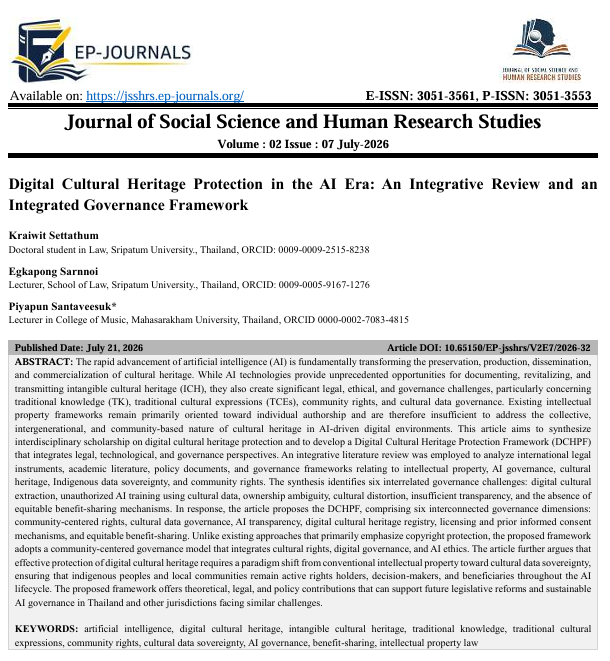
Digital Cultural Heritage Protection in the AI Era: An Integrative Review and an Integrated Governance Framework
DOI:
https://doi.org/10.65150/EP-jsshrs/V2E7/2026-32Keywords:
artificial intelligence, digital cultural heritage, intangible cultural heritage, traditional knowledge, traditional cultural expressions, community rights, cultural data sovereignty, AI governance, benefit-sharing, intellectual property lawAbstract
The rapid advancement of artificial intelligence (AI) is fundamentally transforming the preservation, production, dissemination, and commercialization of cultural heritage. While AI technologies provide unprecedented opportunities for documenting, revitalizing, and transmitting intangible cultural heritage (ICH), they also create significant legal, ethical, and governance challenges, particularly concerning traditional knowledge (TK), traditional cultural expressions (TCEs), community rights, and cultural data governance. Existing intellectual property frameworks remain primarily oriented toward individual authorship and are therefore insufficient to address the collective, intergenerational, and community-based nature of cultural heritage in AI-driven digital environments. This article aims to synthesize interdisciplinary scholarship on digital cultural heritage protection and to develop a Digital Cultural Heritage Protection Framework (DCHPF) that integrates legal, technological, and governance perspectives. An integrative literature review was employed to analyze international legal instruments, academic literature, policy documents, and governance frameworks relating to intellectual property, AI governance, cultural heritage, Indigenous data sovereignty, and community rights. The synthesis identifies six interrelated governance challenges: digital cultural extraction, unauthorized AI training using cultural data, ownership ambiguity, cultural distortion, insufficient transparency, and the absence of equitable benefit-sharing mechanisms. In response, the article proposes the DCHPF, comprising six interconnected governance dimensions: community-centered rights, cultural data governance, AI transparency, digital cultural heritage registry, licensing and prior informed consent mechanisms, and equitable benefit-sharing. Unlike existing approaches that primarily emphasize copyright protection, the proposed framework adopts a community-centered governance model that integrates cultural rights, digital governance, and AI ethics. The article further argues that effective protection of digital cultural heritage requires a paradigm shift from conventional intellectual property toward cultural data sovereignty, ensuring that indigenous peoples and local communities remain active rights holders, decision-makers, and beneficiaries throughout the AI lifecycle. The proposed framework offers theoretical, legal, and policy contributions that can support future legislative reforms and sustainable AI governance in Thailand and other jurisdictions facing similar challenges.
References
1) Antons, C. (2017). Traditional knowledge, traditional cultural expressions and intellectual property law in the Asia-Pacific region. International Journal of Intellectual Property Management, 8(3–4), 289–304. https://doi.org/10.1504/IJIPM.2017.087018
2) Bavikatte, K., & Robinson, D. F. (2011). Towards a community protocol strategy: Liberating genetic resources and traditional knowledge from prior informed consent. Journal of Intellectual Property Rights, 16(5), 414–426.
3) Blakeney, M. (2015). Intellectual property rights and traditional knowledge. Edward Elgar Publishing.
4) Boonaramrueng, P. (2025). Artificial intelligence law and the protection of creative rights: Challenges in the twenty-first century. Winyuchon Publishing. (In Thai)
5) Carroll, S. R., Garba, I., Figueroa-Rodríguez, O. L., Holbrook, J., Lovett, R., Materechera, S., Parsons, M., Raseroka, K., Rodriguez-Lonebear, D., Rowe, R., Sara, R., Walker, J. D., Anderson, J., & Hudson, M. (2020). The CARE principles for Indigenous data governance. Data Science Journal, 19(1), Article 43. https://doi.org/10.5334/dsj-2020-043
6) Chander, A., & Sunder, M. (2024). The AI piracy paradox: Traditional knowledge, data scraping, and cultural justice. Yale Law Journal, 133(4), 1102–1145.
7) Chaturvedi, S. (2016). Biodiversity and intellectual property rights: Legal and policy issues. Routledge.
8) Chiarolla, C. (2011). Intellectual property, agriculture and biodiversity: A rights-based approach towards sustainable agriculture. Edward Elgar Publishing. https://doi.org/10.4337/9781849808330
9) Convention on Biological Diversity. (2011). Nagoya Protocol on Access to Genetic Resources and the Fair and Equitable Sharing of Benefits Arising from Their Utilization. Secretariat of the Convention on Biological Diversity.
10) Couldry, N., & Mejias, U. A. (2019). Data colonialism: Rethinking big data's relation to the contemporary subject. Television & New Media, 20(4), 336–349. https://doi.org/10.1177/1527476418796632
11) Department of Intellectual Property. (2021). Intellectual property laws of Thailand. Ministry of Commerce.
12) Dutfield, G. (2011). Intellectual property, biogenetic resources and traditional knowledge. Routledge.
https://doi.org/10.4324/9781849775847
13) Dutfield, G. (2017). Traditional knowledge and intellectual property: Discipline, disruption and digression. The Journal of World Intellectual Property, 20(3–4), 122–142. https://doi.org/10.1111/jwip.12078
14) European Commission. (2023). Report on the digitization of cultural heritage and AI applications in the European Union. Publications Office of the European Union.
15) European Parliament. (2025). Generative AI and copyright. Publications Office of the European Union. https://doi.org/10.2861/9120512
16) European Union. (2024). Regulation (EU) 2024/1689 laying down harmonised rules on artificial intelligence (Artificial Intelligence Act). Official Journal of the European Union.
17) Floridi, L., & Cowls, J. (2019). A unified framework of five principles for AI in society. Harvard Data Science Review, 1(1). https://doi.org/10.1162/99608f92.8cd550d1
18) Geismar, H. (2021). Museum object lessons for the digital age. UCL Press. https://doi.org/10.2307/j.ctv1fkgc1n
19) Gervais, D. J. (2021). Intellectual property and traditional knowledge: A global framework. Law and Contemporary Problems, 84(2), 1–28.
20) Government of Canada. (2023). Indigenous knowledge policy framework for project reviews and regulatory decisions. Government of Canada.
21) Huang, Y., Chuangprakhon, S., & Santaveesuk, P. (2025). Guzheng music literacy: Preserving cultural heritage through music education in Chinese universities. International Journal of Education and Literacy Studies, 13(2), 11–18.
https://doi.org/10.7575/aiac.ijels.v.13n.2p.11
22) Jian, S., Chuangprakhon, S., & Santaveesuk, P. (2024). Dongjing Chinese folk music in enhancing musical literacy and education. International Journal of Education and Literacy Studies, 12(4), 151–158. https://doi.org/10.7575/aiac.ijels.v.12n.4p.151
23) Kiatkorn, A. (2024). Soft power and Molam performing arts in the digital era: Economic adaptation and legal challenges. Journal of Fine and Applied Arts, 12(3), 201–225. (In Thai)
24) Kukutai, T., & Taylor, J. (Eds.). (2016). Indigenous data sovereignty: Toward an agenda. ANU Press.
https://doi.org/10.22459/CAEPR38.11.2016
25) Kur, A., & Drexl, J. (2023). Intellectual property in the age of generative AI: Reframing the debate on fairness (Max Planck Institute Research Paper No. 23-14). Max Planck Institute for Innovation and Competition.
26) Lucchi, N. (2023). ChatGPT: A case study on copyright challenges for generative artificial intelligence systems. European Journal of Risk Regulation, 15(3), 602–624. https://doi.org/10.1017/err.2023.59
27) Ministry of Culture. (2024). Report on the state of Thai culture in the digital creative economy. Chulalongkorn University Press. (In Thai)
28) Muntarbhorn, W. (2024). International law and the protection of cultural rights of ethnic communities. Thammasat Law Journal, 53(2), 145–168. (In Thai)
29) National Human Rights Commission of Thailand. (2025). Community rights and cultural data governance in the digital era. Office of the National Human Rights Commission of Thailand. (In Thai)
30) National Library of Australia. (2024). Indigenous cultural and intellectual property. National Library of Australia.
31) Organisation for Economic Co-operation and Development. (2019). Recommendation of the Council on Artificial Intelligence (OECD/LEGAL/0449). OECD.
32) Oguamanam, C. (2018). Local knowledge as an ecosystem: Intellectual property, biodiversity, and sovereignty over genetic resources. The Journal of World Intellectual Property, 21(5–6), 233–254. https://doi.org/10.1111/jwip.12107
33) Preechasilpakul, S. (2022). Intellectual property and traditional knowledge: Myths and the struggle of marginalized communities. Chiang Mai University Research and Development Institute. (In Thai)
34) Robinson, D. F. (2010). Confronting biopiracy: Challenges, cases and international debates. Routledge.
https://doi.org/10.4324/9781849774710
35) Sahaviriya, S. (2023). Limitations of Thai copyright law in addressing AI-generated works. Journal of Intellectual Property and International Trade Law, 27(2), 89–112. (In Thai)
36) Santaveesuk, P., Bhutasang, N., Waree, C., Nandy, A., Li, H., Han, W., & Nukthamna, P. (2025). AI innovations and music psychology: The role in driving sustainable mental wellness (SDG 3) and quality music education (SDG 4) in the digital era. TPM, 32(4).
37) Schwab, K. (2025). The fourth industrial revolution meets cultural heritage: The governance of AI in the Global South. World Economic Forum.
38) Suksaoduang, S. (2023). Digital cultural heritage management for sustainable community development. Journal of Cultural Research, 15(1), 34–51. (In Thai)
39) Sunder, M. (2007). The invention of traditional knowledge. Law and Contemporary Problems, 70(2), 97–124.
https://doi.org/10.2307/27592181
40) United Nations Educational, Scientific and Cultural Organization. (2003). Convention for the Safeguarding of the Intangible Cultural Heritage. UNESCO.
41) United Nations Educational, Scientific and Cultural Organization. (2021). Recommendation on the Ethics of Artificial Intelligence.
UNESCO.
42) United Nations Educational, Scientific and Cultural Organization. (2024). Artificial intelligence and intangible cultural heritage: Opportunities and ethical risks. UNESCO Publishing.
43) United Nations Educational, Scientific and Cultural Organization. (2025). Operational guidelines for the implementation of the Convention for the Safeguarding of the Intangible Cultural Heritage in the digital environment. UNESCO.
44) Vermeylen, S. (2007). Contextualizing fair and equitable benefit-sharing. Local Environment, 12(4), 423–436.
https://doi.org/10.1080/13549830701581755
45) World Intellectual Property Organization. (2017). Protecting traditional cultural expressions: A legal and policy overview. World Intellectual Property Organization.
46) World Intellectual Property Organization. (2024). WIPO Treaty on Intellectual Property, Genetic Resources and Associated Traditional Knowledge. World Intellectual Property Organization.
47) World Intellectual Property Organization. (2025). Intergovernmental Committee on Intellectual Property and Genetic Resources, Traditional Knowledge and Folklore: Draft articles. World Intellectual Property Organization.
48) Young, J. O. (2021). Cultural appropriation and the arts. Routledge.
49) Zhang, W. (2013). Legal protection of intangible cultural heritage in China. International Journal of Cultural Property, 20(2), 145–168. https://doi.org/10.1017/S0940739113000089
Downloads
Published
Issue
Section
License
Copyright (c) 2026 Kraiwit Settathum, Egkapong Sarnnoi, Piyapun Santaveesuk (Author)

This work is licensed under a Creative Commons Attribution 4.0 International License.