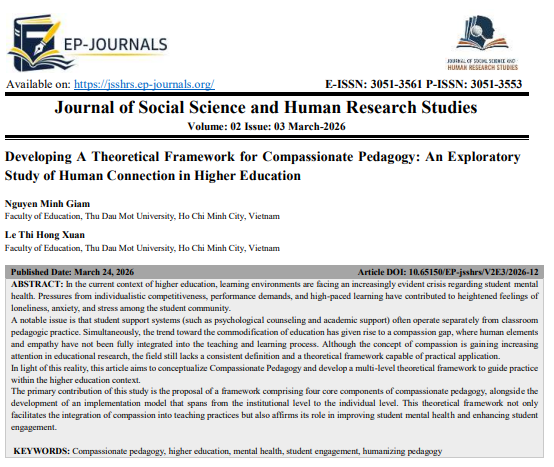
Developing A Theoretical Framework for Compassionate Pedagogy: An Exploratory Study of Human Connection in Higher Education
DOI:
https://doi.org/10.65150/EP-jsshrs/V2E3/2026-12Keywords:
Compassionate pedagogy, higher education, mental health, student engagement, humanizing pedagogyAbstract
In the current context of higher education, learning environments are facing an increasingly evident crisis regarding student mental health. Pressures from individualistic competitiveness, performance demands, and high-paced learning have contributed to heightened feelings of loneliness, anxiety, and stress among the student community.
A notable issue is that student support systems (such as psychological counseling and academic support) often operate separately from classroom pedagogic practice. Simultaneously, the trend toward the commodification of education has given rise to a compassion gap, where human elements and empathy have not been fully integrated into the teaching and learning process. Although the concept of compassion is gaining increasing attention in educational research, the field still lacks a consistent definition and a theoretical framework capable of practical application.
In light of this reality, this article aims to conceptualize Compassionate Pedagogy and develop a multi-level theoretical framework to guide practice within the higher education context.
The primary contribution of this study is the proposal of a framework comprising four core components of compassionate pedagogy, alongside the development of an implementation model that spans from the institutional level to the individual level. This theoretical framework not only facilitates the integration of compassion into teaching practices but also affirms its role in improving student mental health and enhancing student engagement.
References
1) Ampofo, J., Bentum-Micah, G., Xusheng, Q., Sun, B., & Mensah Asumang, R. (2025). Exploring the role of teacher empathy in student mental health outcomes: a comparative SEM approach to understanding the complexities of emotional support in educational settings. Frontiers in Psychology, 16, 1503258.
2) Andrew, M. B., Dobbins, K., Pollard, E., Mueller, B., & Middleton, R. (2023). The role of compassion in higher education practices. Journal of University Teaching and Learning Practice, 20(3), 1-12.
3) Andrews, D. J. C., Brown, T., Castillo, B. M., Jackson, D., & Vellanki, V. (2019). Beyond damage-centered teacher education: Humanizing pedagogy for teacher educators and preservice teachers. Teachers College Record, 121(6), 1-28.
4) Conklin, H. G. (2008). Modeling compassion in critical, justice-oriented teacher education. Harvard Educational Review, 78(4), 652-674.
5) Culshaw, A., & Bodfield, K. (2025). Trauma-informed education: a case for compassion-focused teaching?. Pastoral Care in Education, 43(2), 186-197.
6) Freire, P. (1972). Pedagogy of the oppressed Penguin books. London UK.
7) Gachago, D., Bali, M., & Pallitt, N. (2022). Compassionate learning design as a critical approach to instructional design. Toward a Critical Instructional Design.
8) Gilbert, T. (2016, June). Embedding and assessing compassion in the university curriculum. The European Conference on Education 2016 Official Conference Proceedings (pp. 77-88). The International Academic Forum.
9) Killingback, C., Tomlinson, A., & Stern, J. (2025). Compassionate pedagogy in higher education: A scoping review. Journal of University Teaching and Learning Practice, 22(1), 1-32.
10) Kirby, J. N., Sherwell, C., Lynn, S., & Moloney-Gibb, D. (2023). Compassion as a framework for creating individual and group-level wellbeing in the classroom: New directions. Journal of Psychologists and Counsellors in Schools, 33(1), 2-12.
11) Maratos, F. A., Gilbert, P., & Gilbert, T. (2019). Improving well-being in higher education: Adopting a compassionate approach. In Values of the university in a time of uncertainty (pp. 261-278). Cham: Springer International Publishing.
12) Niemann, J. (2024). Reclaiming Kindness and Compassionate Pedagogy. Glass Ceilings and Ivory Towers: Gender Inequality in the Canadian Academy, 225.
13) Potvin, A. S., Teeters, L. P., & Penuel, W. R. (2021). Designing for compassion in schools: A humanizing approach to co-design. In Proceedings of the 15th International Conference of the Learning Sciences-ICLS 2021.. International Society of the Learning Sciences.
14) Schantz, M. L. (2007, April). Compassion: a concept analysis. In Nursing forum (Vol. 42, No. 2, pp. 48-55). Malden, USA: Blackwell Publishing Inc.
15) Sellnow, D. D., Strawser, M. G., & Miller, A. (2022). Navigating the course integrity/compassionate care dialectic in online teaching and learning. Communication Education, 71(2), 158-160.
16) Soto, N. E. (2005). Caring and relationships: Developing a pedagogy of caring. Villanova Law Review, 50(4), 859-882.
17) Stephens, L. E. (2023). More than students… a pedagogy of kindness. SCHOLE: A journal of leisure studies and recreation education, 38(2), 136-137.
18) Tan, E. (2022). 'Heartware'for the compassionate teacher: Humanizing the academy through mindsight, attentive love, and storytelling. Journal of Applied Learning & Teaching, 5(2), 152-159.
19) Vandeyar, S., & Swart, R. (2016). Educational change: A case for a'pedagogy of compassion'. Education as Change, 20(3), 141-159.
20) Schantz, K. (2016). The compassion gap in UK universities. International Practice Development Journal, 6(1), 1-9.
21) Waddington, K. (2018). Developing compassionate academic leadership: The practice of kindness. Journal of Perspectives in Applied Academic Practice, 6(3), 87-89.
Downloads
Published
Issue
Section
License
Copyright (c) 2026 Nguyen Minh Giam, Le Thi Hong Xuan (Author)

This work is licensed under a Creative Commons Attribution 4.0 International License.