Administrative Leadership Skills of School Heads and Teachers’ Performance in Sirawai District, Schools Division of Zamboanga Del Norte
DOI:
https://doi.org/10.65150/EP-jsshrs/V2E6/2026-24Keywords:
administrative leadership skills, school heads, teacher performance, IPCRF, Sirawai District, school management and operations, descriptive-correlational, PhilippinesAbstract
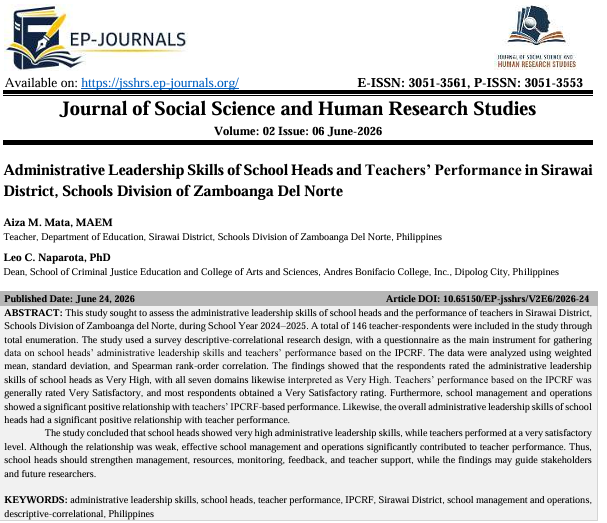
This study sought to assess the administrative leadership skills of school heads and the performance of teachers in Sirawai District, Schools Division of Zamboanga del Norte, during School Year 2024–2025. A total of 146 teacher-respondents were included in the study through total enumeration. The study used a survey descriptive-correlational research design, with a questionnaire as the main instrument for gathering data on school heads’ administrative leadership skills and teachers’ performance based on the IPCRF. The data were analyzed using weighted mean, standard deviation, and Spearman rank-order correlation. The findings showed that the respondents rated the administrative leadership skills of school heads as Very High, with all seven domains likewise interpreted as Very High. Teachers’ performance based on the IPCRF was generally rated Very Satisfactory, and most respondents obtained a Very Satisfactory rating. Furthermore, school management and operations showed a significant positive relationship with teachers’ IPCRF-based performance. Likewise, the overall administrative leadership skills of school heads had a significant positive relationship with teacher performance.
The study concluded that school heads showed very high administrative leadership skills, while teachers performed at a very satisfactory level. Although the relationship was weak, effective school management and operations significantly contributed to teacher performance. Thus, school heads should strengthen management, resources, monitoring, feedback, and teacher support, while the findings may guide stakeholders and future researchers.
References
1) Aiken, L. S., & West, S. G. (1991). Multiple regression: Testing and interpreting interactions.Sage.
2) Aquino, C. J. C. (2021). Managing educational institutions: School heads’ leadership practices and teachers’performance. International Journal of Evaluation and Research in Education, 10(4),1325–1333.
3) Bouwmans, M., Runhaar, P., Wesselink, R., & Mulder, M. (2019). Stimulating teachers’ team performance through team-oriented HR practices: The role of affective team commitment.The International Journal of Human Resource Management, 30(22), 3123–3145. https://doi.org/10.1080/09585192.2017.1322626
4) Boykin, B., & Carney, J. (2024). Closing the gap: The relationship between school climate and student achievement. School Leadership Review, 18(2).
5) Cohen, J., Cohen, P., West, S. G., & Aiken, L. S. (2014). Applied multiple regression/correlation analysis for the behavioral sciences (3rd ed.). Routledge.
6) Creswell, J. W., & Guetterman, T. C. (2019). Educational research: Planning, conducting, and evaluating quantitative and qualitative research (6th ed.). Pearson.
7) Cruz, C. E. (2024). The effectiveness of the Individual Performance Commitment and Review Form as an evaluation tool to improve teachers’ performance: Basis for technical assistance. International Journal of Multidisciplinary: Applied Business and Education Research, 5(2).
8) Daniëls, E., Hondeghem, A., & Dochy, F. (2019). A review on leadership and leadership development in educational settings. Educational Research Review, 27, 110–125.
9) Darling-Hammond, L., Hyler, M. E., & Gardner, M. (2017). Effective teacher professional development. Learning Policy Institute.
10) Day, C., Sammons, P., Hopkins, D., Harris, A., Leithwood, K., Gu, Q., Brown, E., & Ahtaridou, E. (2020).Successful school
leadership. Education Development Trust.
11) DeCarlo, M. (2021). Survey design. In M. DeCarlo, C. Cummings, & K. Agnelli, Graduate research methods in social work: A project-based approach. Open Social Work Education/Open Oregon Educational Resources.
12) Department of Education. (2015). DepEd Order No. 2, s. 2015: Guidelines on the establishment and implementation of the Results-Based Performance Management System (RPMS) in the Department of Education.
13) Department of Education. (2020). DepEd Order No. 024, s. 2020: National adoption and implementation of the Philippine
Professional Standards for School Heads.
14) Department of Education. (2020). DepEd Order No. 025, s. 2020: National adoption and implementation of the Philippine
Professional Standards for Supervisors.
15) Department of Education. (2024). DepEd Order No. 007, s. 2024: Policy guidelines on the implementation of the revised School-Based Management (SBM) system.
16) Estrada, M. J. A., & Gumban, J. L. (2024). School head’s competence and teacher’s performance in the light of Philippine Professional Standards for Teachers. International Journal of Research and Innovation in Social Science.
17) Gacusan, N. D., & Calangi, E. M. (2022). Work performance of teachers: A demographic analysis based on Individual Performance Commitment and Review Form (IPCRF). Global Scientific Journal, 10(7).
18) Grissom, J. A., Egalite, A. J., & Lindsay, C. A. (2021). How principals affect students and schools: A systematic synthesis of two
decades of research. The Wallace Foundation.
19) Hallinger, P., Dongyu, L., & Wang, W.-C. (2016). Assessing instructional leadership with the Principal Instructional Management Rating Scale: A meta-analysis of studies using the PIMRS. Educational Administration Quarterly, 52(1), 5–44. https://doi.org/10.1177/0013161X15619032
20) He, P., Guo, F., & Abazie, G. A. (2024). School principals’ instructional leadership as a predictor of teacher’s professional development. Asian-Pacific Journal of Second and Foreign Language Education, 9, 63. https://doi.org/10.1186/s40862-024-00290-0
21) House, R. J. (1971). A path-goal theory of leader effectiveness. Administrative Science Quarterly, 16(3), 321–339.
https://doi.org/10.2307/2391905
22) Ingersoll, R. M., Merrill, L., & Stuckey, D. (2018). Seven trends: The transformation of the teaching force (Updated ed.). Consortium for Policy Research in Education, University of Pennsylvania.
23) Karim, A., Agus, A., Nurnilasari, N., Widiantari, D., Fikriyah, F., Rosadah, R. A., Syarifudin, A., Triono, W., Lesmi, K., &
Nurkholis, N. (2023). A study on managerial leadership in education: A systematic literature review. Heliyon, 9(6), e16834. https://doi.org/10.1016/j.heliyon.2023.e16834
24) Keung, C., & Cheung, A. (2023). A family-school-community partnership supporting play-based learning: A social capital perspective. Teaching and Teacher Education, 135, 104314.https://doi.org/10.1016/j.tate.2023.104314
25) Kim, S. (2022). Fifty years of parental involvement and achievement research: A second-order meta-analysis. Educational Research Review, 37, 100463. https://doi.org/10.1016/j.edurev.2022.100463
26) Kouhsari, M., Chen, J., & Amirian, S. K. (2022). The effect of principal emotional intelligence on teacher performance: Mediating roles of organizational trust and professional learning community. Leadership and Policy in Schools. https://doi.org/10.1080/15700763.2022.2088392
27) Leithwood, K., Harris, A., & Hopkins, D. (2020). Seven strong claims about successful school leadership revisited. School Leadership & Management, 40(1–2), 5–22. https://doi.org/10.1080/13632434.2019.1596077
28) McCombes, S. (2019, August 20; updated 2025, January 14). Survey research: Definition, examples & methods. Scribbr.
29) Organisation for Economic Co-operation and Development. (2019). TALIS 2018 results (Volume I): Teachers and school leaders as lifelong learners. OECD Publishing.
30) Organisation for Economic Co-operation and Development. (2021). Education at a glance 2021: OECD indicators. OECD Publishing.
31) Refugio, C. N., Galleto, P. G., & Torres, R. (2019). Competence landscape of Grade 9 mathematics teachers: Basis for an enhancement program. Cypriot Journal of Educational Sciences, 14(2), 241–256.
32) Sebastian, J., Allensworth, E., Wiedermann, W., Hochbein, C., & Cunningham, M. (2019). Principal leadership and school performance: An examination of instructional leadership and organizational management. Leadership and Policy in Schools, 18(4), 591–613. https://doi.org/10.1080/15700763.2018.1513151
33) Shaked, H. (2022). How organizational management supports instructional leadership. Journal of Educational Administration, 60(6), 699–714.
34) Shunhaji, A. (2023). Principal’s effective communication and teacher performance: A classroom perspective. Kelola: Jurnal Manajemen Pendidikan.
35) Stogdill, R. M. (1948). Personal factors associated with leadership: A survey of the literature. The Journal of Psychology, 25(1), 35–71. https://doi.org/10.1080/00223980.1948.9917362
36) Taun, K., Muda, I., & Kadir, A. (2022). Management skills and styles of school principals during the COVID-19 pandemic: Teachers’ perception and the effects on teachers’ organizational commitment and motivation. Education Sciences, 12(11), 794. https://doi.org/10.3390/educsci12110794
37) UNESCO. (2024). Global education monitoring report 2024/5: Leadership in education: Lead for learning. United Nations Educational, Scientific and Cultural Organization.
38) Valmores, C. P. (2021). School heads’ administrative and leadership skills: Its influence on school performance. It was published in the International Journal of Multidisciplinary Research and Publications (IJMRAP), Volume 4, Issue 3, pages 21–33.
39) Volante, P., Müller, M., Salinas, Á., & Cravens, X. (2023). Expert teams in instructional leadership practices based on collaboration and their transference to local teaching improvement networks. Research in Educational Administration & Leadership, 8(1), 256–294. https://doi.org/10.30828/real.1095600
40) Zynuddin, S. N., Nurkhin, A., Wafroturrohmah, W., & others. (2023). The relationship between school climate and students’ non-cognitive skills: A systematic literature review. Frontiers in Psychology.
Downloads
Published
Issue
Section
License
Copyright (c) 2026 LEO NAPAROTA (Author)

This work is licensed under a Creative Commons Attribution 4.0 International License.












