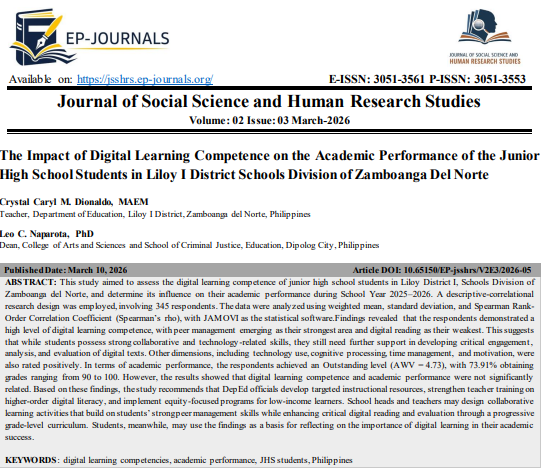
The Impact of Digital Learning Competence on the Academic Performance of the Junior High School Students in Liloy I District Schools Division of Zamboanga Del Norte
DOI:
https://doi.org/10.65150/EP-jsshrs/V2E3/2026-05Keywords:
digital learning competencies, academic performance, JHS students, PhilippinesAbstract
This study aimed to assess the digital learning competence of junior high school students in Liloy District I, Schools Division of Zamboanga del Norte, and determine its influence on their academic performance during School Year 2025–2026. A descriptive-correlational research design was employed, involving 345 respondents. The data were analyzed using weighted mean, standard deviation, and Spearman Rank-Order Correlation Coefficient (Spearman’s rho), with JAMOVI as the statistical software.Findings revealed that the respondents demonstrated a high level of digital learning competence, with peer management emerging as their strongest area and digital reading as their weakest. This suggests that while students possess strong collaborative and technology-related skills, they still need further support in developing critical engagement, analysis, and evaluation of digital texts. Other dimensions, including technology use, cognitive processing, time management, and motivation, were also rated positively. In terms of academic performance, the respondents achieved an Outstanding level (AWV = 4.73), with 73.91% obtaining grades ranging from 90 to 100. However, the results showed that digital learning competence and academic performance were not significantly related. Based on these findings, the study recommends that DepEd officials develop targeted instructional resources, strengthen teacher training on higher-order digital literacy, and implement equity-focused programs for low-income learners. School heads and teachers may design collaborative learning activities that build on students’ strong peer management skills while enhancing critical digital reading and evaluation through a progressive grade-level curriculum. Students, meanwhile, may use the findings as a basis for reflecting on the importance of digital learning in their academic success.
References
1) Alimen, M. C. D., Alimen, R. A., & Isidro, R. V. (2023). Artivism: Art for social transformation and critical ability development. Philippine Social Science Journal, 6(2), 39–45. https://doi.org/10.52006/main.v6i2.705
2) Alvarez, A. V., Jr. (2024). Second chances: Exploring the Philippine alternative learning system. International Journal of Scholars in Education, 7(1), 1–16. https://doi.org/10.52134/ueader.1445226
3) Arifin, Z., Septiati, E., & Rahmawati, D. (2024). Digital literacy as a fundamental competency in 21st-century education. Journal of Education and Learning Innovation, 15(2), 55–67.
4) Barrot, J. S. (2023). Using ChatGPT for second language writing: Pitfalls and potentials. Assessing Writing, 57, 100745.
5) Barrot, J. S., Llenares, I. I., & del Rosario, L. S. (2021). Students’ online learning challenges during the pandemic and how they cope with them: The case of the Philippines. Education and Information Technologies, 26(6), 7321–7338. https://doi.org/10.1007/s10639-021-10589x
6) Bernardo, A. B. (2021). Socioeconomic status moderates the relationship between growth mindset and learning in mathematics and science: Evidence from PISA 2018 Philippine data. International Journal of School & Educational Psychology, 9(2), 208–222.
7) Cabero-Almenara, J., Gutiérrez-Castillo, J. J., Guillén-Gámez, F. D., & Gaete-Bravo, A. F. (2022). Digital competence of higher education students as a predictor of academic success. Technology, Knowledge and Learning.
8) Department of Education. (2015). Policy guidelines on classroom assessment for the K to 12 basic education program.
https://www.deped.gov.ph/wp-content/uploads/2015/04/DO_s2015_08.pdf
9) Di Giacomo, D., Passarotti, A. M., & Mazza, M. (2017). Digital learning as enhanced learning processing: Exploring the role of digital experience on cognitive performance. Frontiers in Psychology.
10) Dinda, N., Noni, V., Munir, M., & Tahir, M. (2025). The effect of digital reading platforms on EFL students’ reading comprehension: A quasi-experimental study. Klasikal: Journal of Education, Language Teaching and Science, 7(1).
11) Espinosa, A. A., Gomez, M. A. C., Miranda, P. A., David, A. P., Abulon, E. L. R., Hermosisima, M. V. C., Quinosa, E. A., Jr., Soliman, A. A., De Vera, J. L., Claros, I. H. A., Cruz, H. G. M., & Gonzales, N. S. (2025). Bridging a digital divide: A critical analysis of contextual factors affecting ICT integration in Philippine schools. https://www.iier.org.au/iier35/espinosa-2.pdf
12) Gac-Ang, E., Fulgencio, M. D., Plando, D., & Opingo, K. M. (2025). Implementation and outcomes of the MATATAG curriculum: A study on its influence in early childhood education. ResearchGate.
13) Kallas, K., & Pedaste, M. (2022). How to improve the digital competence for e-learning? Applied Sciences,12(13),6582. https://doi.org/10.3390/app12136582
14) Limniou, M., Smith, M., & Amet, D. (2021). Learning, student digital capabilities and academic performance during COVID-19 lockdown. Education Sciences, 11(7), 361.
15) Liu, J. (2023). The effect of peer relationship on academic performance in high school students. Lecture Notes in Education Psychology and Public Media, 13(1), 136-144.
16) Lourenço, A. A., & Paiva, M. O. A. (2024). Self-regulation in academic success: Exploring the impact of volitional control strategies, time management planning, and procrastination. International Journal of Changes in Education, 1(3), 113-122.
17) Lourenço, A., Paiva, M. O., & Valente, S. (2025). Strategies That Transform: Self-Regulation and Volitional Control as Keys to Academic Achievement. Social Sciences, 14(5), 285.
18) Magno, C., & Lizada, J. (2023). Teacher job performance through achievement goals, instructional strategies, and student engagement in the Philippine setting. Asia Pacific Higher Education Research Journal.
19) Mangarin, R. A., & Climaco, J. L. T. (2024). Exploring contributing factors on poor digital literacy of students: A review of existing studies. ResearchGate.https://www.researchgate.net/publication/385144403_Exploring_Contributing_Factors_on_Poor_Digital_Literacy_of_Students_A_Review_of_Existing_Studies
20) Mehrvarz, M., Heidari, E., Farrokhnia, M., & Noroozi, O. (2021). The role of digital informal learning in digital competence and academic performance: A structural equation model. Education and Information Technologies, 26(1), 2129–2156.
https://doi.org/10.1007/s10639-020-10325-1
21) Mensah, A. (2024). Exploring the factors influencing students’ academic performance: A multilevel analysis. Cogent Education, 11(1),
2412944. https://doi.org/10.1080/23311983.2024.2412944
22) Porio, E. (2021). State-civil society dynamics: Constraints and possibilities. Critical Reflections on Cities in Southeast Asia, 3, 265.
23) Ragusa, A., González-Bernal, J., Trigueros, R., Caggiano, V., Navarro, N., Minguez-Minguez, L. A., & Fernandez-Ortega, C. (2023).
Effects of academic self-regulation on procrastination, academic stress and anxiety, resilience and academic performance in a sample of Spanish secondary school students. Frontiers in psychology, 14, 1073529.
24) Rodafinos, A., & Barkoukis, V. (2024). Exploring the impact of digital competence and technology acceptance on academic performance in physical education and sports science students. Journal of Information Technology Education: Research, 23, 331–350.
https://www.jite.org/documents/Vol23/JITE-Rv23Art019Rodafinos10199.pdf
25) Rodafinos, A., & Chroni, S. (2024). Digital competence and academic achievement among sports science students. Journal of Learning Analytics and Digital Education, 9(1), 44–58.
26) Roy, K., & Swargiary, K. (2024, June). Effectiveness of peer teaching in enhancing academic performance, engagement, and social-emotional outcomes among high school students: A quasi-experimental study [Preprint]. ResearchGate.
https://doi.org/10.13140/RG.2.2.28650.32965
27) Samane-Cutipa, V. A., Quispe-Quispe, A. M., Talavera-Mendoza, F., & Limaymanta, C. H. (2022). Digital gaps influencing the online learning of rural students in secondary education: A systematic review. World, 1(9), 10. https://www.researchgate.net/profile/Cesar-Limaymanta/publication/360837686_Digital_Gaps_Influencing_the_Online_Learning_of_Rural_Students_in_Secondary_Education_A_Systematic_Review/links/63ac4dfb097c7 832ca720d00/Digital-Gaps-Influencing-the-Online-Learning-of-Rural-Students-in-Secondary-Education-A-Systematic-Review.pdf
28) Scheel, C., Neuendorf, F., & Beutner, M. (2022). Students’ digital competences and acceptance of digital learning systems. International Journal of Educational Technology in Higher Education, 19(1), 1–21. https://doi.org/10.1186/s41239-022-00350-w
29) Suleiman, I. B., Okunade, O. A., Dada, E. G., & Ezeanya, U. C. (2024). Key factors influencing students’ academic performance. Journal of Electrical Systems and Information Technology, 11(1), 41.
30) Surducan, E. M., & Valadas, S. T. (2025). The role of digital competences in the academic success of “digital natives.” Journal of Digital Educational Technology, 5(2), ep2513.
31) Theobald, M. (2021). Self-regulated learning training programs enhance academic performance: A meta-analysis.Learning and Instruction, 73, 101–118.
32) Torres, R. A. O., & Ortega-Dela Cruz, R. A. (2022). Remote learning: Challenges and opportunities for educators and students in the new normal. Anatolian Journal of Education, 7(1), 83–92. https://doi.org/10.29333/aje.2022.717a
33) Waheed, A. (2025). The impact of self-regulated learning strategies on academic performance: A systematic review. International Journal of Instructional Research, 14(1), 55–72.
34) Wolters, C. A., & Brady, A. C. (2021). College students’ time management: A self-regulated learning perspective. Educational psychology review, 33(4), 1319-1351.
35) Yang, J., Tlili, A., Huang, R., Zhuang, R., & Bhagat, K. K. (2021). Development and validation of a digital learning competence scale: A comprehensive review. Sustainability, 13(10), 5593.
36) Zakir, S., Hoque, M. E., Susanto, P., Nisaa, V., Alam, M. K., Khatimah, H., & Mulyani, E. (2025). Digital literacy and academic
performance: The mediating roles of digital informal learning, self-efficacy, and students’ digital competence. Frontiers in Education, 10, 1590274. https://doi.org/10.3389/feduc.2025.1590274
37) Zhang, Y. (2025). Impact of digital literacy on college students' English proficiency: The mediating role of learning motivation and the moderating effect of technological self-efficacy. Acta psychologica, 259, 105452.
Downloads
Published
Issue
Section
License
Copyright (c) 2026 Crystal Caryl M. Dionaldo, MAEM, Leo C. Naparota, PhD (Author)

This work is licensed under a Creative Commons Attribution 4.0 International License.