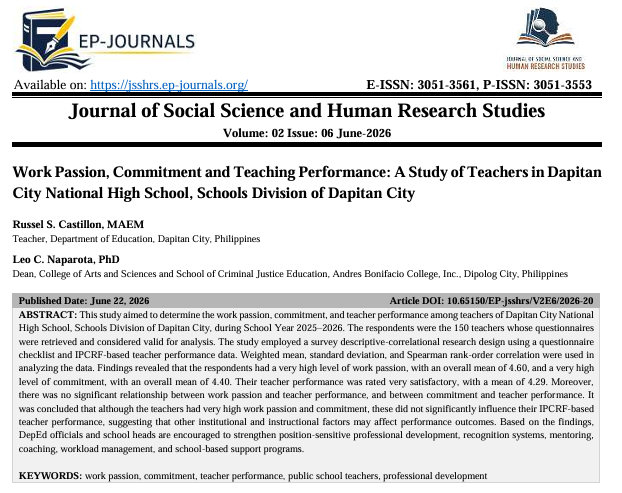
Work Passion, Commitment and Teaching Performance: A Study of Teachers in Dapitan City National High School, Schools Division of Dapitan City
DOI:
https://doi.org/10.65150/EP-jsshrs/V2E6/2026-20Keywords:
work passion, commitment, teacher performance, public school teachers, professional developmentAbstract
This study aimed to determine the work passion, commitment, and teacher performance among teachers of Dapitan City National High School, Schools Division of Dapitan City, during School Year 2025–2026. The respondents were the 150 teachers whose questionnaires were retrieved and considered valid for analysis. The study employed a survey descriptive-correlational research design using a questionnaire checklist and IPCRF-based teacher performance data. Weighted mean, standard deviation, and Spearman rank-order correlation were used in analyzing the data. Findings revealed that the respondents had a very high level of work passion, with an overall mean of 4.60, and a very high level of commitment, with an overall mean of 4.40. Their teacher performance was rated very satisfactory, with a mean of 4.29. Moreover, there was no significant relationship between work passion and teacher performance, and between commitment and teacher performance. It was concluded that although the teachers had very high work passion and commitment, these did not significantly influence their IPCRF-based teacher performance, suggesting that other institutional and instructional factors may affect performance outcomes. Based on the findings, DepEd officials and school heads are encouraged to strengthen position-sensitive professional development, recognition systems, mentoring, coaching, workload management, and school-based support programs.
References
1) Abarquez, C., Lachica, R. L., & Bautista, M. A. (2025). Teachers’ self-efficacy and performance. International Multidisciplinary Journal of Research for Innovation, Sustainability, and Excellence.
2) Aiken, L. S., & Susane, G. (2001). West multiple progression. Sage Publishing, Inc
3) Alonzo, D., Mason, L. H., & Thai, M. (2025). Teachers’ engagement and occupational commitment in a changing world: The role of adaptability, self-efficacy, and collective efficacy. Teaching and Teacher Education, 152, 104821.
4) Aydan, S., Aydan, B., & Koçakülah, M. S. (2025). What makes them self-regulated? Exploring the self-regulated learning processes of high achievers. Acta Psychologica, 256, 105012.
5) Bading, J. R. (2022). Teachers’ organizational commitment and school outcomes.
6) Bodensteiner, J., Dicke, T., Parker, P. D., Marsh, H. W., & Lazarides, R. (2025). Learning to self-regulate the professional work outside the classroom: Effects of a brief cognitive self-regulation training for novice teachers. Teaching and Teacher Education, 150, 104735.
7) Boudouaia, A. (2024). A study on the effect of school culture on teachers’ commitment to curriculum implementation. Heliyon, 10(24), e40558.
8) Burić, I., & Moè, A. (2020). What makes teachers enthusiastic: The interplay of positive affect, self-efficacy, and job satisfaction. Teaching and Teacher Education, 89, 103008. https://doi.org/10.1016/j.tate.2019.103008
9) Chesnut, S. R., & Burley, H. (2015). Self-efficacy as a predictor of commitment to the teaching profession: A meta-analysis. Educational Research Review, 15, 1–16.
10) Christensen, A. A., et al. (2025). Professional learning communities and teacher outcomes: Evidence from TALIS 2018. Teaching and Teacher Education.
11) Cohen, J. (1988). Statistical power analysis for the behavioral sciences (2nd ed.). Lawrence Erlbaum Associates.
12) Cohen, L., Manion, L., & Morrison, K. (2014). Research methods in education. Routledge.
13) Creswell, J. W., & Creswell, J. D. (2018). Research design: Qualitative, quantitative, and mixed methods approaches (5th ed.). SAGE Publications.
14) Creswell, J. W., & Guetterman, T. C. (2019). Educational research: Planning, conducting, and evaluating quantitative and qualitative research (6th ed.). Pearson.
15) Cruz, C. E. (2024). The effectiveness of Individual Performance Commitment Review Form as an evaluation tool to improve teachers’ performance: Basis for technical assistance. International Journal of Multidisciplinary: Applied Business and Education Research, 5(2).
16) Darling-Hammond, L., Hyler, M. E., & Gardner, M. (2017). Effective teacher professional development. Learning Policy Institute. https://doi.org/10.54300/122.311
17) DeCarlo, M. (2021). Scientific inquiry in social work. Open Social Work Education.
18) Department of Education. (2015). DepEd Order No. 2, s. 2015: Guidelines on the establishment and implementation of the Results-Based Performance Management System in the Department of Education. Department of Education.
19) Department of Education. (2023). DM 008, s. 2023: Multi-year guidelines on the Results-Based Performance Management System–Philippine Professional Standards for Teachers. Department of Education.
20) Department of Education. (2025). DM 017, s. 2025: Interim guidelines for the Department of Education performance management and evaluation system for teachers in School Year 2024–2025. Department of Education.
21) Francisco, A. R. S. (2020). Teachers’ personal and professional demographic characteristics as predictors of students’ academic performance in English. International Journal of Management, Technology, and Social Sciences, 5(2).
22) Fu, C., Yang, J., & Zhang, X. (2022). How perceived school culture relates to work engagement among primary and secondary school teachers? The mediating role of affective empathy and organizational commitment. Frontiers in Psychology, 13, 878894.
23) Gella, G. M., & Quines, L. A. (2022). The mediating effect of teaching effectiveness on therelationship between passion and commitment among public elementary school teachers. American Journal of Multidisciplinary Research and Innovation, 1(4), 118–132.
https://doi.org/10.54536/ajmri.v1i4.571
24) Gilal, F. G., Channa, N. A., Gilal, R. G., Shah, S. M. M., Zhang, J., Shah, S. A. A., & Gilal, N. G. (2019). Association between a teacher’s work passion and a student’s work passion: A moderated mediation model. Psychology Research and Behavior Management, 12, 889– 900. https://doi.org/10.2147/PRBM.S212004
25) Hanna, F., Oostdam, R., Severiens, S. E., & Zijlstra, B. J. H. (2019). Domains of teacher identity: A review of quantitative measurement instruments. Educational Research Review, 27, 15–27. https://doi.org/10.1016/j.edurev.2019.01.003
26) Heinschel, A., Praetorius, A.-K., Rakoczy, K., et al. (2024). Links between instructional quality and classroom composition: Differences between classes taught by the same teacher. Learning and Instruction.
27) Herrera-Espinoza, K., Sánchez-Chero, M., et al. (2024). Teachers’ professional identity: A multifactorial study in public educational institutions. Frontiers in Education.
28) Huang, J., et al. (2024). The impact of teaching quality on student academic performance in higher education institutions. SHS Web of Conferences.
29) Jung, K. R., Zhou, A. Q., & Lee, R. M. (2017). Self-efficacy, self-discipline and academic performance: Testing a context-specific mediation model. Learning and Individual Differences, 60, 33–39.
30) Jung, Y., & Sohn, Y. W. (2022). Does work passion benefit or hinder employee’s career commitment? The mediating role of work–family interface and the moderating role of autonomy support. PLOS ONE, 17(6), e0269298.
https://doi.org/10.1371/journal.pone.0269298
31) Karlen, Y., Hertel, S., & Hirt, C. N. (2025). Linking teachers and students’ self-regulated learning: The role of teachers’ professional competences. Oxford Review of Education.
32) Kennedy, M. M. (2016). How does professional development improve teaching? Review of Educational Research, 86(4), 945–980. https://doi.org/10.3102/0034654315626800
33) Kini, T., & Podolsky, A. (2016). Does teaching experience increase teacher effectiveness? A review of the research. Learning Policy Institute.
34) Krimjai, W., Espesjo, A. C., Jr., & Del Villar, J. R. B. (2025). The mediating effect of motivation on the relationship between work passion and job satisfaction in selected private secondary schools in Nakhon Nayok Province. St. Theresa Journal of Humanities and Social Sciences, 11(1), 110–131.
35) Kurteshi, V. (2025). Exploring the impact of continuous professional development on teacher performance: Insights from students and teachers. Education Policy Analysis and Practice.
36) Leung, T. Y. I., & Lam, C. B. I. (2025). Linking professional development opportunities to work performance among Chinese kindergarten teachers: The mediating roles of commitment and engagement. Education Sciences, 15(3), 342.
https://doi.org/10.3390/educsci15030342
37) Li, J.-B., Kong, H., & Chen, Y. (2021). The mediation of work engagement and work stress in the relationship between school self-control and job performance among novice kindergarten teachers. Children and Youth Services Review, 127, 106098.
38) Li, L., Kanchanapoom, K., Deeprasert, J., Duan, N., & Qi, Z. (2025). Unveiling the factors shaping teacher job performance: Exploring the interplay of personality traits, perceived organizational support, self-efficacy, and job satisfaction. BMC Psychology, 13, Article 14. https://doi.org/10.1186/s40359-024-02324-1
39) Ma, D. (2022). The role of motivation and commitment in teachers’ professional identity. Frontiers in Psychology, 13, 910747. https://doi.org/10.3389/fpsyg.2022.910747
40) Magtoltol, J. A. (2025). Teachers’ attitudes, commitment, and job performance.
41) McCombes, S. (2025). Survey research: Definition, examples and methods. Scribbr.
42) Medez, S. (2024). Additional workloads of teachers in public secondary schools and their performance. Journal of Interdisciplinary Perspectives.
43) Meyer, J. P., & Allen, N. J. (1991). A three-component conceptualization of organizational commitment. Human Resource Management Review, 1(1), 61–89.
44) Meyer, J. P., & Morin, A. J. S. (2016). A person-centered approach to commitment research: Theory, research, and methodology. Journal of Organizational Behavior, 37(4), 584–612. https://doi.org/10.1002/job.2085
45) Moè, A. (2016). Harmonious passion and its relationship with teacher well-being. Teaching and Teacher Education, 59, 431–437.
https://doi.org/10.1016/j.tate.2016.07.017
46) Moro, L. A., & Torres-Santos, G. (2022). Organizational commitment and job performance among teachers in a city-owned university in Metro Manila, Philippines.
47) Nwoko, J. C., et al. (2025). From passion to pressure: Exploring the realities of teachers’ work-related well-being. Frontiers in Public Health, 13, Article 1505330. https://doi.org/10.3389/fpubh.2025.1505330
48) Organisation for Economic Co-operation and Development. (2019). TALIS 2018 results (Volume I): Teachers and school leaders as lifelong learners. OECD Publishing. https://doi.org/10.1787/1d0bc92a-en
49) Park, S., & Kim, T. (2025). Understanding the relationship between teacher collaboration and clarity of instruction: The moderating role of organizational commitment. Teaching and Teacher Education, 149, 104732.
50) Philippine Commission on Women, Department of Education, Commission on Higher Education, & Technical Education and Skills Development Authority. (2025). PCW-DepEd-CHED-TESDA Joint Memorandum Circular No. 2025-03: Guidelines on the use of gender- responsive assessment tools for evaluating instructional materials in basic, higher, and technical-vocational education. Philippine Commission on Women.
51) Romorosa, Q., & Ucang, J. (2025). Professional development in the lens of public-school teachers. International Journal of Research in Education Studies.
52) Ruiz-Alfonso, Z., & León, J. (2016). The role of passion in education: A systematic review. Educational Research Review, 19, 173–188.
53) Ryan, R. M., & Deci, E. L. (2020). Intrinsic and extrinsic motivation from a self-determination theory perspective: Definitions, theory, practices, and future directions. Contemporary Educational Psychology, 61, Article 101860.
https://doi.org/10.1016/j.cedpsych.2020.101860
54) Segal, A. (2022). Teacher professional identity in an era of accountability: Teachers’ perceived agency and arenas of responsibility. International Journal of Educational Research Open, 3, 100137.
55) Shu, K. (2022). Teachers’ commitment and self-efficacy as predictors of work engagement and well-being. Frontiers in Psychology, 13, 850204.
56) Skaalvik, E. M., & Skaalvik, S. (2018). Job demands and job resources as predictors of teacher motivation and well-being. Social Psychology of Education, 21, 1251–1275. https://doi.org/10.1007/s11218-018-9464-8
57) Tarantul, A., & Klavir, R. (2024). Teachers’ emotion regulation in coping with discipline issues. Teaching and Teacher Education, 141, 104521.
58) Teig, N., et al. (2024). Teaching quality, limitations to teaching, and their relation to instructional practices. IEA Compass: Briefs in Education. [Incomplete source details; verify issue/report number and DOI/URL.]
59) Toropova, A., Myrberg, E., & Johansson, S. (2021). Teacher job satisfaction: The importance of school working conditions and teacher characteristics. Educational Review, 73(1), 71–97.https://doi.org/10.1080/00131911.2019.1705247
60) Tumaneng, J. G., et al. (2024). The effectiveness of Indiviual Performance Commitment and Review Form (IPCRF) in assessing teachers’ performance. International Journal of Multidisciplinary: Applied Business and Education Research. [Incomplete source details; verify volume, issue, pages, and DOI/URL.]
61) UNESCO. (2024). Global education monitoring report 2024, gender report: Technology on herterms. UNESCO.
62) Vallerand, R. J., Blanchard, C., Mageau, G. A., Koestner, R., Ratelle, C., Léonard, M., Gagné, M., & Marsolais, J. (2003). Les
passions de l’âme: On obsessive and harmonious passion.Journal of Personality and Social Psychology, 85(4), 756–767.
63) Van der Want, A. C., Schellings, G. L. M., & Mommers, J. (2018). Experienced teachers dealing with issues in education: A career perspective. Teachers and Teaching, 24(7), 802–824. https://doi.org/10.1080/13540602.2018.1481024
64) Viador, M. R. (2024). School heads’ and teachers’ initiatives on Education 4.0: Basis for a blueprint for strategic foresight [Doctoral dissertation, Bulacan Agricultural State College].
65) Visscher, A. J., Dmoshinskaia, N., Pellegrini, M., et al. (2025). (When) do teacher professional development interventions improve student achievement? A meta-analysis of 128 high-quality studies. Educational Research Review, 49, Article 100742.
66) Vulley, D. K. (2021). Factors influencing teacher job satisfaction and commitment at Senior High Schools in the Greater Accra Region, Ghana. European Journal of Education Studies, 8(3).
67) Wang, M., et al. (2023). Understanding teachers’ online professional learning. Heliyon, 9(11), e21431.
68) Wang, X., Li, B., & Liu, H. (2022). The relationship between flow experience and teaching well-being of university music teachers: The sequential mediating effect of work passion and work engagement. Frontiers in Psychology, 13, 989386.
https://doi.org/10.3389/fpsyg.2022.989386
69) Wu, J., et al. (2024). Relationship between teachers’ professional identity and career satisfaction: The role of career calling. Frontiers in Psychology.
70) Yin, H., Huang, S., & Chen, G. (2023). Happy teachers are efficacious and committed, but not vice versa: A longitudinal study of
kindergarten teachers. Teaching and Teacher Education, 123, 103996.
71) Yu, X., et al. (2025). Teacher professional identity on work engagement: The roles of ego-resilience and perceived organizational support. Frontiers in Psychology.
Downloads
Published
Issue
Section
License
Copyright (c) 2026 Russel S. Castillon, MAEM, Leo C. Naparota, PhD (Author)

This work is licensed under a Creative Commons Attribution 4.0 International License.












