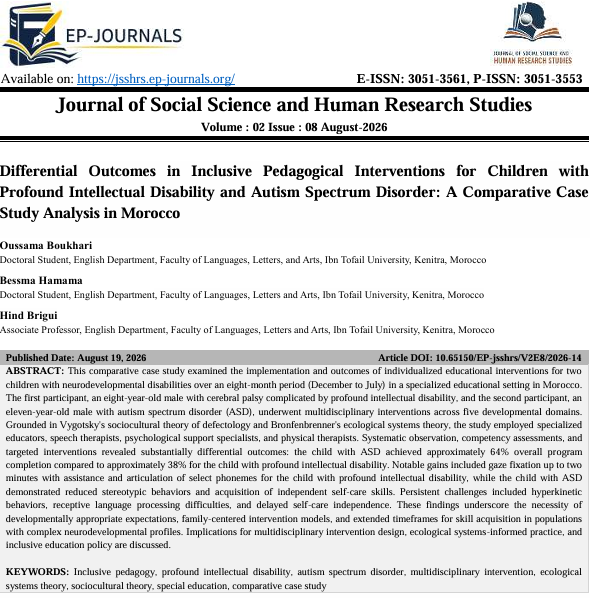
Differential Outcomes in Inclusive Pedagogical Interventions for Children with Profound Intellectual Disability and Autism Spectrum Disorder: A Comparative Case Study Analysis in Morocco
DOI:
https://doi.org/10.65150/EP-jsshrs/V2E8/2026-14Keywords:
Inclusive pedagogy, profound intellectual disability, autism spectrum disorder, multidisciplinary intervention, ecological systems theory, sociocultural theory, special education, comparative case studyAbstract
This comparative case study examined the implementation and outcomes of individualized educational interventions for two children with neurodevelopmental disabilities over an eight-month period (December to July) in a specialized educational setting in Morocco. The first participant, an eight-year-old male with cerebral palsy complicated by profound intellectual disability, and the second participant, an eleven-year-old male with autism spectrum disorder (ASD), underwent multidisciplinary interventions across five developmental domains. Grounded in Vygotsky's sociocultural theory of defectology and Bronfenbrenner's ecological systems theory, the study employed specialized educators, speech therapists, psychological support specialists, and physical therapists. Systematic observation, competency assessments, and targeted interventions revealed substantially differential outcomes: the child with ASD achieved approximately 64% overall program completion compared to approximately 38% for the child with profound intellectual disability. Notable gains included gaze fixation up to two minutes with assistance and articulation of select phonemes for the child with profound intellectual disability, while the child with ASD demonstrated reduced stereotypic behaviors and acquisition of independent self-care skills. Persistent challenges included hyperkinetic behaviors, receptive language processing difficulties, and delayed self-care independence. These findings underscore the necessity of developmentally appropriate expectations, family-centered intervention models, and extended timeframes for skill acquisition in populations with complex neurodevelopmental profiles. Implications for multidisciplinary intervention design, ecological systems-informed practice, and inclusive education policy are discussed.
References
1) Daneshfar, S., & Moharami, M. (2018). Dynamic assessment in Vygotsky's sociocultural theory: Origins and main concepts. Journal of Language Teaching and Research, 9(3), 600-607.
2) Kozulin, A., & Gindis, B. (2007). Sociocultural theory and education of children with special needs: From defectology to remedial pedagogy. In H. Daniels, M. Cole, & J. V. Wertsch (Eds.), The Cambridge companion to Vygotsky (pp. 332-362). Cambridge University Press.
3) Ministry of National Education, Vocational Training, Higher Education and Scientific Research (Directorate of Curricula). (2019). The reference framework for inclusive education for children with disabilities. Directorate of Curricula Publications. https://www.unicef.org/morocco/ar/الإطار-المرجعي-للتربية-الدامجة-لفائدة-الأطفال-فی-وضعية-إعاقة/تقارير
4) Poehner, M. E. (2008). Dynamic assessment: A Vygotskian approach to understanding and promoting L2 development. Springer.
5) Sadownik, A. R. (2023). Bronfenbrenner: Ecology of human development in ecology of collaboration. In Re-theorising more-than-parental involvement in early childhood education and care (pp. 83-95). Springer International Publishing.
6) Vik, S., & Somby, H. M. (2018). Defectology and inclusion. Problemy Wczesnej Edukacji, 42(3), 94-102.
7) Vygotsky, L. S. (1995). Problems of defectology. Prosveshchenie.
8) Yngvesson, T., & Garvis, S. (2021). Preschool and home partnerships in Sweden, what do the children say? Early Child Development and Care, 191(11), 1729–1743. https://doi.org/10.1080/03004430.2019.1673385
Downloads
Published
Issue
Section
License
Copyright (c) 2026 Oussama Boukhari, Bessma Hamama , Hind Brigui (Author)

This work is licensed under a Creative Commons Attribution 4.0 International License.












