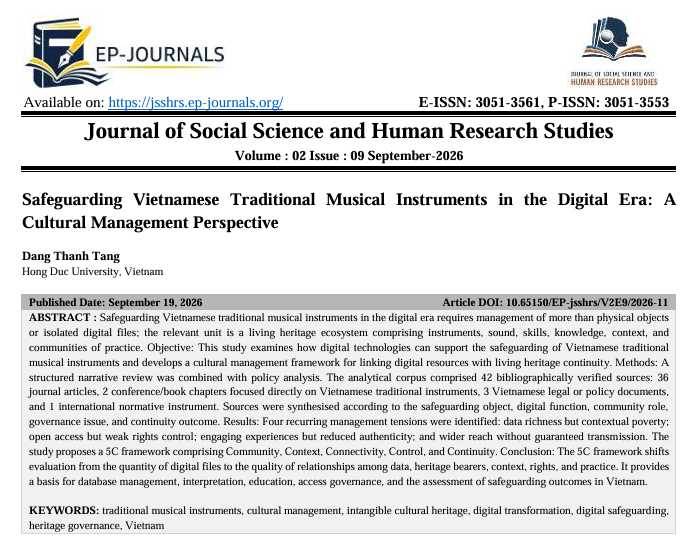
Safeguarding Vietnamese Traditional Musical Instruments in the Digital Era: A Cultural Management Perspective
DOI:
https://doi.org/10.65150/EP-jsshrs/V2E9/2026-11Keywords:
traditional musical instruments, cultural management, intangible cultural heritage, digital transformation, digital safeguarding, heritage governance, VietnamAbstract
Safeguarding Vietnamese traditional musical instruments in the digital era requires management of more than physical objects or isolated digital files; the relevant unit is a living heritage ecosystem comprising instruments, sound, skills, knowledge, context, and communities of practice. Objective: This study examines how digital technologies can support the safeguarding of Vietnamese traditional musical instruments and develops a cultural management framework for linking digital resources with living heritage continuity. Methods: A structured narrative review was combined with policy analysis. The analytical corpus comprised 42 bibliographically verified sources: 36 journal articles, 2 conference/book chapters focused directly on Vietnamese traditional instruments, 3 Vietnamese legal or policy documents, and 1 international normative instrument. Sources were synthesised according to the safeguarding object, digital function, community role, governance issue, and continuity outcome. Results: Four recurring management tensions were identified: data richness but contextual poverty; open access but weak rights control; engaging experiences but reduced authenticity; and wider reach without guaranteed transmission. The study proposes a 5C framework comprising Community, Context, Connectivity, Control, and Continuity. Conclusion: The 5C framework shifts evaluation from the quantity of digital files to the quality of relationships among data, heritage bearers, context, rights, and practice. It provides a basis for database management, interpretation, education, access governance, and the assessment of safeguarding outcomes in Vietnam.
References
1) Boboc, R. G., Băutu, E., Gîrbacia, F., Popovici, N., &Popovici, D. M. (2022). Augmented reality in cultural heritage: An overview of the last decade of applications. Applied Sciences, 12(19), 9859. https://doi.org/10.3390/app12199859
2) Chen, L., Dang, L., & Wang, C. (2026). Digital media strategies for the global dissemination of intangible cultural heritage: A systematic review of communication approaches. Review of Communication Research, 14, 180-194. https://doi.org/10.52152/RCR.V14.11
3) Di Dalmazi, M., Mandolfo, M., Guixeres, J., Alcañiz Raya, M., & Lamberti, L. (2024). How immersive technologies impact behavioral responses in destination marketing: The role of physiological arousal, presence, and age. International Journal of Contemporary Hospitality Management, 36(11), 3628-3650. https://doi.org/10.1108/IJCHM-09-2023-1511
4) Ginzarly, M., & Teller, J. (2025). Leveraging social media for resilient cultural heritage: A people-centred conceptual framework for community engagement and crisis response. Built Heritage, 9, 40. https://doi.org/10.1186/s43238-025-00209-9
5) Ha, D. H., Vu, V. T., & Pham, T. H. (2026). The impact of architectural heritage interpretation quality at the Imperial Citadel of Hue on responsible tourist behavior in sustainable tourism: The mediating role of personal norms. Heritage and Sustainable Development, 8(2), 43-58. https://doi.org/10.37868/hsd.v8i2.2035
6) He, T.-L., & Qin, F. (2024). Exploring how the metaverse of cultural heritage (MCH) influences users' intentions to experience offline: A two-stage SEM-ANN analysis. Heritage Science, 12, 193. https://doi.org/10.1186/s40494-024-01315-0
7) Hung, N. T. V., & Tuyen, V. V. (2026). The impact of tourism development dimensions on the effectiveness of conserving marine cultural heritage in Thanh Hoa Province, Vietnam. Geojournal of Tourism and Geosites, 67(3), 2133-2142. https://doi.org/10.30892/gtg.67326-1838
8) Lai, S., Tian, Y., & Zhang, Q. (2025). The impact of AI-generated technologies-driven digital cultural heritage platforms on users' offline cultural participation intentions. npj Heritage Science, 13, 574. https://doi.org/10.1038/s40494-025-02148-1
9) Lee, S., & King, B. E. M. (2025). A virtual lens on tradition: Safeguarding intangible cultural heritage through AR and VR. Journal of Smart Tourism, 5(1-2), 64-69. https://doi.org/10.1177/27652157251344834
10) Ma, T., Do, H.-N., Nguyen, H., Doan, H., & Do, T.-N. (2024a). Exploring distillation models for cultural heritage preservation: Traditional Vietnamese instruments. In Future Data and Security Engineering (Communications in Computer and Information Science, Vol. 2309, pp. 254-268). Springer. https://doi.org/10.1007/978-981-96-0434-0_18
11) Ma, T., Nguyen, H., Nguyen, K., Nguyen, X., & Do, T.-N. (2024b). ViTIP: AI-powered Vietnamese traditional instrument preservation system using 3D space. In Intelligent Systems and Data Science (Communications in Computer and Information Science, Vol. 2190, pp. 231-245). Springer. https://doi.org/10.1007/978-981-97-9613-7_17
12) Meighan, P. J. (2021). Decolonizing the digital landscape: The role of technology in Indigenous language revitalization. AlterNative: An International Journal of Indigenous Peoples, 17(3), 397-405. https://doi.org/10.1177/11771801211037672
13) National Assembly. (2024). Law on Cultural Heritage No. 45/2024/QH15 dated November 23, 2024 [in Vietnamese].
14) Nguyen, D. T., & Nguyen, T. P. (2026). Storytelling in heritage tourism for sustainable development: Enriching visitor experiences in Vietnam's heritage destinations. Heritage and Sustainable Development, 8(2), 21-42. https://doi.org/10.37868/hsd.v8i2.1950
15) Nguyen, L. T., & Bui, T. T. (2025). Exploring users' utilization and perceptions of cultural heritage information in Vietnam's public libraries. Public Library Quarterly. Advance online publication. https://doi.org/10.1080/01616846.2025.2565961
16) Nguyen, L. T., & Bui, T. T. (2026). Promotional efforts for cultural heritage information in Vietnamese public libraries. IFLA Journal. Advance online publication. https://doi.org/10.1177/03400352261445606
17) Nguyen, T. P. (2025). The impact of sustainable tourism on local community cultural heritage conservation awareness in Hanoi. Heritage and Sustainable Development, 7(2), 675-690. https://doi.org/10.37868/hsd.v7i2.1233
18) Nijdam, E. B. (2023). Sami-digital storytelling: Survivance and revitalization in Indigenous digital games. New Media & Society, 25(11), 3093-3116. https://doi.org/10.1177/14614448211038902
19) Nikolakopoulou, V., &Koutsabasis, P. (2025). The "making" of participatory and co-design for digital experiences in cultural heritage: A review. CoDesign, 21(4), 876-902. https://doi.org/10.1080/15710882.2025.2511791
20) Oladokun, B. D., Ajani, Y. A., Ukaegbu, B. C. N., &Oloniruha, E. A. (2024). Cultural preservation through immersive technology: The metaverse as a pathway to the past. Preservation, Digital Technology & Culture, 53(3), 157-164. https://doi.org/10.1515/pdtc-2024-0015
21) Pham, C. H., Pham, N. D., Duong, D. T., Hoang, A. C., & Tran, D. L. (2025). Leveraging the value of brocade weaving for the development of distinctive tourism in the Northern mountainous region. Journal of Science and Technology - Nguyen Tat Thanh University, 8(S1), 424-428. https://doi.org/10.55401/sdxxf292
22) Phuong, N. T. (2026). Digital preservation of Vietnamese cultural heritage: Opportunities and limitations in the age of smart technology. Preservation, Digital Technology & Culture, 55(2), 117-129. https://doi.org/10.1515/pdtc-2025-0035
23) Phuong, N. T., & Lam, N. T. N. (2025). Evaluating the effectiveness of cultural heritage communication based on local community feedback: A case study of Hanoi city. Scientific Culture, 11(3), 1-11. https://doi.org/10.5281/zenodo.17379320
24) Prime Minister. (2021a). Decision No. 1909/QD-TTg dated November 12, 2021, approving the Cultural Development Strategy to 2030 [in Vietnamese].
25) Prime Minister. (2021b). Decision No. 2026/QD-TTg dated December 2, 2021, approving the Programme for Digitisation of Vietnamese Cultural Heritage, 2021-2030 [in Vietnamese].
26) Rachman, Y. B. (2024). Unveiling local community initiatives and participation in safeguarding cultural heritage through digital spaces. Library Hi Tech News, 41(7), 17-19. https://doi.org/10.1108/LHTN-07-2024-0127
27) Saputra, R. (2025). STEM-enabled governance for cultural heritage: Integrating digital innovation and policy in Indonesia. Journal of Ethnic and Cultural Studies, 12(5), 325-344. https://doi.org/10.29333/ejecs/2586
28) Sun, D. (2025). The application of new media technologies in intangible cultural heritage preservation: A case study of Xinjiang Uygur Muqam art. International Journal of Web Services Research, 22(1), 1-23. https://doi.org/10.4018/IJWSR.371400
29) Tan, Y.-C., Yang, L.-H., & Wang, B. (2026). Community-engaged digital safeguarding of intangible cultural heritage: A review of methods and challenges. npj Heritage Science, 14, 184. https://doi.org/10.1038/s40494-026-02458-y
30) Tran, D. L. (2024a). Student entrepreneurship at Thanh Hoa University of Culture, Sports and Tourism: Current status, international experience, and proposed solutions for promotion. Vietnam Journal of Education, 24(Special Issue 13), 349-353. https://tcgd.tapchigiaoduc.edu.vn/index.php/tapchi/article/view/3475
31) Tran, D. L. (2024b). Improving the teaching quality of sewing and cutting techniques for students of fashion design at Thanh Hoa University of Culture, Sports and Tourism. Journal of Science, Thanh Hoa University of Culture, Sports and Tourism, (19), 117-126. https://doi.org/10.55988/2588-1264/186
32) UNESCO. (2003). Convention for the Safeguarding of the Intangible Cultural Heritage. UNESCO. https://ich.unesco.org/en/convention
33) Vu, V. T., & Nguyen, T. P. (2026). Heritage memory and identity in Vietnam with a focus on residents' topophilia for sustainable cultural tourism development. Heritage and Sustainable Development, 8(1), 55-76. https://doi.org/10.37868/hsd.v8i1.1758
34) Wang, S., Yang, Y., & Shi, W. (2025). Configuring factors for effective dissemination of intangible cultural heritage on Douyin: An fsQCA approach. Humanities and Social Sciences Communications, 12, 979. https://doi.org/10.1057/s41599-025-05414-6
35) Wei, S., Wang, L., Xu, S., Xu, J., Wang, M., Shi, J., Fan, H., & Gan, F. (2026). How digital technologies empower the safeguarding of intangible cultural heritage: A scoping review of research from 2020 to 2025. npj Heritage Science. https://doi.org/10.1038/s40494-026-02774-3
36) Wen, X., Sotiriadis, M., & Shen, S. (2023). Determining the key drivers for the acceptance and usage of AR and VR in cultural heritage monuments. Sustainability, 15(5), 4146. https://doi.org/10.3390/su15054146
37) Yang, C., TengkuWook, T. S. M., &Rosdi, F. (2025). Advancing cultural heritage: A decadal review of digital transformation in Chinese museums. npj Heritage Science, 13, 189. https://doi.org/10.1038/s40494-025-01714-x
38) Ye, X., Ruan, Y., Xia, S., & Gu, L. (2025). Adoption of digital intangible cultural heritage: A configurational study integrating UTAUT2 and immersion theory. Humanities and Social Sciences Communications, 12, 23. https://doi.org/10.1057/s41599-024-04222-8
39) Zhang, J., & Xu, C. (2024). A grounded theory-based model of information communication in cultural heritage digital reading on social media from the perspective of embodied theory. Heritage Science, 12, 208. https://doi.org/10.1186/s40494-024-01313-2
40) Zhang, Y., Kaya, D. I., & van Wesemael, P. J. V. (2024). An assessment framework for digital participatory practices engaging youth in cultural heritage management. Journal of Cultural Heritage, 70, 408-421. https://doi.org/10.1016/j.culher.2024.10.014
41) Zheng, S. (2024). Intangible heritage restoration of damaged tomb murals through augmented reality technology: A case study of Zhao Yigong Tomb murals in Tang Dynasty of China. Journal of Cultural Heritage, 69, 135-147. https://doi.org/10.1016/j.culher.2024.08.005
42) Zhu, C., Io, M. U., Ngan, H. F. B., & Peralta, R. L. (2023). Understanding augmented reality marketing in world cultural heritage site: The lens of authenticity perspective. Journal of Vacation Marketing, 29(2), 242-255. https://doi.org/10.1177/13567667221090990
Downloads
Published
Issue
Section
License
Copyright (c) 2026 Dang Thanh Tang (Author)

This work is licensed under a Creative Commons Attribution 4.0 International License.