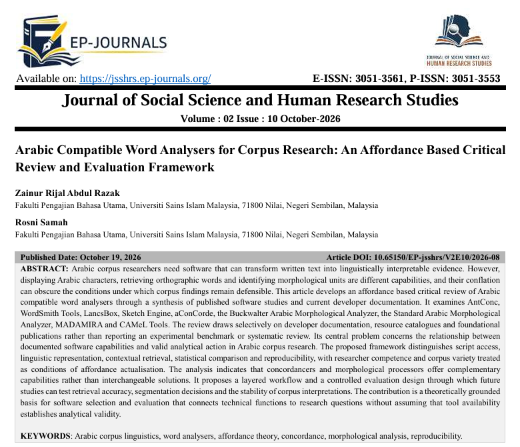
Arabic Compatible Word Analysers for Corpus Research: An Affordance Based Critical Review and Evaluation Framework
DOI:
https://doi.org/10.65150/EP-jsshrs/V2E10/2026-08Keywords:
Arabic corpus linguistics, word analysers, affordance theory, concordance, morphological analysis, reproducibilityAbstract
Arabic corpus researchers need software that can transform written text into linguistically interpretable evidence. However, displaying Arabic characters, retrieving orthographic words and identifying morphological units are different capabilities, and their conflation can obscure the conditions under which corpus findings remain defensible. This article develops an affordance based critical review of Arabic compatible word analysers through a synthesis of published software studies and current developer documentation. It examines AntConc, WordSmith Tools, LancsBox, Sketch Engine, aConCorde, the Buckwalter Arabic Morphological Analyzer, the Standard Arabic Morphological Analyzer, MADAMIRA and CAMeL Tools. The review draws selectively on developer documentation, resource catalogues and foundational publications rather than reporting an experimental benchmark or systematic review. Its central problem concerns the relationship between documented software capabilities and valid analytical action in Arabic corpus research. The proposed framework distinguishes script access, linguistic representation, contextual retrieval, statistical comparison and reproducibility, with researcher competence and corpus variety treated as conditions of affordance actualisation. The analysis indicates that concordancers and morphological processors offer complementary capabilities rather than interchangeable solutions. It proposes a layered workflow and a controlled evaluation design through which future studies can test retrieval accuracy, segmentation decisions and the stability of corpus interpretations. The contribution is a theoretically grounded basis for software selection and evaluation that connects technical functions to research questions without assuming that tool availability establishes analytical validity.
References
1) Alfaifi, A., & Atwell, E. (2016). Comparative evaluation of tools for Arabic corpora search and analysis. International Journal of Speech Technology, 19(2), 347–357. https://doi.org/10.1007/s10772-015-9285-5
2) Al-Sughaiyer, I. A., & Al-Kharashi, I. A. (2004). Arabic morphological analysis techniques: A comprehensive survey. Journal of the American Society for Information Science and Technology, 55(3), 189–213. https://doi.org/10.1002/asi.10368
3) Anthony, L. (2026).AntConc (Version 4.4.2) [Computer software].Waseda University. https://www.laurenceanthony.net/software/antconc/
4) Brezina, V. (2018). Statistics in corpus linguistics: A practical guide. Cambridge University Press.
5) Brezina, V., McEnery, T., & Wattam, S. (2015). Collocations in context: A new perspective on collocation networks. International Journal of Corpus Linguistics, 20(2), 139–173. https://doi.org/10.1075/ijcl.20.2.01bre
6) Brezina, V., & Platt, W. (2026). LancsBox X [Computer software]. Lancaster University. https://lancsbox.lancs.ac.uk/
7) Buckwalter, T. (2004). Buckwalter Arabic Morphological Analyzer version 2.0 (LDC2004L02) [Software and lexical resources]. Linguistic Data Consortium. https://doi.org/10.35111/050q-5r95
8) CAMeL Lab. (n.d.-a). Camel_tools.tokenizers.morphological [Software documentation]. Retrieved October 2, 2026, from https://camel-tools.readthedocs.io/en/latest/api/tokenizers/morphological.html
9) CAMeL Lab. (n.d.-b). *camel_tools.utils.normalize* [Software documentation]. Retrieved September 29, 2026, from https://camel-tools.readthedocs.io/en/latest/api/utils/normalize.html
10) Grant, M. J., & Booth, A. (2009). A typology of reviews: An analysis of 14 review types and associated methodologies. Health Information & Libraries Journal, 26(2), 91–108. https://doi.org/10.1111/j.1471-1842.2009.00848.x
11) Habash, N. Y. (2010). Introduction to Arabic natural language processing. Morgan & Claypool. https://doi.org/10.1007/978-3-031-02139-8
12) Hutchby, I. (2001). Technologies, texts and affordances. Sociology, 35(2), 441–456. https://doi.org/10.1177/S0038038501000219
13) Lexical Computing. (n.d.). Arabic text corpora. Sketch Engine. Retrieved October 1, 2026, from https://www.sketchengine.eu/corpora-and-languages/arabic-text-corpora/
14) Maamouri, M., Graff, D., Bouziri, B., Krouna, S., Bies, A., & Kulick, S. (2010). LDC Standard Arabic Morphological Analyzer version 3.1(LDC2010L01) [Software and lexical resources]. Linguistic Data Consortium. https://doi.org/10.35111/wgjk-zy44
15) Obeid, O., Zalmout, N., Khalifa, S., Taji, D., Oudah, M., Alhafni, B., Inoue, G., Eryani, F., Erdmann, A., & Habash, N. (2020). CAMeL Tools: An open source Python toolkit for Arabic natural language processing. Proceedings of the Twelfth Language Resources and Evaluation Conference (pp. 7022–7032). European Language Resources Association. https://aclanthology.org/2020.lrec-1.868/
16) Pasha, A., Al-Badrashiny, M., Diab, M., El Kholy, A., Eskander, R., Habash, N., Pooleery, M., Rambow, O., & Roth, R. (2014). MADAMIRA: A fast, comprehensive tool for morphological analysis and disambiguation of Arabic. Proceedings of the Ninth International Conference on Language Resources and Evaluation (pp. 1094–1101). European Language Resources Association. https://aclanthology.org/L14-1479/
17) Roberts, A., Al-Sulaiti, L., & Atwell, E. (2006). aConCorde: Towards an open-source, extendable concordancer for Arabic. Corpora, 1(1),
39–60. https://doi.org/10.3366/cor.2006.1.1.39
18) Scott, M. (n.d.). WordSmith Tools version 9 documentation [Software documentation]. Retrieved October 11, 2026, from https://lexically.net/downloads/version9/HTML/overview.html
19) Snyder, H. (2019). Literature review as a research methodology: An overview and guidelines. Journal of Business Research, 104, 333–339. https://doi.org/10.1016/j.jbusres.2019.07.039
20) Unicode Consortium. (2024). Middle East I. In The Unicode Standard, version 16.0 (Chapter 9).
https://www.unicode.org/versions/Unicode16.0.0/core-spec/chapter-9/
21) van Lier, L. (2004). The ecology and semiotics of language learning: A sociocultural perspective. Kluwer Academic Publishers. https://doi.org/10.1007/1-4020-7912-5
Downloads
Published
Issue
Section
License
Copyright (c) 2026 Zainur Rijal Abdul Razak, Rosni Samah (Author)

This work is licensed under a Creative Commons Attribution 4.0 International License.