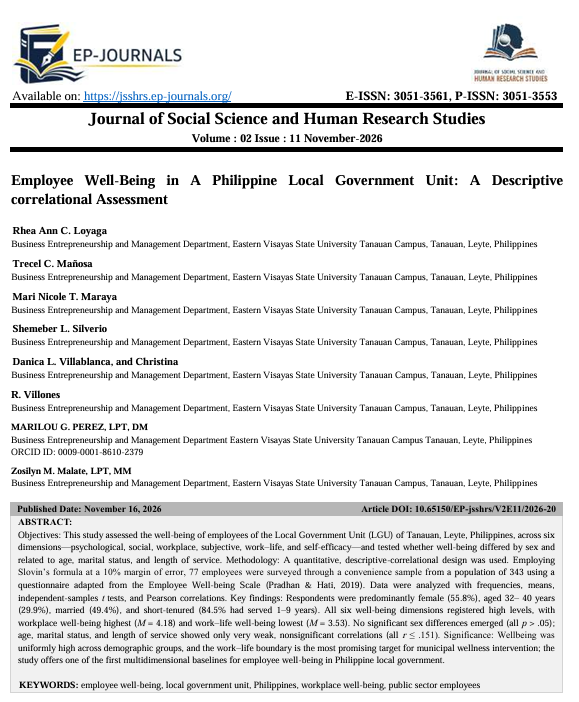
Employee Well-Being in A Philippine Local Government Unit: A Descriptive correlational Assessment
DOI:
https://doi.org/10.65150/EP-jsshrs/V2E11/2026-20Keywords:
employee well-being, local government unit, Philippines, workplace well-being, public sector employeesAbstract
Objectives: This study assessed the well-being of employees of the Local Government Unit (LGU) of Tanauan, Leyte, Philippines, across six dimensions—psychological, social, workplace, subjective, work–life, and self-efficacy—and tested whether well-being differed by sex and related to age, marital status, and length of service. Methodology: A quantitative, descriptive-correlational design was used. Employing Slovin’s formula at a 10% margin of error, 77 employees were surveyed through a convenience sample from a population of 343 using a questionnaire adapted from the Employee Well-being Scale (Pradhan & Hati, 2019). Data were analyzed with frequencies, means, independent-samples t tests, and Pearson correlations. Key findings: Respondents were predominantly female (55.8%), aged 32– 40 years (29.9%), married (49.4%), and short-tenured (84.5% had served 1–9 years). All six well-being dimensions registered high levels, with workplace well-being highest (M = 4.18) and work–life well-being lowest (M = 3.53). No significant sex differences emerged (all p > .05); age, marital status, and length of service showed only very weak, nonsignificant correlations (all r ≤ .151). Significance: Wellbeing was uniformly high across demographic groups, and the work–life boundary is the most promising target for municipal wellness intervention; the study offers one of the first multidimensional baselines for employee well-being in Philippine local government.
References
1) Adendorff, G., Dick, T., Xerri, M., & Brunetto, Y. (2021). Does the talk match the walk for Australian local government employees: The link between leadership and employee well-being. Australian Journal of Public Administration, 80(4), 769–789. https://doi.org/10.1111/1467-8500.12467
2) Arbiol, J., Gonzales, E. S., & Cabajes, A. V. (2022). Psychological well-being of employees of a Philippine state university in times of COVID-19 pandemic.Southeastern Philippines Journal of Research and Development,27(1),75–84. https://doi.org/10.53899/spjrd.v27i1.190
3) Bandura, A. (1977). Self-efficacy: Toward a unifying theory of behavioral change. Psychological Review, 84(2), 191–215.
https://doi.org/10.1037/0033-295X.84.2.191
4) Diener, E. (1984). Subjective well-being. Psychological Bulletin, 95(3), 542–575. https://doi.org/10.1037/0033-2909.95.3.542
5) Gallup. (2022). State of the global workplace: 2022 report. https://www.gallup.com/workplace/349484/state-of-the-global-workplace2022report.aspx
6) Gao, J., & McLellan, R. (2018). Using Ryff’s scales of psychological well-being in adolescents in mainland China. BMC Psychology, 6, Article 17. https://doi.org/10.1186/s40359-018-0231-6
7) Keyes, C. L. M. (1998). Social well-being. Social Psychology Quarterly, 61(2), 121–140. https://doi.org/10.2307/2787065
8) Kundi, Y. M., Aboramadan, M., Elhamalawi, E. M. I., & Shahid, S. (2021). Employee psychological well-being and job performance: Exploring mediating and moderating mechanisms. International Journal of Organizational Analysis, 29(3), 736–754. https://doi.org/10.1108/IJOA-05-2020-2204
9) Pradhan, R. K., & Hati, L. (2019). The measurement of employee well-being: Development and validation of a scale. Global Business Review, 23(2), 385–407. https://doi.org/10.1177/0972150919859101
10) Republic Act No. 10173. (2012). Data Privacy Act of 2012. Republic of the Philippines.
11) Ryff, C. D. (1989). Happiness is everything, or is it? Explorations on the meaning of psychological well-being. Journal of Personality and Social Psychology, 57(6), 1069–1081. https://doi.org/10.1037/0022-3514.57.6.1069
12) Sabharwal, M., Kiel, L. D., & Hijal-Moghrabi, I. (2019). Best practices in local government wellness programs: The benefits of organizational investment and performance monitoring. Review of Public Personnel Administration, 39(1), 24–45.
https://doi.org/10.1177/0734371X16682817
13) Usman, A. (2017). The effect of psychological well-being on employee job performance: Comparison between the employees of projectized and non-projectized organizations. Journal of Entrepreneurship & Organization Management, 6(1), 8–12.
https://doi.org/10.4172/2169-026X.1000206
14) Wang, W., Kang, S. W., & Choi, S. B. (2021). Effects of employee well-being and self-efficacy on the relationship between coaching leadership and knowledge sharing intention: A study of UK and US employees. International Journal of Environmental Research and Public Health, 18(20), Article 10638. https://doi.org/10.3390/ijerph182010638
15) Weziak-Bialowolska, D., Bialowolski, P., Sacco, P. L., VanderWeele, T. J., & McNeely, E. (2020). Well-being in life and well-being at work: Which comes first? Evidence from a longitudinal study. Frontiers in Public Health, 8, Article 103. https://doi.org/10.3389/fpubh.2020.00103
16) Zhang, Y., & Ma, Z. F. (2020). Impact of the COVID-19 pandemic on mental health and quality of life among local residents in Liaoning Province, China: A cross-sectional study. International Journal of Environmental Research and Public Health, 17(7), 2381.
Downloads
Published
Issue
Section
License
Copyright (c) 2026 Rhea Ann C. Loyaga, Trecel C. Mañosa, Mari Nicole T. Maraya, Shemeber L. Silverio, Danica L. Villablanca, Christina R. Villones , MARILOU G. PEREZ, LPT, DM , Zosilyn M. Malate, LPT, MM (Author)

This work is licensed under a Creative Commons Attribution 4.0 International License.