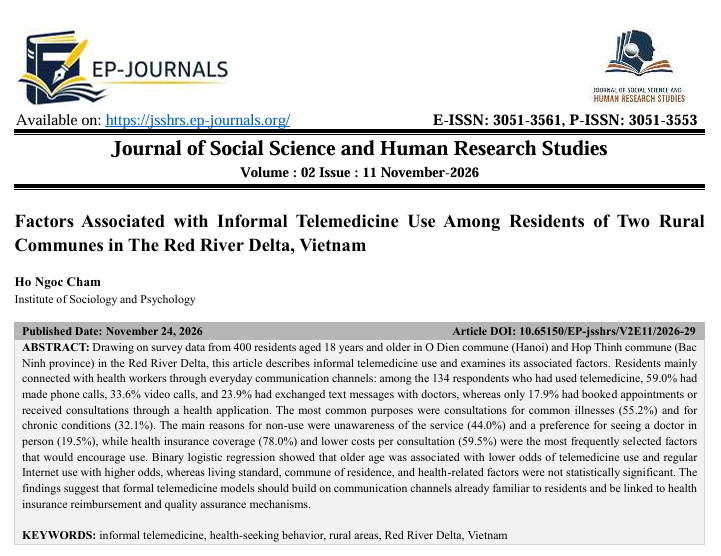
Factors Associated with Informal Telemedicine Use Among Residents of Two Rural Communes in The Red River Delta, Vietnam
DOI:
https://doi.org/10.65150/EP-jsshrs/V2E11/2026-29Keywords:
informal telemedicine, health-seeking behavior, rural areas, Red River Delta, VietnamAbstract
Drawing on survey data from 400 residents aged 18 years and older in O Dien commune (Hanoi) and Hop Thinh commune (Bac Ninh province) in the Red River Delta, this article describes informal telemedicine use and examines its associated factors. Residents mainly connected with health workers through everyday communication channels: among the 134 respondents who had used telemedicine, 59.0% had made phone calls, 33.6% video calls, and 23.9% had exchanged text messages with doctors, whereas only 17.9% had booked appointments or received consultations through a health application. The most common purposes were consultations for common illnesses (55.2%) and for chronic conditions (32.1%). The main reasons for non-use were unawareness of the service (44.0%) and a preference for seeing a doctor in person (19.5%), while health insurance coverage (78.0%) and lower costs per consultation (59.5%) were the most frequently selected factors that would encourage use. Binary logistic regression showed that older age was associated with lower odds of telemedicine use and regular Internet use with higher odds, whereas living standard, commune of residence, and health-related factors were not statistically significant. The findings suggest that formal telemedicine models should build on communication channels already familiar to residents and be linked to health insurance reimbursement and quality assurance mechanisms.
References
1) Hampshire, K., Porter, G., Owusu, S. A., et al. (2015). Informal m-health: How are young people using mobile phones to bridge healthcare gaps in Sub-Saharan Africa? Social Science & Medicine, 142, 90–99. https://doi.org/10.1016/j.socscimed.2015.07.033
2) Hampshire, K., Mwase-Vuma, T., Alemu, K., et al. (2021). Informal mhealth at scale in Africa: Opportunities and challenges. World Development, 140, 105257. https://doi.org/10.1016/j.worlddev.2020.105257
3) Ministry of Health. (2020). Decision No. 2628/QĐ-BYT dated 22 June 2020 approving the Telemedicine Scheme for the 2020–2025 period (in Vietnamese). Hanoi.
4) Ministry of Health. (2023). Circular No. 30/2023/TT-BYT dated 30 December 2023 on the list of diseases and health conditions eligible for telemedicine (in Vietnamese). Hanoi.
5) Ministry of Health. (2026a). Official Letter No. 7780/BYT-KCB dated 14 October 2026 on piloting the guidelines for telemedicine and remote support for medical examination and treatment (in Vietnamese). Hanoi.
6) Ministry of Health. (2026b). Draft Circular on health insurance payment for family medicine, home-based, and remote medical examination and treatment (in Vietnamese). Hanoi.
7) National Assembly. (2023). Law on Medical Examination and Treatment No. 15/2023/QH15 dated 9 January 2023 (in Vietnamese). Hanoi.
8) National Assembly. (2024). Law No. 51/2024/QH15 amending and supplementing a number of articles of the Law on Health Insurance (in Vietnamese). Hanoi.
9) Nguyen, D. Q. A. (2023). Current status and demand for telemedicine among patients with chronic diseases in Central Vietnam (in Vietnamese). Journal of Medical Research, 163(2), 255–264.
10) Nguyen, D. Q. A., & Nguyen, M. T. (2021). Assessment of the demand for cardiovascular care through telemedicine services among residents of Central Vietnam (in Vietnamese). Vietnam Journal of Cardiology, (98), 135–141. https://doi.org/10.58354/jvc.98.2021.108
11) Nguyen, H. L., Tran, K., Doan, P. L. N., & Nguyen, T. (2022). Demand for mobile health in developing countries during COVID-19: Vietnamese’s perspectives from different age groups and health conditions. Patient Preference and Adherence, 16, 265–284. https://doi.org/10.2147/PPA.S348790
12) Nguyen, T. M. T., Truong, T. S., Nguyen, V. H., Truong, H. S., Phan, N. M. T., Tran, X. B., Le, M. N., Nguyen, H. D. N., Trinh, T. T., & Vo, T. L. (2023). Utilization of telehealth consultation services at the General Clinic of Pham Ngoc Thach University of Medicine, 2021–2022 (in Vietnamese). Pham Ngoc Thach Journal of Medicine and Pharmacy, 2(1), 26–34. https://doi.org/10.59715/pntjmp.2.1.3
13) Politburo. (2025). Resolution No. 72-NQ/TW dated 9 September 2025 on breakthrough solutions to strengthen the protection, care, and improvement of people’s health (in Vietnamese). Hanoi.
14) Ta, H. D., Vu, H. V., Mai, T. X., Nguyen, H. T. M., Do, T. T. T., & Luu, H. N. (2025). Utilization, demand, and willingness to pay for telehealth services: A study of patients in selected Vietnamese provinces. Asia Pacific Journal of Health Management, 20(1), Article i3889.
https://doi.org/10.24083/apjhm.v20i1.3889
15) UNDP & Ministry of Health. (2023). Project on telemedicine consultation at the grassroots health level using the “Bác sĩ cho mọi nhà” (Doctors for Every Home) software (in Vietnamese). Hanoi.
16) World Health Organization. (2022). Consolidated telemedicine implementation guide. World Health Organization.
Downloads
Published
Issue
Section
License
Copyright (c) 2026 Ho Ngoc Cham (Author)

This work is licensed under a Creative Commons Attribution 4.0 International License.