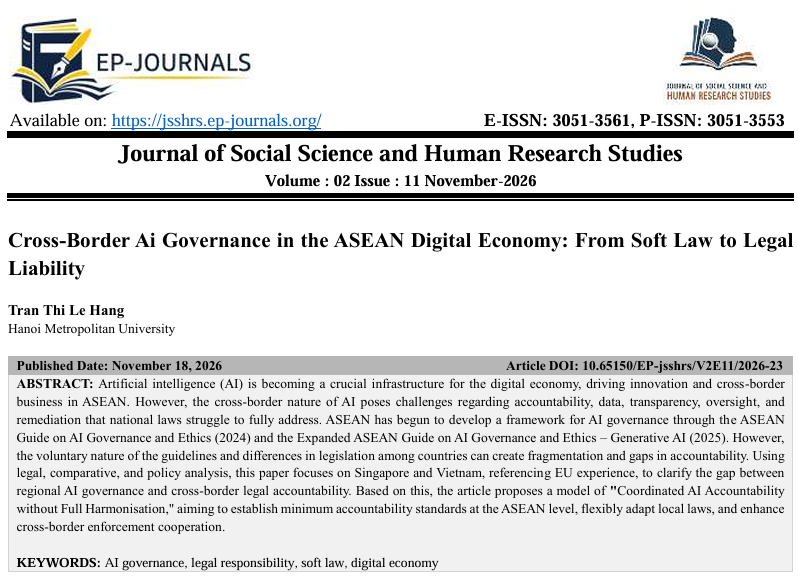
Cross-Border Ai Governance in the ASEAN Digital Economy: From Soft Law to Legal Liability
DOI:
https://doi.org/10.65150/EP-jsshrs/V2E11/2026-23Keywords:
AI governance, legal responsibility, soft law, digital economyAbstract
Artificial intelligence (AI) is becoming a crucial infrastructure for the digital economy, driving innovation and cross-border business in ASEAN. However, the cross-border nature of AI poses challenges regarding accountability, data, transparency, oversight, and remediation that national laws struggle to fully address. ASEAN has begun to develop a framework for AI governance through the ASEAN Guide on AI Governance and Ethics (2024) and the Expanded ASEAN Guide on AI Governance and Ethics – Generative AI (2025). However, the voluntary nature of the guidelines and differences in legislation among countries can create fragmentation and gaps in accountability. Using legal, comparative, and policy analysis, this paper focuses on Singapore and Vietnam, referencing EU experience, to clarify the gap between regional AI governance and cross-border legal accountability. Based on this, the article proposes a model of "Coordinated AI Accountability without Full Harmonisation," aiming to establish minimum accountability standards at the ASEAN level, flexibly adapt local laws, and enhance cross-border enforcement cooperation.
References
1) ASEAN Secretariat. (2024). ASEAN guide on AI governance and ethics. ASEAN. https://asean.org/book/asean-guide-on-ai-governance-and-ethics
2) ASEAN Secretariat. (2025). Expanded ASEAN guide on AI governance and ethics – Generative AI. ASEAN. https://asean.org/book/expanded-asean-guide-on-ai-governance-and-ethics-generative-ai
3) ASEAN Secretariat. (2025). ASEAN Responsible AI Roadmap (2025–2030). ASEAN. https://asean.org/book/asean-responsible-ai-roadmap-2025-2030
4) ASEAN Secretariat. (2026). Statement of the Chairperson of the ASEAN Senior. ASEAN. Economic Officials (SEOM) on the conclusion of ASEAN DEFA negotiations. https://asean.org/book/expanded-asean-guide-on-ai-governance-and-ethics-generative-ai
5) Infocomm Media Development Authority. (2020). Model artificial intelligence governance framework (2nd ed.). IMDA. https://www.imda.gov.sg/-/media/imda/files/infocomm-media-landscape/sg-digital/tech-pillars/artificial-intelligence/second-edition-of-the-model-ai-governance-framework-22jan.pdf
6) Infocomm Media Development Authority. (2022). Singapore launches AI Verify. https://www.imda.gov.sg/resources/press-releases-factsheets-and-speeches/press-releases/2022/sg-launches-worlds-first-ai-testing-framework-and-toolkit-to-promote-transparency
7) Infocomm Media Development Authority. (2024). Model AI governance framework for generative AI. https://www.imda.gov.sg/resources/press-releases-factsheets-and-speeches/factsheets/2024/gen-ai-and-digital-foss-ai-governance-playbook
8) Infocomm Media Development Authority. (2026). Updated Model AI Governance Framework for Agentic AI . https://www.imda.gov.sg/resources/press-releases-factsheets-and-speeches/factsheets/2026/updated-model-ai-governance-framework-for-agentic-ai
9) OECD. (2024). AI principles. Organization for Economic Co-operation and Development. https://www.oecd.org/en/topics/ai-principles.html
10) Tabassi, E. (2023). Artificial intelligence risk management framework (AI RMF 1.0). National Institute of Standards and Technology. https://doi.org/10.6028/NIST.AI.100-1
11) UNESCO. (2021). Recommendation on the ethics of artificial intelligence. United Nations Educational, Scientific and Cultural Organization.
12) National Assembly. (2025). Artificial Intelligence Act 2025
Downloads
Published
Issue
Section
License
Copyright (c) 2026 Tran Thi Le Hang (Author)

This work is licensed under a Creative Commons Attribution 4.0 International License.