Artificial Intelligence in Solfeggio Teaching and Learning: Current Status, Needs, And Lecturer-Guided Priorities
DOI:
https://doi.org/10.65150/EP-jsshrs/V2E11/2026-08Keywords:
artificial intelligence, solfeggio, sight-singing, aural skills, higher music education, formative feedback, personalized practice.Abstract
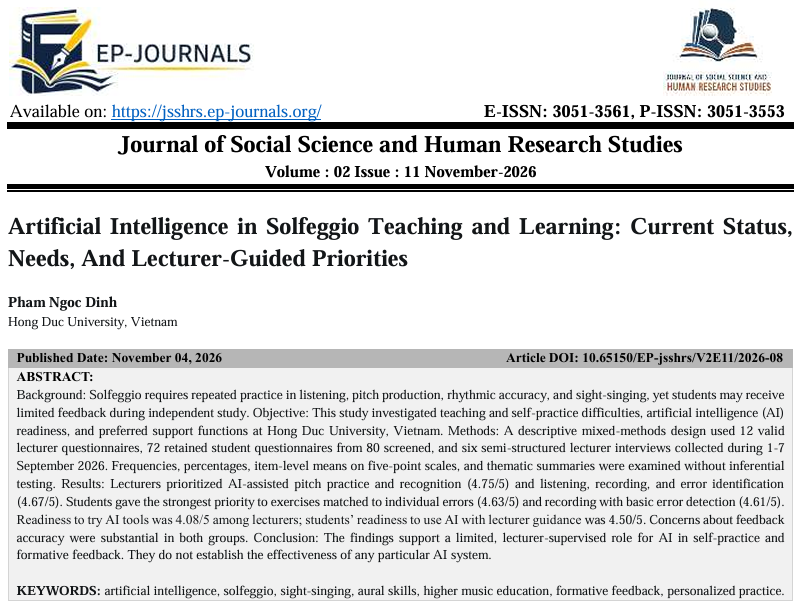
Background: Solfeggio requires repeated practice in listening, pitch production, rhythmic accuracy, and sight-singing, yet students may receive limited feedback during independent study. Objective: This study investigated teaching and self-practice difficulties, artificial intelligence (AI) readiness, and preferred support functions at Hong Duc University, Vietnam. Methods: A descriptive mixed-methods design used 12 valid lecturer questionnaires, 72 retained student questionnaires from 80 screened, and six semi-structured lecturer interviews collected during 1-7 September 2026. Frequencies, percentages, item-level means on five-point scales, and thematic summaries were examined without inferential testing. Results: Lecturers prioritized AI-assisted pitch practice and recognition (4.75/5) and listening, recording, and error identification (4.67/5). Students gave the strongest priority to exercises matched to individual errors (4.63/5) and recording with basic error detection (4.61/5). Readiness to try AI tools was 4.08/5 among lecturers; students’ readiness to use AI with lecturer guidance was 4.50/5. Concerns about feedback accuracy were substantial in both groups. Conclusion: The findings support a limited, lecturer-supervised role for AI in self-practice and formative feedback. They do not establish the effectiveness of any particular AI system.
References
1) Chen, Z.-L., & Lin, H. (2026). AI and digital technologies in sight-singing and aural training: A systematic review of innovations in higher music education. European Journal of Education, 61(1), e70502. https://doi.org/10.1111/ejed.70502
2) Chiu, T. K. F., Xia, Q., Zhou, X., Chai, C. S., & Cheng, M. (2023). Systematic literature review on opportunities, challenges, and future research recommendations of artificial intelligence in education. Computers and Education: Artificial Intelligence, 4, 100118.
https://doi.org/10.1016/j.caeai.2022.100118
3) Ericsson, K. A., Krampe, R. T., & Tesch-Römer, C. (1993). The role of deliberate practice in the acquisition of expert performance. Psychological Review, 100(3), 363-406. https://doi.org/10.1037/0033-295X.100.3.363
4) Hattie, J., & Timperley, H. (2007). The power of feedback. Review of Educational Research, 77(1), 81-112.
https://doi.org/10.3102/003465430298487
5) Karlıdağ, B. A., Malkoç, T., & Küçüktepe, S. E. (2026). Artificial intelligence-supported solfège instruction in higher music education: Effects on student performance and learning attitudes. Applied Sciences, 16(11), 5383. https://doi.org/10.3390/app16115383
6) Karpinski, G. S. (2000). Aural skills acquisition: The development of listening, reading, and performing skills in college-level musicians. Oxford University Press. https://doi.org/10.1093/oso/9780195117851.001.0001
7) Liu, C., Hwang, G.-J., Tu, Y.-F., Yin, Y., & Wang, Y. (2023). Research advancement and foci of mobile technology-supported music education: A systematic review and social network analysis on 2008-2019 academic publications. Interactive Learning Environments, 31(7), 4535-4554. https://doi.org/10.1080/10494820.2021.1974890
8) Miao, F., Holmes, W., Huang, R., & Zhang, H. (2021). AI and education: Guidance for policy-makers. UNESCO.
https://doi.org/10.54675/PCSP7350
9) Roll, I., & Wylie, R. (2016). Evolution and revolution in artificial intelligence in education. International Journal of Artificial Intelligence in Education, 26, 582-599. https://doi.org/10.1007/s40593-016-0110-3
10) Tran, D. L. (2024). Improving the teaching quality of sewing and cutting techniques for students of fashion design at Thanh Hoa University of Culture, Sports and Tourism [in Vietnamese]. Journal of Science, Thanh Hoa University of Culture, Sports and Tourism, (19), 117-126. https://doi.org/10.55988/2588-1264/186
11) VanLehn, K. (2011). The relative effectiveness of human tutoring, intelligent tutoring systems, and other tutoring systems. Educational Psychologist, 46(4), 197-221. https://doi.org/10.1080/00461520.2011.611369
Downloads
Published
Issue
Section
License
Copyright (c) 2026 Pham Ngoc Dinh (Author)

This work is licensed under a Creative Commons Attribution 4.0 International License.