The Current Situation of The Physical Education Curriculum for Students at Saigon University, Vietnam
DOI:
https://doi.org/10.65150/EP-jsshrs/V2E3/2026-01Keywords:
Current situation, program, physical education, students, Saigon University, Vietnam.Abstract
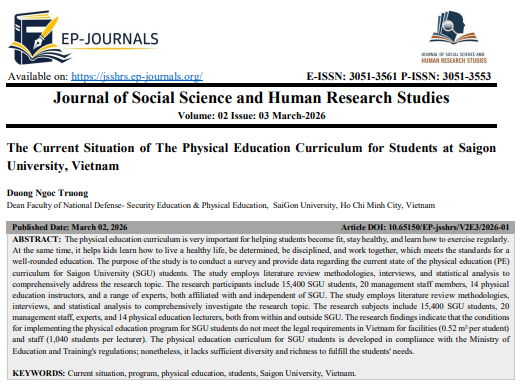
The physical education curriculum is very important for helping students become fit, stay healthy, and learn how to exercise regularly. At the same time, it helps kids learn how to live a healthy life, be determined, be disciplined, and work together, which meets the standards for a well-rounded education. The purpose of the study is to conduct a survey and provide data regarding the current state of the physical education (PE) curriculum for Saigon University (SGU) students. The study employs literature review methodologies, interviews, and statistical analysis to comprehensively address the research topic. The research participants include 15,400 SGU students, 20 management staff members, 14 physical education instructors, and a range of experts, both affiliated with and independent of SGU. The study employs literature review methodologies, interviews, and statistical analysis to comprehensively investigate the research topic. The research subjects include 15,400 SGU students, 20 management staff, experts, and 14 physical education lecturers, both from within and outside SGU. The research findings indicate that the conditions for implementing the physical education program for SGU students do not meet the legal requirements in Vietnam for facilities (0.52 m² per student) and staff (1,040 students per lecturer). The physical education curriculum for SGU students is developed in compliance with the Ministry of Education and Training's regulations; nonetheless, it lacks sufficient diversity and richness to fulfill the students' needs.
References
1) Encyclopedic Dictionary (2001), Dictionary of Education—Encyclopedia Publishing House, Hanoi.
2) "Oxford," Definition in the Cambridge English Dictionary. Feb. 18, 2026. [Online]. Available: https://dictionary.cambridge.org/vi/dictionary/english/oxford.
3) Nguyen Toan, Pham Danh Ton (2006), Theory and Methods of Physical Education. Sports Publishing House, Hanoi.
4) Novikov, A.D. (2003): Highly qualified athletes training system. In: Theory and Practice of Physical Culture: coach: journal inside journal, 2003, No. 10.
5) Matveev, L.P (1991): On modern approaches to building macrocycles of training. In: Theory and Practice of Physical Culture, 1971, No.11, pp.9‐14, No.12.
6) Холодов Ж.К, Кузнецов В.С. “Теория и методика физического воспитания и спорта” (2000). Учеб. Пособие для студентов института физической культуры, Москва, Академик.
7) Максименко А.М. “Основы теории и методики физической культуры” (1999). Учеб.пособие для студентов вузов физической культуры, Российский государственный академик физической культуры, Москва.
8) Stephen J.Virgilio, 1997, Fitness Education for Children- A team approach Publisher Human Kinetics, in New York, page 3-4.
9) The National Assembly of the Socialist Republic of Vietnam (2019), Education Law, National Political Truth Publishing House, Hanoi.
10) Ministry of Education and Training (2011), Circular 08/2011/TT-BGDĐT on the regulation of training programs at the university, college, and vocational high school levels.
11) The Prime Minister (2015), Decree No. 11/2015/ND-CP, Regulations on physical education and sports activities in schools.
12) Ministry of Education and Training (2015), Circular 25/2015/TT-BGDĐT, dated October 14, 2015, Regulations on the Physical Education Program within training programs.
13) The Prime Minister (2013), Decision No. 2160/QĐ-TTg, dated November 11, 2013, on the approval of the "Vietnam Sports Development Plan until 2020, with a vision toward 2030."
Downloads
Published
Issue
Section
License
Copyright (c) 2026 Duong Ngoc Truong (Author)

This work is licensed under a Creative Commons Attribution 4.0 International License.