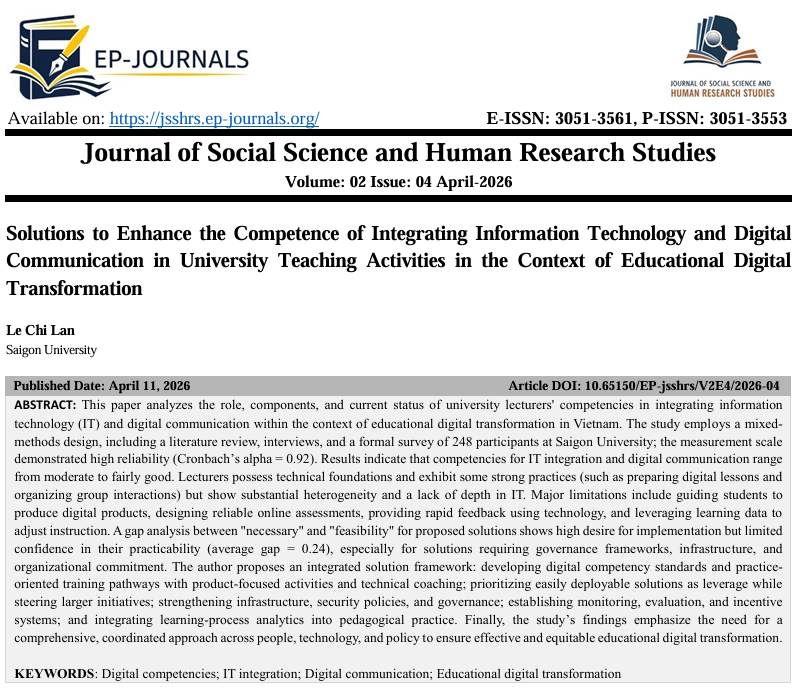
Solutions to Enhance the Competence of Integrating Information Technology and Digital Communication in University Teaching Activities in the Context of Educational Digital Transformation
DOI:
https://doi.org/10.65150/EP-jsshrs/V2E4/2026-04Keywords:
Digital competencies, IT integration, Digital communication, Educational digital transformationAbstract
This paper analyzes the role, components, and current status of university lecturers' competencies in integrating information technology (IT) and digital communication within the context of educational digital transformation in Vietnam. The study employs a mixed-methods design, including a literature review, interviews, and a formal survey of 248 participants at Saigon University; the measurement scale demonstrated high reliability (Cronbach’s alpha = 0.92). Results indicate that competencies for IT integration and digital communication range from moderate to fairly good. Lecturers possess technical foundations and exhibit some strong practices (such as preparing digital lessons and organizing group interactions) but show substantial heterogeneity and a lack of depth in IT. Major limitations include guiding students to produce digital products, designing reliable online assessments, providing rapid feedback using technology, and leveraging learning data to adjust instruction. A gap analysis between "necessary" and "feasibility" for proposed solutions shows high desire for implementation but limited confidence in their practicability (average gap = 0.24), especially for solutions requiring governance frameworks, infrastructure, and organizational commitment. The author proposes an integrated solution framework: developing digital competency standards and practice-oriented training pathways with product-focused activities and technical coaching; prioritizing easily deployable solutions as leverage while steering larger initiatives; strengthening infrastructure, security policies, and governance; establishing monitoring, evaluation, and incentive systems; and integrating learning-process analytics into pedagogical practice. Finally, the study’s findings emphasize the need for a comprehensive, coordinated approach across people, technology, and policy to ensure effective and equitable educational digital transformation.
References
1) Cyprian O. Nyambane and David M. Nzuki (2019). Influence of IT Capacity on Effective Utilization of IT to Improve Organizational Performance of Learning Institutions: A Literature Review, Doi:10.19044/esj.2019.v15n31p264. https:// www.researchgate.net/publication/340861556
2) Balyk, N., Vasylenko, Y., Shmyger, G., Barna, O., & Oleksiuk, V. (2020). The Digital Capabilities Model of University Teachers in the Educational Activities Context. Trong IT in Education, Research and Industrial Applications Proceedings of the 16th International Conference, ITERI 2020. Volume II: Workshops (1097-1112). (Kharkiv, Ukraine, October 06-10)
3) Chan, B. S. K., Churchill, D., & Chiu, T. K. F. (2017). Digital Literacy Learning In Higher Education Through Digital Storytelling Approach. In Journal of International Education Research (JIER) (Vol. 13, Issue 1, pp. 1–16). https://doi.org/10.19030/jier.v13i1.9907
4) Đặng Thành Hưng (2012). Competence and Education from a Competency-Based Approach. Journal of Educational Management, No. 43, December 2012, pp. 18–26.
5) Honga, J., Hornga, J., Lin, C., & ChanLin, L. (2008). Competency disparity between pre-service teacher education and in-service teaching requirements in Taiwan. International Journal of Educational Development, 28, pp. 4–20.
6) Le Chi Lan, Co Ton Minh Dăng (2023). Teachers’ Teaching Competence in the Context of Digital Transformation. Journal of Education Management Science, Vol. 37, No. 01.
7) Le Chi Lan (2024). Innovating University Teaching Activities in the Context of Digital Transformation. Journal of Education, Vol. 24 (Special Issue 8), pp. 1–5.
8) Ninh Thi Kim Thoa (2022). Survey on the Current State of Digital Competence of Teachers in the Social Sciences and Humanities. Bulletin of Information and Documentation, University of Social Sciences and Humanities, Vietnam National University Ho Chi Minh City (VNU-HCM).
9) Nguyen Tan Dai & Marquet, P. (2018). Digital Technology Competence to Meet Social Needs: International Models and Approaches in Vietnam. Journal of Social Sciences of Ho Chi Minh City, 244(12), 23–39.
10) Nguyen Thi Thu Van (2021). Digital Transformation in Higher Education Institutions. State Management Review, No. 309 (10/2021), pp. 8–13.
11) Prime Minister. (2020). Decision No. 749/QĐ-TTg approving the “National Digital Transformation Program to 2025, with orientations toward 2030.” Issued on June 3, 2020.
Downloads
Published
Issue
Section
License
Copyright (c) 2026 Le Chi Lan (Author)

This work is licensed under a Creative Commons Attribution 4.0 International License.