Factors Influencing Science High School Students’ Aspirations to Pursue Medical Programs at the University, Rwanda
DOI:
https://doi.org/10.65150/EP-jsshrs/V2E5/2026-02Keywords:
Social Influence, Personal Interest, Personal Motivation, Family Background, Financial Consideration, Science High School Students, Predictors, Aspirations, Medical ProgramsAbstract
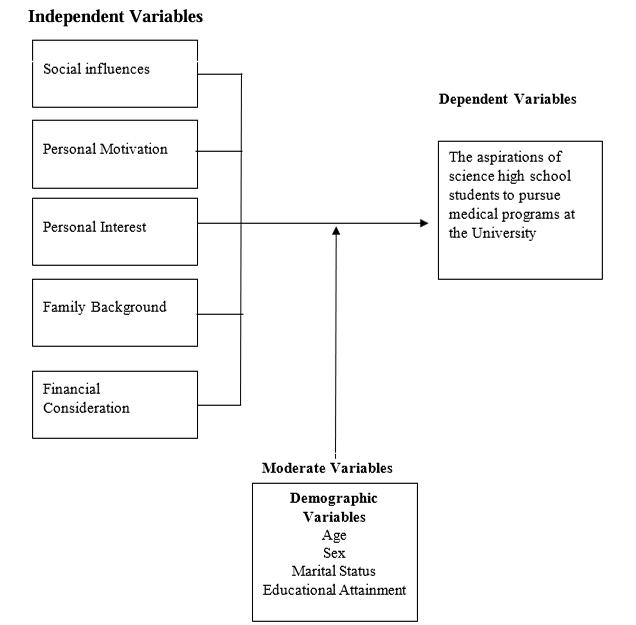
This study examined the factors influencing science high school students’ aspirations to pursue medical programs at the university level in Rwanda. Employing a quantitative design that integrated descriptive–evaluative, correlational, and comparative approaches, the research analyzed how social influence, personal motivation, personal interest, family background, and financial consideration shape students’ intentions to study medicine. Data were collected from a sample of 238 Senior Six (S6) students drawn from five science-oriented high schools using a validated four-point Likert scale questionnaire. The collected data were analyzed using descriptive statistics, Pearson correlation, and multiple regression at a 0.05 significance level. Results revealed a high level of aspiration among students (M = 3.35, SD = 0.54), primarily driven by intrinsic motivation, personal interest, family encouragement, and financial readiness. Social influence showed a weak negative correlation (ρ = –0.169, p = 0.009), indicating that external pressure minimally affects students’ career choices. Financial consideration (R² = 0.997) emerged as the strongest predictor, followed by family background (R² = 0.487) and personal interest (R² = 0.388). These findings highlight that students’ ambitions to pursue medicine are strong but heavily conditioned by economic feasibility and access to educational opportunities. The study underscores the urgent need to expand medical schools and training programs in Rwanda to accommodate the growing student demand and reduce geographic and financial barriers. Strengthening scholarship schemes, mentorship initiatives, and institutional capacity will ensure that motivated students can fulfill their aspirations, thereby contributing to the development of a sustainable national healthcare workforce.
References
1) Akinyinka, Ashipa, T., Oluwole, E., Odusanya, O., & Alakija, W. (2017). Career aspirations of a set of new intake students at a Government owned medical school in Lagos, Nigeria. Babcock University Medical Journal, 2(1), 1–7.https://doi.org/10.38029/bumj.v2i1.1
2) Amparo, A. L. S., Angeles, A. C. C., Cabotaje, A. N. M., Seno, M. R. T., & Arcinas, M. M. (2022). Factors Influencing the Doctor of Medicine Career Choice Intention Among STEM Senior High School Students from a Private Educational Institution in Manila, Philippines. International Journal of Multidisciplinary Applied Business and Education Research, 3(6), 1060–1074.https://doi.org/10.11594/ijmaber.03.06.10
3) Aschbacher, P. R., Li, E., & Roth, E. J. (2009). Is science me? High school students’ identities, participation and aspirations in science, engineering, and medicine. Journal of Research in Science Teaching, 47(5), 564–582. https://doi.org/10.1002/tea.20353
4) Bajunirwe, F., Semakula, D., & Izudi, J. (2022). Career aspirations of specialty among medical students in sub-Saharan Africa: a systematic review and meta-analysis of data from two decades, 2000–2021. BMJ Open, 12(8), e057020.https://doi.org/10.1136/bmjopen-2021-057020
5) Buchmann, C., & Dalton, B. (2002). Interpersonal Influences and Educational Aspirations in 12 countries: The importance of Institutional context. Sociology of Education, 75(2), 99. https://doi.org/10.2307/3090287
6) Corsi, P. R., Fernandes, É. L., Intelizano, P. M., Montagnini, C. C. B., Baracat, F. I., & De Almeida Ribeiro, M. C. S. (2014). Fatores que influenciam o aluno na escolha da especialidade médica. Revista Brasileira De Educação Médica, 38(2), 213–220.https://doi.org/10.1590/s0100-55022014000200008
7) Ezegwui, C. O., Nwaze, C. E., Magboh, V. O., Olusoji, E. B., & Lawal, T. A. (2022). PREFERENCES OF CHOICE OF FUTURE SPECIALTY: INSIGHTS FROM FINAL YEAR MEDICAL STUDENTS IN IBADAN, NIGERIA. PubMed, 20(2), 108–114.https://pubmed.ncbi.nlm.nih.gov/37384343
8) Faihs, V., Heininger, S., McLennan, S., Gartmeier, M., Berberat, P. O., & Wijnen-Meijer, M. (2023). Professional Identity and Motivation for Medical School in First-Year Medical Students: A Cross-sectional study. Medical Science Educator, 33(2), 431–441.https://doi.org/10.1007/s40670-023-01754-7
9) Fuchs, T. T., Sadler, P. M., & Sonnert, G. (2015). High school predictors of a career in medicine. Journal of Career and Technical Education, 30(1). https://doi.org/10.21061/jcte.v30i1.711
10) Gameraddin, M., Al-Sultan, K., Salih, S., Gareeballah, A., Hasaneen, M., Alomaim, W., & Omer, A. (2022). Factors influencing undergraduate students’ preference of health sciences specialties. Advances in Medical Education and Practice, Volume 13, 1351–1358. https://doi.org/10.2147/amep.s377344
11) Garcia, M., & Sievering, L. (2022). A study of the impacts of medical dramas on high school students’ career aspirations and expectations. Journal of Student Research, 11(3). https://doi.org/10.47611/jsrhs.v11i3.2916
12) Gore, J., Patfield, S., Holmes, K., & Smith, M. (2017). Widening participation in medicine? New insights from school students’ aspirations. Medical Education, 52(2), 227–238. https://doi.org/10.1111/medu.13480
13) Guo, L., & Hau, K. (2022). Attracting adolescents to become doctors and nurses: Differential importance of personal and environmental factors in 61 economies. Research Square (Research Square). https://doi.org/10.21203/rs.3.rs-2349997/v1
14) Herrera Moya, V. A., M., Tejeda, I. A., Quintana Uguando, M., Pérez Ineránty, M., Navarro Aguirre, L., Sosa Fleites, I. M., Universidad de Ciencias Médicas de Villa Clara, & Universidad Central “Marta Abreu” de Las Villas. (2018). Formación vocacional y motivación: su incidencia en el estudio de la carrera de Medicina. In EDUMECENTRO (Vol. 10, Issue 2, pp. 111–125) [Journal-article]. https://dialnet.unirioja.es/descarga/articulo/6359021.pdf
15) Holzer, B. M., Ramuz, O., Minder, C. E., & Zimmerli, L. (2022). Motivation and personality factors of Generation Z high school students aspiring to study human medicine. BMC Medical Education, 22(1). https://doi.org/10.1186/s12909-021-03099-4
16) Holzer, B. M., Ramuz, O., Minder, C. E., & Zimmerli, L. (2022). Motivation and personality factors of Generation Z high school students aspiring to study human medicine. BMC Medical Education, 22(1). https://doi.org/10.1186/s12909-021-03099-4
17) Kansayisa, G., Yi, S., Lin, Y., & Costas-Chavarri, A. (2018). Gender-based analysis of factors affecting junior medical students’ career selection: addressing the shortage of surgical workforce in Rwanda. Human Resources for Health, 16(1).
https://doi.org/10.1186/s12960-018-0295-7
18) Monteiro, M. F. a. D., Barbosa, J. M. P., Carteado, E. M. F. L., Ferreira, M. a. D., & André, A. M. (2010). Opção pelo curso de Medicina em Angola: o caso da Universidade Agostinho Neto. Revista Brasileira De Educação Médica, 34(3), 346–354.https://doi.org/10.1590/s0100-55022010000300003
19) Mutwali, I. M., Omer, A. I. A., & Abdalhalim, S. M. (2015). Why a medical career? What makes Sudanese students to join a medical college and pursue a medical career? World Journal of Education, 5(2). https://doi.org/10.5430/wje.v5n2p19
20) Nakasujja, N., Baingana, R., Gumikiriza, J., & Galukande, M. (2021). What influences students choice for health professions education at Makerere University? Advances in Medical Education and Practice, Volume 12, 1499–1504. https://doi.org/10.2147/amep.s307328
21) N’cho-Mottoh, M. B., Coulibaly, I., Boka, B., Bamba-Kamagate, D., Ekou, A., & Aubrege, A. (2022). [Career choice of ivorian medical students at the end of curriculum: influencing factors and aspirations]. PubMed, 2(1). https://doi.org/10.48327/mtsi.v2i1.2022.202
22) Neil, K. L., Umucyo, D., Binagwaho, A., & Waka, T. Y. (2024). Gender-based support systems influencing female students to pursue a bachelor of medicine, bachelor of surgery (MBBS) in Rwanda. BMC Medical Education, 24(1).https://doi.org/10.1186/s12909-024-05613-w
23) Obadeji, A., Olo, T., Ntoye, N., & Oluwole, O. (2014). Career in Medicine: What factors influence medical students? Journal of Contemporary Medical Education, 2(4), 218. https://doi.org/10.5455/jcme.20141021122018
24) Pitanupong, J., & Wongsuwan, K. (2017). Factors for choosing residency training programs of medical students. Songklanagarind Medical Journal, 35(3), 263. https://doi.org/10.31584/smj.2017.35.3.736
25) PREFERENCES OF CHOICE OF FUTURE SPECIALTY: INSIGHTS FROM FINAL YEAR MEDICAL STUDENTS IN IBADAN, NIGERIA. (2022, December 1). PubMed. https://pubmed.ncbi.nlm.nih.gov/37384343/
26) Salawati, E., Ghamri, R., Amir, A., Alsubaie, M., Abualsaud, R., Bahowarth, S., Abdulrahman, L., & Alyazidi, A. (2024). The magnitude of influence of personal and professional factors on the career choices of medical students. Journal of Medicine and Life, 17(4), 449–456. https://doi.org/10.25122/jml-2023-0453
27) Sisa-Chamba, T. R., & Donoso-Norona, R. F. (2024). La influencia de las expectativas familiares en la elección de carreras de salud. Revista Arbitrada Interdisciplinaria De Ciencias De La Salud Salud Y Vida, 8(1), 480–486. https://doi.org/10.35381/s.v.v8i1.3787
28) Sobral, D. T. (2008). Autodeterminação da motivação em alunos de Medicina: relações com motivos de escolha da opção e intenção de adesão ao curso. Revista Brasileira De Educação Médica, 32(1), 56–65. https://doi.org/10.1590/s0100-55022008000100008
Downloads
Published
Issue
Section
License
Copyright (c) 2026 Aime Fidele Ndayiragije Mvuyekure, Dr. Kingsley Jacob Garba, Dr. Joseph Rwandema, Berton Barikumana, Philippe Hakizimana, Simon Pierre Ndayishimye Mvuyekure, Ishimwe Thierry Patrick (Author)

This work is licensed under a Creative Commons Attribution 4.0 International License.