The Relationship Between Topography of Area and Accessibility to Schools Case Study: Ecole Primaire Kibande, Mugano Sector in Nyamagabe District
DOI:
https://doi.org/10.65150/EP-jsshrs/V2E5/2026-08Keywords:
Topography of Area, Accessibility to SchoolsAbstract
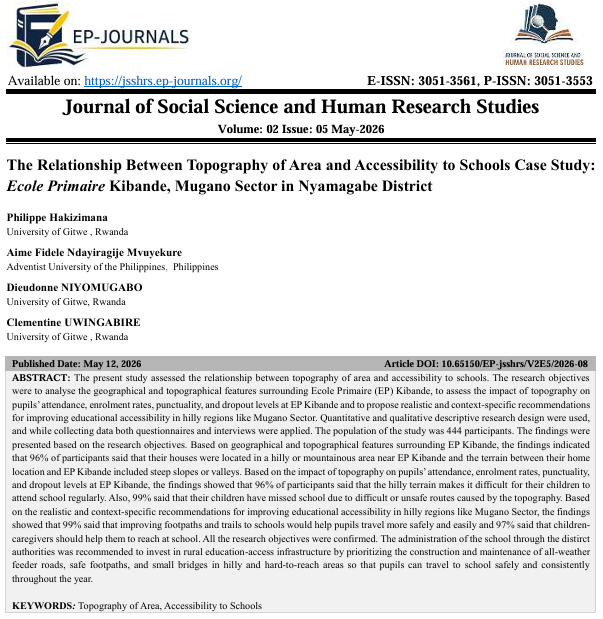
The present study assessed the relationship between topography of area and accessibility to schools. The research objectives were to analyse the geographical and topographical features surrounding Ecole Primaire (EP) Kibande, to assess the impact of topography on pupils’ attendance, enrolment rates, punctuality, and dropout levels at EP Kibande and to propose realistic and context-specific recommendations for improving educational accessibility in hilly regions like Mugano Sector. Quantitative and qualitative descriptive research design were used, and while collecting data both questionnaires and interviews were applied. The population of the study was 444 participants. The findings were presented based on the research objectives. Based on geographical and topographical features surrounding EP Kibande, the findings indicated that 96% of participants said that their houses were located in a hilly or mountainous area near EP Kibande and the terrain between their home location and EP Kibande included steep slopes or valleys. Based on the impact of topography on pupils’ attendance, enrolment rates, punctuality, and dropout levels at EP Kibande, the findings showed that 96% of participants said that the hilly terrain makes it difficult for their children to attend school regularly. Also, 99% said that their children have missed school due to difficult or unsafe routes caused by the topography. Based on the realistic and context-specific recommendations for improving educational accessibility in hilly regions like Mugano Sector, the findings showed that 99% said that improving footpaths and trails to schools would help pupils travel more safely and easily and 97% said that children-caregivers should help them to reach at school. All the research objectives were confirmed. The administration of the school through the distirct authorities was recommended to invest in rural education-access infrastructure by prioritizing the construction and maintenance of all-weather feeder roads, safe footpaths, and small bridges in hilly and hard-to-reach areas so that pupils can travel to school safely and consistently throughout the year.
References
1) Almendarez, L. (2021). Human capital theory: Implications for educational development. In Belize Country Conference paper (Vol. 59, No. 3-4, pp. 21-33).
2) Conz, C. R. (2024). Environment, Knowledge, and Injustice in Lesotho: The Poverty of Progress. Boydell & Brewer.
3) De Dieu, H. J., Theogene, H., Philothere, N., & Ke, Z. (2022). Quality education in Rwanda: A critical analysis of quality indicators. IOSR Journal of Humanities and Social Science, 27(2), 52-70.
4) De Lame, D. (2020). A hill among a thousand: Transformations and ruptures in rural Rwanda. Univ of Wisconsin Press.
5) Guzzetti, F., & Reichenbach, P. (2021). Towards a definition of topographic divisions for Italy. Geomorphology, 11(1), 57-74.
6) Hartter, J., & Southworth, J. (2019). Dwindling resources and fragmentation of landscapes around parks: wetlands and forest patches around Kibale National Park, Uganda. Landscape Ecology, 24(5), 643-656.
7) Knight, J. (2021). Transforming the physical geography of a city: An example of Johannesburg, South Africa. In Urban geomorphology (pp. 129-147). Elsevier.
8) Lackney, J. A. (2021). Educational Facilities: The Impact and Role of the Physical Environment of the School on Teaching, Learning and Educational Outcomes. Center for Architecture and Urban Planning Research, University of Wisconsin-Milwaukee, PO Box 413, Milwaukee, WI 53201.
9) Miller, H. J. (2020). Place-based versus people-based accessibility. In Access to destinations (pp. 63-89). Emerald Group Publishing Limited.
10) Moeyersons, J. (2023). The topographic thresholds of hillslope incisions in southwestern Rwanda. Catena, 50(2-4), 381-400.
11) Nkurunziza, J. (2021). Human capital development in Rwanda: effects of education, Social Protection and Rural Development Policies (Doctoral dissertation, Utrecht University).
12) Teferi, M. (2019). Geography of Ethiopia and the Horn.
13) Thier, M., Longhurst, J. M., Grant, P. D., & Hocking, J. E. (2021). Research deserts: A systematic mapping review of US rural education definitions and geographies. Journal of Research in Rural Education, 37(2).
14) Timonina, I. L. V. (2021). Japan’s New Spatial Development Strategy: Challenges of the 2i st Century. Russian Japanology Review, 4(1), 5-34.
15) Webb, S. C., Lahiri-Roy, R., Knight, E., & Koshy, P. (2024). The Intersection of geography, topography and mindset: A nuanced understanding of regional, rural and remote pupils’ tertiary participation in Australia. Australian and International Journal of Rural Education, 34(3), 1-18.
16) Wei, Y. D. (2021). Spatiality of regional inequality. Applied Geography, 61, 1-10.
17) Yao, L., Lv, M., Li, T., Wang, D., & Cao, X. (2022). Exploring the evolution of the accessibility of schools and its influencing factors in mountainous areas: a case study of the Rocky Desertification Area in Yunnan, Guangxi, and Guizhou. ISPRS International Journal of Geo-Information, 11(5), 296.
Downloads
Published
Issue
Section
License
Copyright (c) 2026 Philippe Hakizimana , Aime Fidele Ndayiragije Mvuyekure , Dieudonne NIYOMUGABO , Clementine UWINGABIRE (Author)

This work is licensed under a Creative Commons Attribution 4.0 International License.