Evaluation of Nursing Knowledge and Compliance with Evidence-Based Hypertension Management Protocols at Kabaya District Hospital
DOI:
https://doi.org/10.65150/EP-jsshrs/V2E3/2026-07Keywords:
Nursing Knowledge, Compliance with Hypertension Management, Evidence-Based Practice, Hypertension Management, Nursing PracticeAbstract
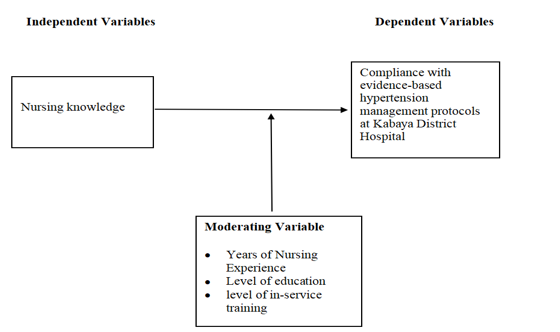
Background: Hypertension remains a major global public health concern and a leading contributor to cardiovascular morbidity and mortality. Nurses play a critical role in hypertension management through screening, monitoring, medication administration, patient education, and lifestyle counseling. However, the effectiveness of these interventions largely depends on nurses’ knowledge and their compliance with evidence-based management protocols. This study aimed to evaluate the level of nursing knowledge and its influence on compliance with evidence-based hypertension management protocols at Kabaya District Hospital in Rwanda.
Methods: A cross-sectional descriptive quantitative design was employed. The target population consisted of registered nurses directly involved in hypertension care, and a sample of 57 nurses was selected from a total population of 67 using Yamane’s formula and purposive sampling. Data were collected using structured questionnaires and observation checklists administered through both face-to-face and online surveys. The instruments assessed nurses’ socio-demographic characteristics, knowledge, and compliance with hypertension management protocols. Data were coded in Microsoft Excel and analyzed using SPSS version 25. Descriptive statistics (frequencies, percentages, means, and standard deviations) summarized the data, while Spearman’s rho correlation analysis was used to examine the relationship between knowledge and compliance. Ethical approval was obtained from the University of Gitwe Ethical Review Board and Kabaya District Hospital administration.
Findings: The findings revealed that nurses demonstrated a very high level of knowledge regarding evidence-based hypertension management protocols (composite mean = 4.41, SD = 0.929) and a very high level of compliance in implementing these protocols (composite mean = 4.38, SD = 0.939). A strong positive and statistically significant relationship was found between nursing knowledge and compliance (ρ = 0.762, p < 0.001), indicating that higher levels of knowledge are associated with improved adherence to hypertension management protocols. However, workload pressures were identified as a factor that may affect full compliance.
Conclusion: The study concludes that strengthening nurses’ knowledge through continuous professional development and institutional support is essential for improving adherence to evidence-based hypertension management protocols and enhancing patient outcomes. Future research should explore additional organizational and contextual factors influencing compliance in similar healthcare settings.
References
1) Ataro, B., Mulatu, G., Mengistu, D., Ataro, B., Nugent, R., Bertram, M., Jan, S., Niessen, L., Sassi, F., Jamison, D., Beaglehole, R, Ruby, A., Knight, A., Perel, P., Blanchet, K., Roberts, B., Gillam, S., Siko, P., . . . C. (2023). Compliance with guidelines of hypertension management, and associated factors; a retrospective Cross-Sectional study conducted among the healthcare workers. Archives of Clinical and Medical Microbiology, 2(3). https://doi.org/10.33140/acmmj.02.03.03
2) Delgado. (1990, November 1). [Evaluation of the degree of compliance in arterial hypertension protocol]. PubMed.
https://www.ncbi.nlm.nih.gov/pubmed/2104118
3) Drevenhorn, E. (2018). A proposed Middle-Range Theory of Nursing in hypertension care. International Journal of Hypertension, 2018, 1–11. https://doi.org/10.1155/2018/2858253
4) Dzudie, A., Ojji, D., Damasceno, A., Sani, M. U., Kramoh, E., Kacou, J. B. A., Anisiuba, B., Ogola, E., Awad, M., Nel, G., Otieno, H., Toure, A. I., Kane, A., Kengne, A. P., Ngwasiri, C., Ba, H., Kingue, S., Mipinda, B., Mbolla, B. E., . . . Subhani, S. (2018). Development of the certificate course in the management of hypertension in Africa (CCMH-Africa): proceedings of the first continental faculty meeting, Nairobi, Kenya, 25–26 February 2018. Cardiovascular Journal of South Africa/Cardiovascular Journal of Southern Africa, 29(5), 331–334. https://doi.org/10.5830/cvja-2018-055
5) Himmelfarb, C. R. D., Commodore-Mensah, Y., & Hill, M. N. (2016). Expanding the role of nurses to improve hypertension care and control globally. Annals of Global Health, 82(2), 243. https://doi.org/10.1016/j.aogh.2016.02.003
6) Mbabazi, O., Ogendi, J., & Uwambajimana, J. (2024). Adherence to Hypertensive Medication among Hypertensive Patients Aged ≥ 35 Years Old Attending Muhima District Hospital, Rwanda. Journal of Medicine Nursing & Public Health, 7(1). https://doi.org/10.53819/81018102t2308
7) Ndateba, I., Mukeshimana, M., Nsekambabaye, J. P., Musabwa, E., & Collins, A. (2023). Quality of Care for Patients with Hypertension in selected Health Centres in Rwamagana District, Rwanda. Rwanda Journal of Medicine and Health Sciences, 6(1), 84–98. https://doi.org/10.4314/rjmhs.v6i1.10
8) Pelaj, B., & Arslani, N. (2020, June 17). Nursing Management of Patients with Arterial Hypertension. © 2012-2019 International Journal of Sciences: Basic and Applied Research (IJSBAR). https://www.gssrr.org/index.php/JournalOfBasicAndApplied/article/view/11280
9) Zhang, Y., Zhang, Q., Ren, Q., Wang, Y., Wang, J., Wu, Y., Shang, M., Zhou, Y., Liu, R., Li, X., Wang, Z., Wang, F., & Yuan, F. (2025). Knowledge, Attitudes, and Practices of Healthcare Professionals toward Internet-Based Hypertension Management: A Cross-Sectional Study. Journal of Multidisciplinary Healthcare, Volume 18, 3545–3561. https://doi.org/10.2147/jmdh.s522108
Downloads
Published
Issue
Section
License
Copyright (c) 2026 Aime Fidele Ndayiragije Mvuyekure, Josiane Niyonkuru, Jacob Kingsley Garba, Tumusingize Emmanuel, Mushirarungu Jean Bosco, Christian Ndede (Author)

This work is licensed under a Creative Commons Attribution 4.0 International License.