Institutional Integrity and Whistleblowing Architecture in Corruption Prevention: A Systematic Literature Review
DOI:
https://doi.org/10.65150/EP-jsshrs/V2E5/2026-07Keywords:
institutional integrity, whistleblowing; corruption prevention, systematic literature review, anti-corruption governance, public sector ethicsAbstract
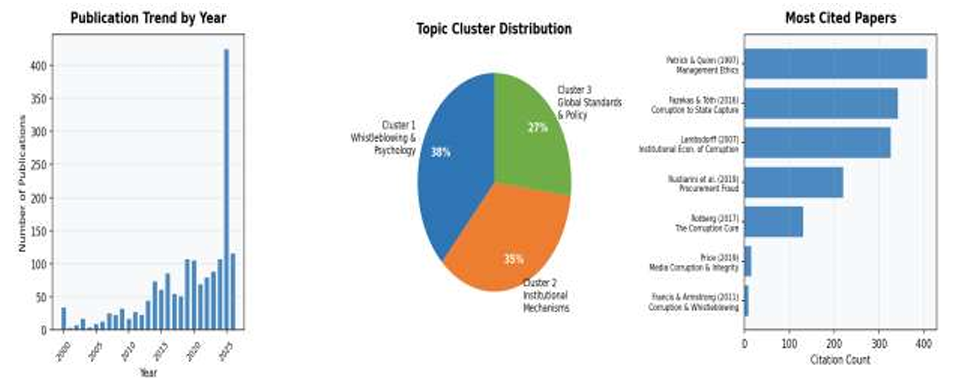
This systematic literature review examines the relationship between institutional integrity frameworks and whistleblowing architecture as mechanisms for corruption prevention. Drawing on 1,818 deduplicated studies identified across Google Scholar and Crossref, with a primary analytical focus on 1,296 papers published between 2016 and 2026, the review follows the PRISMA protocol to synthesize evidence on how reporting systems and organizational ethics interact to either sustain or suppress corrupt practices. The review finds that whistleblowing remains critically underutilized: despite growing legal protections under international frameworks such as the UN Convention Against Corruption (UNCAC), fear of retaliation and weak organizational trust continue to suppress disclosure rates across public and private sectors. Three dominant thematic clusters emerge from the literature — the psychology of reporting behavior, the design of institutional reporting mechanisms, and the harmonization of global regulatory standards — each illuminating a distinct gap between policy intention and operational reality. The review concludes that effective corruption prevention depends not on legal instruments alone, but on a dynamic alignment between structural oversight mechanisms, leadership accountability, and a genuine organizational culture of transparency. For policymakers and institutional leaders, the findings suggest that investing in psychological safety and independent oversight channels produces measurably better outcomes than compliance-driven reporting mandates. Future research should prioritize longitudinal studies that track whistleblowing outcomes across institutional reform cycles.
References
1) Assay, B. E. (2023). Whistleblowing policy against corruption. Journal of Public Administration and Policy Research, 15(2), 45–58.
2) Campbell, J. W., & Danar, O. R. (2025). Institutional independence, credible commitment, and anti-corruption reform failure in developing contexts: Three illustrative examples from Indonesia. Public Administration and Development, 45(1), 12–28.
3) Ceva, E., & Ferretti, M. P. (2021). Political corruption: Individual or institutional? In E. Ceva & M. P. Ferretti (Eds.), Political corruption: The internal enemy of public institutions (pp. 1–30). Oxford University Press.
4) Di Salvo, P. (2024). Digital whistleblowing platforms for anti-corruption: The Transparency International Italia case. Journal of Information Policy, 14(3), 201–225.
5) Fazekas, M., & Tóth, I. J. (2016). From corruption to state capture: A new analytical framework with empirical applications from Hungary. Political Research Quarterly, 69(2), 320–334.
6) Francis, R. D., & Armstrong, A. (2011). Corruption and whistleblowing in international humanitarian aid agencies. Journal of Financial Crime, 18(3), 201–212.
7) Gumelar, M. (2019). The connectivity of whistleblowing online system between government agencies in Indonesia. Journal of Governance and Public Policy, 6(2), 110–128.
8) Hamzi, L. (2026). Digital integrity in the Gulf: Policy innovations and technological tools to combat corruption. In L. Hamzi (Ed.), Digital governance in the GCC (pp. 88–114). Springer.
9) Huberts, L., & van Montfort, A. (2021). Ethics, corruption, and integrity of governance: What it is and what helps. In L. Huberts (Ed.), The integrity of governance (pp. 1–22). Palgrave Macmillan.
10) Ifejika, S. I. (2018). The "other side" of whistleblowing practice: Experiences from Nigeria. African Journal of Criminology and Justice Studies, 11(1), 33–52.
11) Kim, M. J., & Lee, S. J. (2025). A meta-regression approach to the determinants of integrity perception in public organizations: Evidence from institutional integrity survey data. Public Management Review, 27(4), 815–838.
12) Lambsdorff, J. G. (2007). The institutional economics of corruption and reform: Theory, evidence and policy. Cambridge University Press.
13) Lee, J. C. (2025). The role of the Lee Jae-myung administration in building an integrity-based society. Korean Journal of Public Administration, 63(1), 1–28.
14) Lee, J., & Cho, H. (2022). Media reports and whistleblowing disclosure. Journal of Financial Crime, 29(2), 456–470.
15) Ledeneva, A. (2009). Corruption in post-communist societies in Europe: A re-examination. Perspectives on European Politics and Society, 10(1), 69–86.
16) Maolani, D. Y. (2024). Governance and corruption: Evaluating anti-corruption policies and their effectiveness in strengthening institutional integrity. Journal of Governance Studies, 12(3), 78–99.
17) Marks, J. H. (2019). The perils of partnership: Industry influence, institutional integrity, and public health. Oxford University Press.
18) Maulidi, A., Rizal, A. S., & Alnajar, A. E. A. (2025). The whispering guardian: Religiosity and internal whistleblowing in the realm of normalized corruption. Journal of Business Ethics, 168(2), 441–461.
19) Meini, B. (2023). Corruption: A long-lasting historical disease infecting the integrity of the police. Police Practice and Research, 24(5), 512–530.
20) Nortje, W. (2023). Section 9B of the Protected Disclosures Amendment Act 5 of 2017: Discouraging whistleblowing in South Africa? South African Journal of Criminal Justice, 36(2), 198–218.
21) Pereira, B. de Q., & Braghirolli, L. F. de A. N. (2020). Whistleblowing channels and internal investigations in electoral and partisan contexts: Parameters and guidelines for ensuring integrity and compliance. Compliance & Integrity Journal, 2(1), 1–18.
22) Rashid, M., & Johara, F. (2020). Corruption and institutional integrity: The case of Bangladesh. Asian Affairs, 51(3), 600–618.
23) Rustiarini, N. W., Sutrisno, T., Nurkholis, N., & Andayani, W. (2019). Why people commit public procurement fraud? The fraud diamond view. Journal of Financial Crime, 26(4), 1243–1260.
24) Sandari, T. E. (2022). The influence of the whistleblowing system on fraud detection in efforts to eradicate corruption in government agencies. Journal of Accounting and Finance, 22(4), 89–104.
25) Singh, D. (2020). Corruption in Afghanistan: External intervention and institutional legacy. In D. Singh (Ed.), Corruption and state fragility in Asia (pp. 111–134). Palgrave Macmillan.
26) Teichmann, F., & Falker, M.-C. (2021). Public procurement and corruption during Covid-19: Self-monitoring and whistleblowing. Journal of Financial Crime, 28(4), 1274–1281.
27) Thulo, M. S. (2025). Guardians of integrity: Comparative analysis of whistleblower protection frameworks in Lesotho, the United Kingdom, and South Africa. SN Social Sciences, 5(7), 1–24.
28) Villalpando-Acuña, A. (2026). Corruption in Latin America: An institutional perspective. In A. Villalpando-Acuña (Ed.), Corruption and governance in Latin America (pp. 3–28). Springer.
29) Waromi, J., & Falah, S. (2025). Whistleblowing studies for corruption prevention in Indonesian local governments: A systematic literature review. Cogent Business and Management, 12(1), 1–28.
30) Wong, A. (2024). Legislating for good governance in the pharmaceutical sector through UN Convention Against Corruption (UNCAC) compliance. Global Public Health, 19(1), 1–15.
Downloads
Published
Issue
Section
License
Copyright (c) 2026 Eka Sudarmaji (Author)

This work is licensed under a Creative Commons Attribution 4.0 International License.