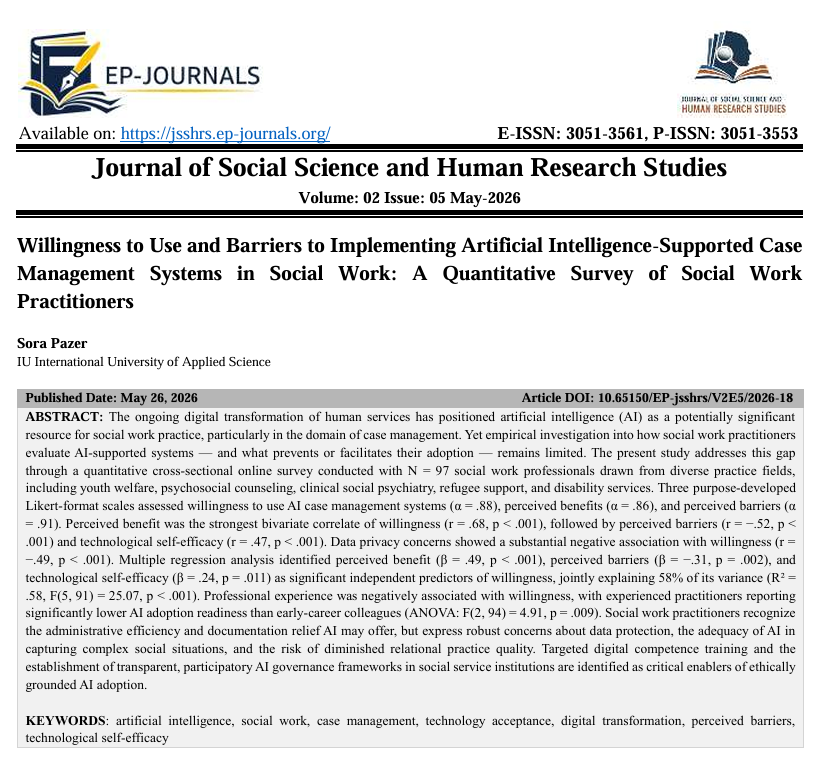
Willingness to Use and Barriers to Implementing Artificial Intelligence-Supported Case Management Systems in Social Work: A Quantitative Survey of Social Work Practitioners
DOI:
https://doi.org/10.65150/EP-jsshrs/V2E5/2026-18Keywords:
artificial intelligence, social work, case managemet, technology, digital transformation, self efficacyAbstract
The ongoing digital transformation of human services has positioned artificial intelligence (AI) as a potentially significant resource for social work practice, particularly in the domain of case management. Yet empirical investigation into how social work practitioners evaluate AI-supported systems — and what prevents or facilitates their adoption — remains limited. The present study addresses this gap through a quantitative cross-sectional online survey conducted with N = 97 social work professionals drawn from diverse practice fields, including youth welfare, psychosocial counseling, clinical social psychiatry, refugee support, and disability services. Three purpose-developed Likert-format scales assessed willingness to use AI case management systems (α = .88), perceived benefits (α = .86), and perceived barriers (α = .91). Perceived benefit was the strongest bivariate correlate of willingness (r = .68, p < .001), followed by perceived barriers (r = −.52, p < .001) and technological self-efficacy (r = .47, p < .001). Data privacy concerns showed a substantial negative association with willingness (r = −.49, p < .001). Multiple regression analysis identified perceived benefit (β = .49, p < .001), perceived barriers (β = −.31, p = .002), and technological self-efficacy (β = .24, p = .011) as significant independent predictors of willingness, jointly explaining 58% of its variance (R² = .58, F(5, 91) = 25.07, p < .001). Professional experience was negatively associated with willingness, with experienced practitioners reporting significantly lower AI adoption readiness than early-career colleagues (ANOVA: F(2, 94) = 4.91, p = .009). Social work practitioners recognize the administrative efficiency and documentation relief AI may offer, but express robust concerns about data protection, the adequacy of AI in capturing complex social situations, and the risk of diminished relational practice quality. Targeted digital competence training and the establishment of transparent, participatory AI governance frameworks in social service institutions are identified as critical enablers of ethically grounded AI adoption.
References
Aiken, L. S., & West, S. G. (1991). Multiple regression: Testing and interpreting interactions. Sage.
Buolamwini, J., & Gebru, T. (2018). Gender shades: Intersectional accuracy disparities in commercial gender classification. Proceedings of Machine Learning Research, 81, 1–15.
Davis, F. D. (1989). Perceived usefulness, perceived ease of use, and user acceptance of information technology. MIS Quarterly, 13(3), 319–340. https://doi.org/10.2307/249008
Doel, M. (2012). Social work: The basics. Routledge.
Dressel, J., & Farid, H. (2018). The accuracy, fairness, and limits of predicting recidivism. Science Advances, 4(1), eaao5580. https://doi.org/10.1126/sciadv.aao5580
Eubanks, V. (2018). Automating inequality: How high-tech tools profile, police, and punish the poor. St. Martin's Press.
Garner, R. T., & Bhatt, S. (2021). Technology acceptance and digital professional identity in human services. Human Service Organizations: Management, Leadership & Governance, 45(2), 127–143.
Gillingham, P. (2019). Electronic information systems and social work: What are we doing? British Journal of Social Work, 49(6), 1506–1521. https://doi.org/10.1093/bjsw/bcy048
Gillingham, P., & Graham, T. (2017). Big data in social welfare: The development of a critical perspective on social work's latest "electronic turn." Australian Social Work, 70(2), 135–147. https://doi.org/10.1080/0312407X.2015.1134606
Goldkind, L., & Wolf, L. (2015). A digital environment approach: Four technologies that will disrupt social work practice. Social Work, 60(1), 85–87. https://doi.org/10.1093/sw/swu045
Keddell, E. (2019). Algorithmic justice in child protection: Statistical fairness, social justice and the implications for practice. Social Sciences, 8(10), 281. https://doi.org/10.3390/socsci8100281
LeCun, Y., Bengio, Y., & Hinton, G. (2015). Deep learning. Nature, 521(7553), 436–444. https://doi.org/10.1038/nature14539
Lythreatis, S., Singh, S. K., & El-Kassar, A.-N. (2022). The digital divide: A review and future research agenda. Technological Forecasting and Social Change, 175, 121359. https://doi.org/10.1016/j.techfore.2021.121359
Mantelero, A. (2018). AI and Big Data: A blueprint for a human rights, social and ethical impact assessment. Computer Law & Security Review, 34(4), 754–772. https://doi.org/10.1016/j.clsr.2018.05.017
Mishna, F., Bogo, M., Root, J., Sawyer, J.-L., & Khoury-Kassabri, M. (2012). "It just crept in": The digital age and implications for social work practice. Clinical Social Work Journal, 40(3), 277–286. https://doi.org/10.1007/s10615-012-0383-4
Podsakoff, P. M., MacKenzie, S. B., Lee, J.-Y., & Podsakoff, N. P. (2003). Common method biases in behavioral research: A critical review of the literature and recommended remedies. Journal of Applied Psychology, 88(5), 879–903. https://doi.org/10.1037/0021-9010.88.5.879
Smuha, N. A. (2021). From a "race to AI" to a "race to AI governance": Regulatory developments in Europe and beyond. Law, Innovation and Technology, 12(1), 1–29. https://doi.org/10.1080/17579961.2021.1898300
Stoll, J., Müller, J. A., & Trachsel, M. (2020). Ethical issues in online psychotherapy: A narrative review. Frontiers in Psychiatry, 10, 993. https://doi.org/10.3389/fpsyt.2019.00993
Taylor, A. (2017). Social work and digitalisation: Bridging the theory-practice gap. Palgrave Macmillan.
Topol, E. J. (2019). High-performance medicine: The convergence of human and artificial intelligence. Nature Medicine, 25(1), 44–56. https://doi.org/10.1038/s41591-018-0300-7
Venkatesh, V., Morris, M. G., Davis, G. B., & Davis, F. D. (2003). User acceptance of information technology: Toward a unified view. MIS Quarterly, 27(3), 425–478. https://doi.org/10.2307/30036540
Wastell, D., & White, S. (2014). Making sense of complex electronic records: Sociotechnical design in social care. Applied Ergonomics, 45(2), 143–149. https://doi.org/10.1016/j.apergo.2013.05.005
World Medical Association. (2013). World Medical Association Declaration of Helsinki: Ethical principles for medical research involving human subjects. JAMA, 310(20), 2191–2194. https://doi.org/10.1001/jama.2013.281053
Yan, Y. Y., & Shah, R. (2022). Artificial intelligence in social work education: Implications and opportunities. Journal of Social Work Education, 58(2), 221–234. https://doi.org/10.1080/10437797.2021.1882402
Zuboff, S. (2019). The age of surveillance capitalism: The fight for a human future at the new frontier of power. PublicAffairs.
Downloads
Published
Issue
Section
License
Copyright (c) 2026 Sora Pazer (Author)

This work is licensed under a Creative Commons Attribution 4.0 International License.