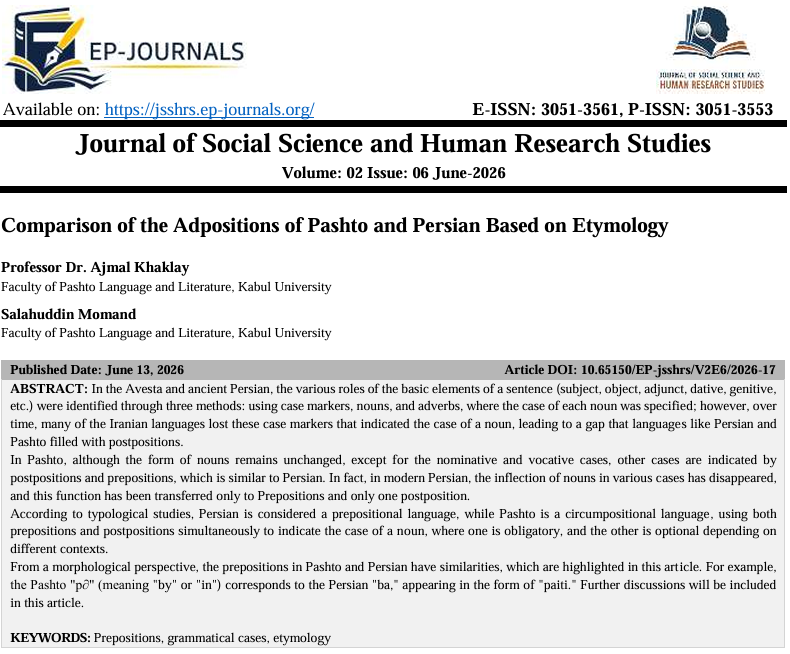
Comparison of the Adpositions of Pashto and Persian Based on Etymology
DOI:
https://doi.org/10.65150/EP-jsshrs/V2E6/2026-17Keywords:
Prepositions, grammatical cases, etymologyAbstract
In the Avesta and ancient Persian, the various roles of the basic elements of a sentence (subject, object, adjunct, dative, genitive, etc.) were identified through three methods: using case markers, nouns, and adverbs, where the case of each noun was specified; however, over time, many of the Iranian languages lost these case markers that indicated the case of a noun, leading to a gap that languages like Persian and Pashto filled with postpositions.
In Pashto, although the form of nouns remains unchanged, except for the nominative and vocative cases, other cases are indicated by postpositions and prepositions, which is similar to Persian. In fact, in modern Persian, the inflection of nouns in various cases has disappeared, and this function has been transferred only to Prepositions and only one postposition.
According to typological studies, Persian is considered a prepositional language, while Pashto is a circumpositional language, using both prepositions and postpositions simultaneously to indicate the case of a noun, where one is obligatory, and the other is optional depending on different contexts.
From a morphological perspective, the prepositions in Pashto and Persian have similarities, which are highlighted in this article. For example, the Pashto "p∂" (meaning "by" or "in") corresponds to the Persian "ba," appearing in the form of "paiti." Further discussions will be included in this article.
References
1) Abu al-Qasimi, M. (2010). Historical grammar of the Persian language. Tehran: Semat
2) Farhadi, R. (1977). History of Pronunciation and inflection in Pasht. Faculties of Literature and Humanities.
3) Morgenstierne, G. (1972). An etymological vocabulary of Pashto. University of Michigan
4) Sepideh, A. K, & Falah, S. B. (2021). Meanings of the constructive prepositions “for” and “until” in explaining their secondary grammaticalization. Journal of Linguistics Research, 13(1), 65-88
5) Shpoon, W. (2018). Comparative study of Pashto verbs with Avestan. Ministry of Information and Public Relations
6) Sokolov, S. N. (2009). Avestan language. (R. Behzadi, Trans.).
Downloads
Published
Issue
Section
License
Copyright (c) 2026 Professor Dr. Ajmal Khaklay (Author)

This work is licensed under a Creative Commons Attribution 4.0 International License.












