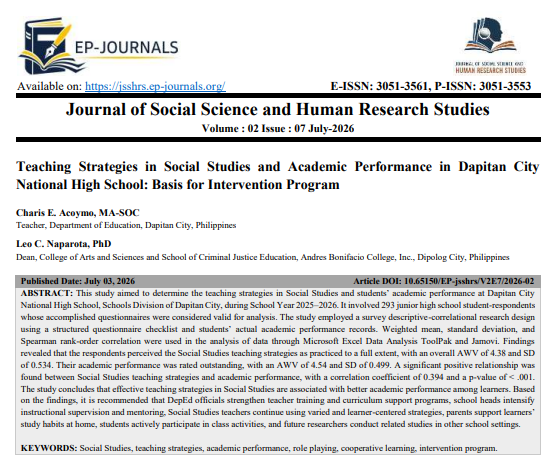
Teaching Strategies in Social Studies and Academic Performance in Dapitan City National High School: Basis for Intervention Program
DOI:
https://doi.org/10.65150/EP-jsshrs/V2E7/2026-02Keywords:
Social Studies, teaching strategies, academic performance, role playing, cooperative learning, intervention programAbstract
This study aimed to determine the teaching strategies in Social Studies and students’ academic performance at Dapitan City National High School, Schools Division of Dapitan City, during School Year 2025–2026. It involved 293 junior high school student-respondents whose accomplished questionnaires were considered valid for analysis. The study employed a survey descriptive-correlational research design using a structured questionnaire checklist and students’ actual academic performance records. Weighted mean, standard deviation, and Spearman rank-order correlation were used in the analysis of data through Microsoft Excel Data Analysis ToolPak and Jamovi. Findings revealed that the respondents perceived the Social Studies teaching strategies as practiced to a full extent, with an overall AWV of 4.38 and SD of 0.534. Their academic performance was rated outstanding, with an AWV of 4.54 and SD of 0.499. A significant positive relationship was found between Social Studies teaching strategies and academic performance, with a correlation coefficient of 0.394 and a p-value of < .001. The study concludes that effective teaching strategies in Social Studies are associated with better academic performance among learners. Based on the findings, it is recommended that DepEd officials strengthen teacher training and curriculum support programs, school heads intensify instructional supervision and mentoring, Social Studies teachers continue using varied and learner-centered strategies, parents support learners’ study habits at home, students actively participate in class activities, and future researchers conduct related studies in other school settings.
References
1) Agustin, S. P., Alvarez, J. I., & Del Carmen, J. M. V. (2025). Mediators of teaching strategies and students’ academic performance in social studies: A mediation analysis. Educational Process: International Journal, 16, Article e2025207. https://doi.org/10.22521/edupij.2025.16.207
2) Aiken, L. S., & Susane, G. (2001). West multiple progression. Sage Publishing, Inc.
3) Al-Mubireek, S. (2021). The effects of cooperative learning versus traditional teaching on students’ achievement: A case study. TESOL International Journal, 16(5), 168–193.
4) Al-Shuqairat, S. R. (2025). The effectiveness of using digital scientific stations in teaching social studies on the development of visual thinking and self-learning skills among seventh-grade students. Educational Process: International Journal.
5) Altaftazani, D. H., Sapriya, Maftuh, B., & Agustin, M. (2025). Objective conditions of social studies learning in improving students’ conflict-resolution skills in elementary schools. KnE Social Sciences. https://doi.org/10.18502/kss.v10i12.18865
6) Bihag, J. G. Q., Celso, R. B., Arabbi, A. A., Ladjakahal, M. L., Idlana, N. J., Karim, S. N. I., Sahidul, Z. A., Tandih, S. A., & Kunting, A. F. (2025). Instructional practices of social studies teachers in basic education. Journal of Health Research and Society, 4(1), 93–106. https://doi.org/10.34002/jhrs.v4i1.114
7) Boke, H., Araújo, R., Sierra-Díaz, J., Hortigüela-Alcalá, D., & Pérez-Pueyo, Á. (2025). Effects of cooperative learning on students’ learning outcomes in physical education: A meta-analysis. Frontiers in Psychology, 16, Article 1508808.
8) Brown, L. G., & Chidume, T. (2023). Don’t forget about role play: An enduring active teaching strategy. Teaching and Learning in Nursing, 18(1), 238–241. https://doi.org/10.1016/j.teln.2022.09.002
9) Cai, Z., & Meng, Q. (2025). Academic resilience and academic performance of university students: The mediating role of teacher support. Frontiers in Psychology, 16, Article 1463643.
10) Check, J., & Schutt, R. K. (2012). Research methods in education. SAGE Publications. https://doi.org/10.4135/9781544307725
11) Cohen, J. (1988). Statistical power analysis for the behavioral sciences (2nd ed.). Lawrence Erlbaum Associates.
12) Creswell, J. W., & Guetterman, T. C. (2019). Educational research: Planning, conducting, and evaluating quantitative and qualitative research (6th ed.). Pearson.
13) Darling-Hammond, L., Flook, L., Cook-Harvey, C., Barron, B., & Osher, D. (2020). Implications for educational practice of the science of learning and development. Applied Developmental Science, 24(2), 97–140.https://doi.org/10.1080/10888691.2018.1537791
14) Delgado-Galindo, P., García-Jiménez, J., Torres-Gordillo, J.-J., & Rodríguez-Santero, J. (2025). School climate and academic performance: Key factors for sustainable education in high-efficacy schools and low-efficacy schools. Sustainability, 17(14), Article 6497. https://doi.org/10.3390/su17146497
15) Eikeland, I., & Ohna, S. E. (2022). Differentiation in education: A configurative review. Nordic Journal of Studies in Educational Policy, 8(3), 157–170. https://doi.org/10.1080/20020317.2022.2039351
16) Gillies, R. M. (2016). Cooperative learning: Review of research and practice. Australian Journal of Teacher Education, 41(3), 39–54. https://doi.org/10.14221/ajte.2016v41n3.3
17) Gyeltshen, L. (2021). Enhancing sixth-grade students’ learning in social studies through technology-based approaches. Bhutan Journal of Research and Development.
18) Hafeez, M. (2021). Impact of teachers’ training on the interest and academic achievement of students through multiple teaching methods. Pedagogical Research, 6(3). https://doi.org/10.29333/pr/11187
19) Haleem, A., Javaid, M., Qadri, M. A., & Suman, R. (2022). Understanding the role of digital technologies in education: A review. Sustainable Operations and Computers, 3, 275–285. https://doi.org/10.1016/j.susoc.2022.05.004
20) Ituralde, A. J., & Garcia, L. H. (2025). Influencing factors of students’ preference toward specialization selection among Grade 9 students. International Journal of Research Publication and Reviews, 6(8), 5590–5604.
21) Jibililu, O. S. (2024). Evaluating the impact of instructional materials on social studies learning outcomes in senior high schools in the Bono East Region of Ghana. Social Education Research, 5(2), 380–397. https://doi.org/10.37256/ser.5220244881
22) Kara, S., & Tekindur, M. (2025). The effect of differentiated instruction on the academic achievement and opinions of third-grade
students in science education: A mixed- methods study. Journal of Intelligence, 13(10), Article 126.https://doi.org/10.3390/jintelligence13100126
23) Kyei, S., & Tedukpor, J. (2025). Teaching Social Studies in high schools: Knowledge construction versus knowledge transmission methods. EIKI Journal of Effective Teaching Methods, 3(1). https://doi.org/10.59652/jetm.v3i1.355
24) Lamaro, G., & Anena, D. J. (2024). Relationship between teaching strategies and students’ academic performance at ordinary-level secondary schools in Gulu District. East African Journal of Education Studies, 7(2), 330–347. https://doi.org/10.37284/eajes.7.2.1953
25) Löfstrand, P., Zakrisson, I., Cehajic-Clancy, S., & Jonsson, R. (2025). Exploring the impact of role-playing exercises on cognitive and emotional engagement with complex social phenomena. Frontiers in Psychology, 16, Article 1645213.
26) Manan, & Mastul, A. R. H. (2023). The impact of applying the role-playing method on social studies lessons among fourth-grade students. Journal of Pedagogy and Education Science, 2(1). https://doi.org/10.56741/jpes.v2i01.99
27) Mellado-Moreno, P. C., & Burgos, C. (2025). Didactics in social studies for global citizenship education: Dimensions and technological contexts. Frontiers in Education, 10, Article 1514027. https://doi.org/10.3389/feduc.2025.1514027
28) Nguyen, T. N. T., & Oanh, D. T. K. (2025). Cooperative learning and its influences on student engagement. Cogent Education, 12(1), Article 2513414.
29) Organisation for Economic Co-operation and Development. (2021). The state of school education: One year into the COVID pandemic. OECD Publishing.
30) Qin, Z., Chen, Y., & Liu, Z. (2025). The impact of academic burnout on academic achievement: A moderated chain mediation effect from the stimulus-organism-response perspective. Frontiers in Psychology, 16, Article 1559330.
31) Rashid, S., & Qaisar, S. (2017). Role play: A productive teaching strategy to promote critical thinking. Bulletin of Education and Research, 39(2), 197–213.
32) Reardon, S. F. (2019). Educational opportunity in early and middle childhood: Using full-population administrative data to study
variation by place and age. RSF: The Russell Sage Foundation Journal of the Social Sciences, 5(2), 40–68.https://doi.org/10.7758/RSF.2019.5.2.03
33) Refugio, C. N., Galleto, P. G., & Torres, R. (2019). Competence landscape of Grade 9 mathematics teachers: Basis for an enhancement program. Cypriot Journal of Educational Sciences, 14(2), 241–256. https://doi.org/10.18844/cjes.v14i2.4125
34) Rožman, M., Vrečko, I., & Tominc, P. (2025). Psychological factors impacting academic performance among business studies students. Education Sciences, 15(2), Article 121. https://doi.org/10.3390/educsci15020121
35) Segura Hudson, M. (2025). More than a game: Strengthening subject literacy through role-play in a content and language integrated classroom. Frontiers in Education, 10, Article 1685102.
36) Shih, Y.-H. (2024). Children’s learning for sustainability in social studies: A study of story-based teaching. Frontiers in Education, 9, Article 1353420. https://doi.org/10.3389/feduc.2024.1353420
37) Schmid, R., Pauli, C., & Petko, D. (2023). Examining the use of digital technology in schools with a school-wide approach to personalized learning. Educational Technology Research and Development, 71(2), 367–390.https://doi.org/10.1007/s11423-022-10167-z
38) Tatoy, E. V. (2025). High school students’ learning-style preferences and level of academic achievement: A cross-sectional study. European Online Journal of Natural and Social Sciences, 14(3), 181–194.
39) Tomlinson, C. A. (2017). How to differentiate instruction in academically diverse classrooms (3rd ed.). ASCD.
40) Tutal, Ö., & Yazar, T. (2023). Active learning improves academic achievement and learning retention in K–12 settings: A meta-analysis. SAGE Open, 13(2). https://doi.org/10.1177/21582440231177077
41) United Nations Children’s Fund. (2017). The adolescent brain: A second window of opportunity—A compendium. UNICEF Office of Research–Innocenti.
42) United Nations Educational, Scientific and Cultural Organization. (2019). From access to empowerment: UNESCO strategy for gender equality in and through education 2019–2025. UNESCO.
43) Valente, S., Lourenço, A. A., & Németh, Z. (2020). School conflicts: Causes and management strategies in classroom relationships. In M. P. Levine (Ed.), Interpersonal relationships. IntechOpen. https://doi.org/10.5772/intechopen.95395
44) Wang, H., Zhang, T., & Li, Y. (2024). The effects of cooperative learning approaches on students’ interpersonal competence: A
systematic review. Current Psychology.
45) Yalçın, A., & Güleç, S. (2024). Activity-based social studies teaching: An investigation of activity-based teaching of responsibility as a value. Journal of Inquiry Based Activities, 14(1), 43–61.
46) Zhang, H., Yang, J., & Liu, Y. (2024). Effect of teachers’ teaching strategies on students’ learning engagement: A moderated mediation model. Frontiers in Psychology, 15, Article 1475048. https://doi.org/10.3389/fpsyg.2024.1475048
Downloads
Published
Issue
Section
License
Copyright (c) 2026 Charis E. Acoymo, MA-SOC, Leo C. Naparota, PhD (Author)

This work is licensed under a Creative Commons Attribution 4.0 International License.












