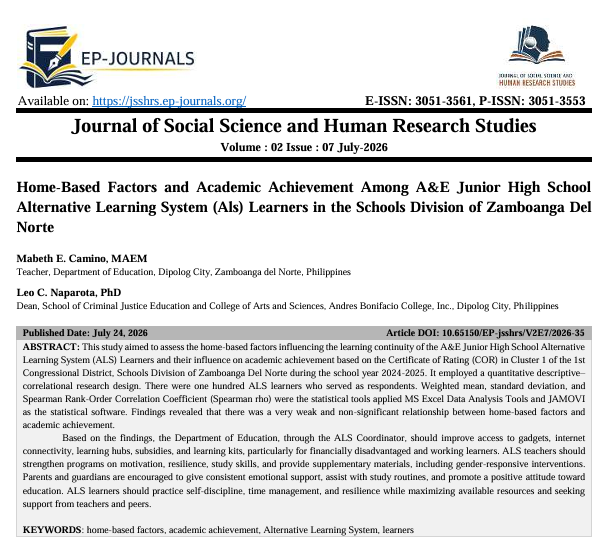
Home-Based Factors and Academic Achievement Among A&E Junior High School Alternative Learning System (Als) Learners in the Schools Division of Zamboanga Del Norte
DOI:
https://doi.org/10.65150/EP-jsshrs/V2E7/2026-35Keywords:
home-based factors, academic achievement, Alternative Learning System, learnersAbstract
This study aimed to assess the home-based factors influencing the learning continuity of the A&E Junior High School Alternative Learning System (ALS) Learners and their influence on academic achievement based on the Certificate of Rating (COR) in Cluster 1 of the 1st Congressional District, Schools Division of Zamboanga Del Norte during the school year 2024-2025. It employed a quantitative descriptive–correlational research design. There were one hundred ALS learners who served as respondents. Weighted mean, standard deviation, and Spearman Rank-Order Correlation Coefficient (Spearman rho) were the statistical tools applied MS Excel Data Analysis Tools and JAMOVI as the statistical software. Findings revealed that there was a very weak and non-significant relationship between home-based factors and academic achievement.
Based on the findings, the Department of Education, through the ALS Coordinator, should improve access to gadgets, internet connectivity, learning hubs, subsidies, and learning kits, particularly for financially disadvantaged and working learners. ALS teachers should strengthen programs on motivation, resilience, study skills, and provide supplementary materials, including gender-responsive interventions. Parents and guardians are encouraged to give consistent emotional support, assist with study routines, and promote a positive attitude toward education. ALS learners should practice self-discipline, time management, and resilience while maximizing available resources and seeking support from teachers and peers.
References
1) Aiken, L. S., & Susane, G. (2001). West multiple progression. Sage Publishing.
2) Bahian, J., & Dechos, R., Jr. (2025). Parental support: Its influence to the Indigenous learners’ academic performance. Psychology and Education: A Multidisciplinary Journal, 43(10), 1248–1273. https://doi.org/10.70838/pemj.431001
3) Bercasio, J. J. O. (2023). Home environment and achievement motivation and their effect on the academic performance of selected students of PSHS-BRC. BU R&D Journal, 26(1), 61–74. systems.bicol-u.edu.ph
4) Calo, W. P., & Salvaña, R. A. (2024). Academic motivation, resilience and achievement of junior high school learners in Alternative Learning System (ALS): A structural equation modeling analysis. International Journal of Research and Scientific Innovation, 11(7), 999–1010. https://doi.org/10.51244/IJRSI.2024.1107079
5) Catacutan, R. M. (2025). Home-related factors influencing the learning continuity and levels of learning continuity of Alternative Learning System (ALS) learners: Foundation for an enhanced learning continuity program. International Journal of Education Humanities and Social Science, 8(2), 337–359. https://doi.org/10.54922/IJEHSS.2025.0923
6) Cohen, J., Cohen, P., West, S. G., & Aiken, L. S. (2013). Applied multiple regression/correlation analysis for the behavioral sciences (3rd ed.). Routledge. https://doi.org/10.4324/9780203774441
7) Coronel, E. M. S., & Miasco, W. P., Jr. (2025). Social and economic barriers to the academic performance of Alternative Learning System learners. Psychology and Education: A Multidisciplinary Journal, 42(9), 1343–1351. https://doi.org/10.70838/pemj.420910
8) Creswell, J. W., & Guetterman, T. C. (2019). Educational research:Planning, conducting, and evaluating quantitative and qualitative research (6th ed.). Pearson.
9) Defacto, A. R. (2022). Assessing the academic performance of Alternative Learning System (ALS) students of Barotac Viejo, Iloilo: An implication to remedial teaching. International Journal of Research and Innovation in Social Science, 6(5), 37–41.
10) Department of Education. (2018, April 19). Change in the passing score of the 2016 Accreditation and Equivalency (A&E) Test from 75% to 60% (DepEd Memorandum No. 076, s. 2018).
11) Estabillo, B. P., & Linga, E. E. (2025). Implementation of Alternative Learning System (ALS) and students’ academic performance in the Division of Rizal. International Journal of Multidisciplinary Research in Arts, Science and Technology, 3(8), 55–100. https://doi.org/10.61778/ijmrast.v3i8.163
12) Fuentes, J., & Victoria, V. (2024). Correlation of home environment in the academic performance of elementary learners in Catanauan District, Division of Quezon. Home ⇛ Psychology and Education: A Multidisciplinary Journal, 20(7). Philippine EJournals
13) Guo, Q., Huang, Y., Wang, Y., & Yang, B. (2025). Family support more strongly associated with academic performance in collectivist and in economically less developed societies. Personality and Individual Differences, 240,113156. https://doi.org/10.1016/j.paid.2025.113156
14) Joshi, D. R., et al. (2025). The impact of digital resource utilization on student learning outcomes across different economic categories. [Journal]. ScienceDirect
15) Kaizirege, A., & Biswalo, U. P. (2023). Home environmental factors and their effects on students’ academic achievement in secondary schools in Dodoma City, Tanzania. Journal of Research, Innovation and Implications in Education, 7(4), 695–703. jriiejournal.com
Khan, F. N., & Begum, M. (2019). Relationship between students’ home environment and their academic achievement. Journal of Education and Practice, 10(14), 224–231.
16) Khan, F. N., Begum, M., & Imad, M. (2019). Relationship between students’ home environment and their academic achievement. Journal of Education and Practice, 10(14), 224–231. ERIC
17) Liquigan, M. L. B., & Ortiz, V. I. (2023). Effects of home environment on the academic performance of Grade 10 students at Sto. Niño National High School, Cagayan, Philippines. International Journal of Contemporary Issues in Social Sciences (IJCISS). ResearchGate+1
18) Mensah, R. O., & Frimpong (2024). Home factors affecting the academic performances of girl children: A case study of Dome cluster of schools. Early Childhood Education Journal, 1–??. Taylor & Francis Online
19) Refugio, C. N., Galleto, P. G., & Torres, R. C. (2019). Competence landscape of Grade 9 mathematics teachers: Basis for an enhancement program. Cypriot Journal of Educational Sciences, 14(2), 241–256.
20) Ren, W., Zhu, X., & Liang, Z. (2024). How does Internet access quality affect learning outcomes? A multiple mediation analysis among international students in China. Journal of International Students, 14(1), 449–468.
21) Republic Act No. 11510. (2020). An act institutionalizing the Alternative Learning System in basic education for out-of-school children in special cases and adults and appropriating funds therefor.
22) Villanueva, H. D., & Campos, C. V. (2022). Learners’ home-based learning activities and academic achievement in modular learning. EduLine: Journal of Education and Learning Innovation, 2(4), 447–455. https://doi.org/10.35877/454RI.eduline1339
23) Zhao, L., & Zhao, W. (2022). Impacts of family environment on adolescents’ academic achievement: The role of peer interaction quality and educational expectation gap. Frontiers in Psychology, 13, Article 911959. https://doi.org/10.3389/fpsyg.2022.911959
Downloads
Published
Issue
Section
License
Copyright (c) 2026 Mabeth E. Camino, MAEM, Leo C. Naparota, PhD (Author)

This work is licensed under a Creative Commons Attribution 4.0 International License.