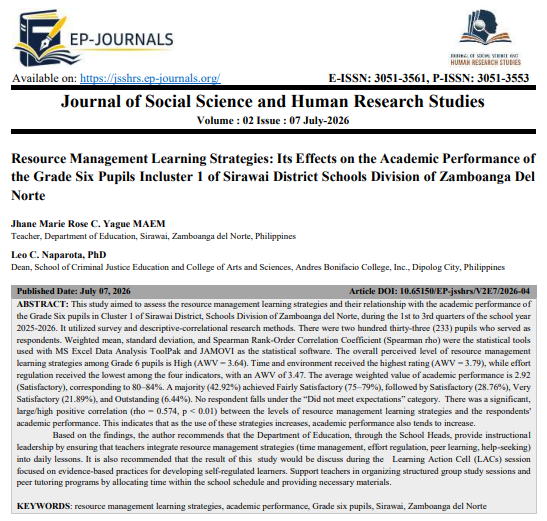
Resource Management Learning Strategies: Its Effects on the Academic Performance of the Grade Six Pupils Incluster 1 of Sirawai District Schools Division of Zamboanga Del Norte
DOI:
https://doi.org/10.65150/EP-jsshrs/V2E7/2026-04Keywords:
resource management learning strategies, academic performance, Grade six pupils, Sirawai, Zamboanga del NorteAbstract
This study aimed to assess the resource management learning strategies and their relationship with the academic performance of the Grade Six pupils in Cluster 1 of Sirawai District, Schools Division of Zamboanga del Norte, during the 1st to 3rd quarters of the school year 2025-2026. It utilized survey and descriptive-correlational research methods. There were two hundred thirty-three (233) pupils who served as respondents. Weighted mean, standard deviation, and Spearman Rank-Order Correlation Coefficient (Spearman rho) were the statistical tools used with MS Excel Data Analysis ToolPak and JAMOVI as the statistical software. The overall perceived level of resource management learning strategies among Grade 6 pupils is High (AWV = 3.64). Time and environment received the highest rating (AWV = 3.79), while effort regulation received the lowest among the four indicators, with an AWV of 3.47. The average weighted value of academic performance is 2.92 (Satisfactory), corresponding to 80–84%. A majority (42.92%) achieved Fairly Satisfactory (75–79%), followed by Satisfactory (28.76%), Very Satisfactory (21.89%), and Outstanding (6.44%). No respondent falls under the “Did not meet expectations” category. There was a significant, large/high positive correlation (rho = 0.574, p < 0.01) between the levels of resource management learning strategies and the respondents' academic performance. This indicates that as the use of these strategies increases, academic performance also tends to increase.
Based on the findings, the author recommends that the Department of Education, through the School Heads, provide instructional leadership by ensuring that teachers integrate resource management strategies (time management, effort regulation, peer learning, help-seeking) into daily lessons. It is also recommended that the result of this study would be discuss during the Learning Action Cell (LACs) session focused on evidence-based practices for developing self-regulated learners. Support teachers in organizing structured group study sessions and peer tutoring programs by allocating time within the school schedule and providing necessary materials.
References
1) Aguilar, M. C., Villanueva, J. R., & Delos Santos, L. P. (2026). Help-seeking behaviors and academic self-regulation among Filipino elementary learners. Philippine Journal of Educational Research, 35(2), 112–129.
2) Aiken, L. S., & Susane, G. (2001). West multiple progression. Sage Publishing, Inc.
3) Albert, J. R. G., Vizmanos, J. F. V., & Muñoz, M. S. (2026a). Maternal education and student proficiency in literacy and numeracy: Evidence from the Philippines. Philippine Institute for Development Studies.
4) Albert, J. R. G., Vizmanos, J. F. V., & Muñoz, M. S. (2026b). Parental education and children’s learning outcomes in the Philippines: A longitudinal analysis (Discussion Paper Series No. 2026-03). Philippine Institute for Development Studies.
5) Alecida, L., & Marcia, A. (2025). Metacognitive strategies and academic achievement in social studies among Grade 4 pupils. Psychology and Education: A Multidisciplinary Journal, 39(7).
6) Apostol, G. C. (2023). Self-regulated learning strategies, academic motivation, perception of technology, and mathematics performance of senior high school STEM students. International Journal of Advanced Research and Publications, 6(1), 1–4.
7) Cagatan, A. N. P., & Quirap, E. A. (2024). Collaborative learning and learners’ academic performance. International Journal of Multidisciplinary Research and Analysis, 7(3), 1326–1335. https://doi.org/10.47191/ijmra/v7-i03-57
8) Camangyan, E. T. M. (2023). Time management skills and academic performance of Grade 9 students. International Research Journal of Modernization in Engineering, Technology and Science, 5(10). https://doi.org/10.56726/IRJMETS45276
9) Castejón, J. L., Gilar-Corbi, R., Veas, A. M., & Miñano, P. (2021). Differences in learning strategies based on academic performance in secondary education. [Journal, volume, issue, and page numbers not provided in the manuscript].
10) Cohen, J., West, S. G., & Aiken, L. S. (2014). Applied multiple regression/correlation analysis for the behavioral sciences. Routledge.
11) Creswell, J. W., & Guetterman, T. C. (2019). Educational research: Planning, conducting, and evaluating quantitative and qualitative research (6th ed.). Pearson.
12) Dagoc, R. P., & Oco, R. M. (2024). Pupils’ study habits and academic performance. International Journal of Multidisciplinary Research and Analysis, 7(3), 1336–1342.
13) Dalisay, D. (2024). Effect of peer learning strategy on students’ academic performance in mathematics. Psychology and Education: A Multidisciplinary Journal, 18(9).
14) Dela Cruz, R. M., & Reyes, M. E. S. (2026). Grit, academic self-efficacy, and academic achievement among Filipino intermediate pupils in rural communities. Philippine Journal of Educational Psychology, 18(1), 45–62.
15) Department of Education. (2024a). MATATAG curriculum guide (DepEd Order No. 10, s. 2024).
16) Department of Education. (2024b). MATATAG curriculum: K to 12 curriculum guide for Grade 6. DepEd Complex.
17) Department of Education. (2024c). National Learning Recovery Program implementation guidelines (DepEd Order No. 12, s. 2024).
18) Dimal, R. J., & Salva, R. (2025). Study habits and academic performance: Basis for the optimization of guidance and counseling programs. Journal of Interdisciplinary Perspectives, 3(9), 234–241.
19) EDCOM II. (2025). Year two report: Addressing the learning crisis in Philippine basic education. Second Congressional Commission on Education.
20) EDCOM II. (2026, January 24). EDCOM 2 set to unveil its final report and a 10-year roadmap to address the learning crisis. Second Congressional Commission on Education. https://edcom2.gov.ph/edcom-2-set-to-unveil-its-final-report-and-a-10-year-roadmap-to-address-the-learning-crisis/
21) GMA News. (2025). SEA-PLM 2024: Filipino learners show modest gains in reading, math but gaps persist. GMA Integrated News.
22) Gonzales, J. P., & Santos, R. M. (2026). Collaborative learning strategies and academic engagement among intermediate pupils in the Zamboanga Peninsula. Philippine Journal of Education Research, 34(1), 78–94.
23) Hsu, C. Y. (2023). Supporting “time awareness” in self-regulated learning: How learners allocate time and evaluate time-use effectiveness. Smart Learning Environments, 10, Article 2.
24) Labrador, R. K. M., Lumaad, M. I. A., Amihan, S. M., Balaba, K. S., Diagoso, S. B. N., Fernandez, N. M., … Pelandas, A. M. O. (2024). The influence of study habits and attitudes on the academic performance of junior high school students. Psychology and Education: A Multidisciplinary Journal.
25) Layson, M. D., & Fernandez, R. A. (2025). Peer support networks and academic motivation in multigrade and monograde classrooms in rural Philippines. Asian Journal of Education and Social Studies, 51(8).
26) Lourenço, A. A., et al. (2024). The impact of self-regulated learning and academic time management on student performance in basic education. Education Sciences, 14(2), 16.
27) Madalo, W. C., Olig, H. M. D., & Franca, G. C. (2025). Study behavior of intermediate pupils. Asian Journal of Education and Social Studies, 51(6), 1293–1303.
28) Martinez, A. B., Co, M., Lau, J., & Brown, J. S. (2020). Filipino help-seeking for mental health problems and associated barriers and facilitators: A systematic review. Social Psychiatry and Psychiatric Epidemiology.
29) Naujoks, N., Renkl, A., Scheiter, K., Schubert, S., & Holzberger, D. (2021). Self-regulated resource management in emergency remote higher education: Status quo and predictors. Frontiers in Psychology.
30) Pantaleon, J. A. K., & Uy, L. L. (2022). Understanding help-seeking behaviour among Filipino university students. IAFOR Educational Research & Innovation Conference Proceedings.
31) Philippine Institute for Development Studies. (2026). Socio-emotional skills and learning outcomes in Philippine basic education (Policy Note No. 2026-05).
32) Piamonte, S. M., & Ventura-Escote, M. J. (2023). Factors affecting the academic performance of elementary pupils in the post-COVID-19 pandemic. Psychology and Education: A Multidisciplinary Journal.
33) Pintrich, P. R. (1991). A manual for the use of the Motivated Strategies for Learning Questionnaire (MSLQ).
34) Ramos, R. G. A., Caragay, J. A., & Apostol, G. C. (2023). Students’ self-regulated learning strategies, self-efficacy, and mathematics performance in a mobile technology-integrated classroom.
35) Refugio, C. N., Galleto, P. G., & Torres, R. (2019). Competence landscape of Grade 9 mathematics teachers: Basis for an enhancement program. Cypriot Journal of Educational Sciences, 14(2), 241–256. https://doi.org/10.18844/cjes.v14i2.4125
36) Segundo, R. C. (2025). Factors affecting the academic performance of Grade 6 learners in Buguias, Benguet, Philippines. Journal of Education, Learning, and Management, 2(2), 130–143. doi:10.69739/jelm.v2i2.910
37) Theobald, M. (2021). Self-regulated learning training programs enhance university students’ academic performance, self-regulated learning strategies, and motivation: A meta-analysis. Contemporary Educational Psychology, 66, 101976. https://doi.org/10.1016/j.cedpsych.2021.101976
38) Vaezi, M., Hatamzadeh, N., Zinat Motlagh, F., Rahimi, H., & Khalvandi, M. (2018). The relationship between resource management learning strategies and academic achievement. Journal of Health Reports and Technology, 4(1), e79607. https://doi.org/10.5812/ijhls.79607
39) Xu, Z., Zhao, Y., Zhang, B., Liew, J., & Kogut, A. (2023). A meta-analysis of the efficacy of self-regulated learning interventions on academic achievement in online and blended environments in K–12 and higher education. Behaviour & Information Technology, 42(16), 2911–2931. https://doi.org/10.1080/0144929X.2022.2151935
40) Zhao, Y., Xu, Z., Zhang, B., & Liew, J. (2025). A meta-analysis of the correlation between self-regulated learning strategies and academic performance in online and blended learning environments. Computers & Education, 212, 105279. https://doi.org/10.1016/j.compedu.2025.105279
Downloads
Published
Issue
Section
License
Copyright (c) 2026 Jhane Marie Rose C. Yague MAEM, LEO NAPAROTA (Author)

This work is licensed under a Creative Commons Attribution 4.0 International License.












