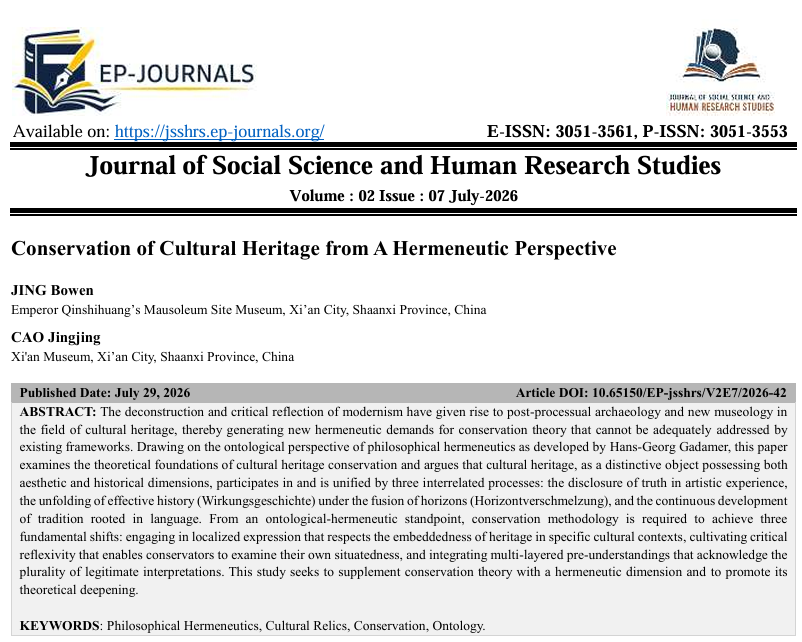
Conservation of Cultural Heritage from A Hermeneutic Perspective
DOI:
https://doi.org/10.65150/EP-jsshrs/V2E7/2026-42Keywords:
Philosophical Hermeneutics, Cultural Relics, Conservation, Ontology.Abstract
The deconstruction and critical reflection of modernism have given rise to post-processual archaeology and new museology in the field of cultural heritage, thereby generating new hermeneutic demands for conservation theory that cannot be adequately addressed by existing frameworks. Drawing on the ontological perspective of philosophical hermeneutics as developed by Hans-Georg Gadamer, this paper examines the theoretical foundations of cultural heritage conservation and argues that cultural heritage, as a distinctive object possessing both aesthetic and historical dimensions, participates in and is unified by three interrelated processes: the disclosure of truth in artistic experience, the unfolding of effective history (Wirkungsgeschichte) under the fusion of horizons (Horizontverschmelzung), and the continuous development of tradition rooted in language. From an ontological-hermeneutic standpoint, conservation methodology is required to achieve three fundamental shifts: engaging in localized expression that respects the embeddedness of heritage in specific cultural contexts, cultivating critical reflexivity that enables conservators to examine their own situatedness, and integrating multi-layered pre-understandings that acknowledge the plurality of legitimate interpretations. This study seeks to supplement conservation theory with a hermeneutic dimension and to promote its theoretical deepening.
References
1) Gadamer, H.-G. (1989). Truth and method (2nd ed., J. Weinsheimer & D. G. Marshall, Trans.). Crossroad. (Original work published 1960)
2) Zhang, S. (2007). The critique and transcendence of “postmodernism” over “modernity”. Peking University Journal (Philosophy and Social Sciences Edition), (1), 43–48.
3) Xu, H. (2008). History as text: On the hermeneutic perspective in Western postmodernist philosophy of history. Study and Exploration, (4), 221–225.
4) Chen, S. (2013). Understanding post-processual archaeology: The humanistic turn in archaeology. Southeast Culture, (5), 6–16, 127–128.
5) Zhen, S. (2001). What is new museology. Chinese Museum, (1), 25–28, 32.
6) Ruan, Y., & Lin, L. (2003). The principle of authenticity in cultural heritage conservation. Journal of Tongji University (Social Science Edition), (2), 1–5.
7) Gao, Q., & Jones, S. (2021). Authenticity and heritage conservation: Seeking common complexities beyond the “Eastern” and “Western” dichotomy. International Journal of Heritage Studies, 27(1), 90–106. https://doi.org/10.1080/13527258.2020.1769306
8) Guo, H. (2003). On the content and methods of scientific research in cultural relics conservation. Sciences of Conservation and Archaeology, (3), 61–64.
9) Winter, T. (2013). Clarifying the critical in critical heritage studies. International Journal of Heritage Studies, 19(6), 532–545.
https://doi.org/10.1080/13527258.2012.720997
10) Fu, Y. (2006). How is critical social knowledge possible? The Gadamer-Habermas hermeneutic debate and the reconstruction of critical theory foundations. Literature, History and Philosophy, (1), 136–144.
11) Piñeiro-Naval, V., & Frutos-Esteban, F. J. (2024). Theoretical perspectives: Sociology and the conservation of scientific heritage. Frontiers in Sociology, 9, Article 1473206. https://doi.org/10.3389/fsoc.2024.1473206
12) Hou, H., Lai, J. H. K., Wu, H., & Wang, T. (2024). Digital twin application in heritage facilities management: Systematic literature review and future development directions. Engineering, Construction and Architectural Management, 31(9), 3193–3221.
Downloads
Published
Issue
Section
License
Copyright (c) 2026 JING Bowen , CAO Jingjing (Author)

This work is licensed under a Creative Commons Attribution 4.0 International License.