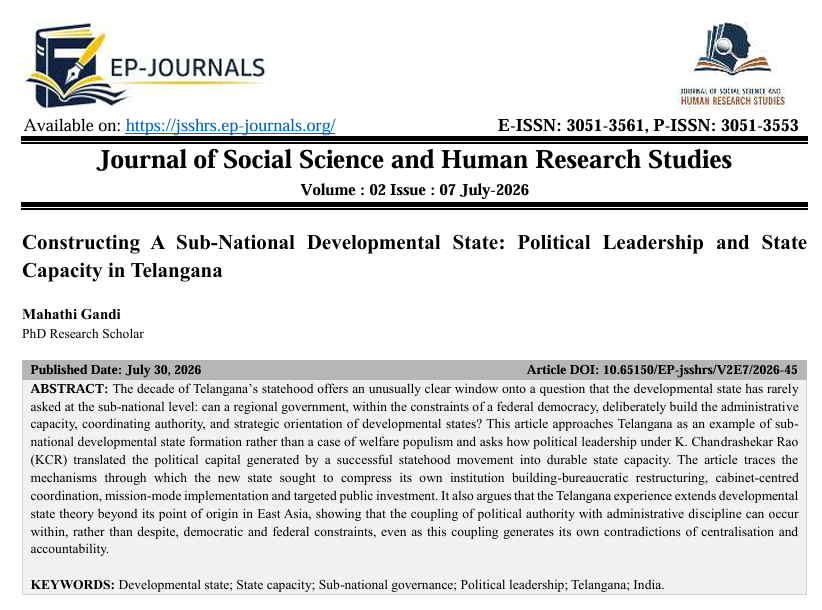
Constructing A Sub-National Developmental State: Political Leadership and State Capacity in Telangana
DOI:
https://doi.org/10.65150/EP-jsshrs/V2E7/2026-45Keywords:
Developmental state, State capacity, Sub-national governance, Political leadership, elangana; India.Abstract
The decade of Telangana’s statehood offers an unusually clear window onto a question that the developmental state has rarely asked at the sub-national level: can a regional government, within the constraints of a federal democracy, deliberately build the administrative capacity, coordinating authority, and strategic orientation of developmental states? This article approaches Telangana as an example of sub-national developmental state formation rather than a case of welfare populism and asks how political leadership under K. Chandrashekar Rao (KCR) translated the political capital generated by a successful statehood movement into durable state capacity. The article traces the mechanisms through which the new state sought to compress its own institution building-bureaucratic restructuring, cabinet-centred coordination, mission-mode implementation and targeted public investment. It also argues that the Telangana experience extends developmental state theory beyond its point of origin in East Asia, showing that the coupling of political authority with administrative discipline can occur within, rather than despite, democratic and federal constraints, even as this coupling generates its own contradictions of centralisation and accountability.
References
1) Aiyar, S., Piriou-Sall, S., McLean, K., & Williams. (1996). The political economy of democratic decentralization.
2) B N, S. (2010). Committee for Consultations on the Situation in Andhra Pradesh.
3) Bonagani, R. R. (2018). Assemblies elections of 2014: A comparative analysis of Andhra Pradesh and Telangana States in India. Research Journal of Humanities and Social Sciences, 9(2), 461-468.
4) CCSAP-REPORT. (2010, December). COMMITTEE FOR CONSULTATIONS ON THE SITUATION IN ANDHRA PRADESH. Retrieved from Ministry of Home Affairs: https://www.mha.gov.in/sites/default/files/2022-08/CCSAP-REPORT-060111%5B1%5D.pdf
5) Cingolani, L. (2013). The State of State Capacity: a review of concepts, evidence and measures.
6) Dhawan, M. A. (2025). Recent Trends of Party Politics of India: With special reference to the state elections 2023.
7) Doner, R., Ritchie, B., & Slater, D. (2005). Systemic vulnerability and the origins of developmental states: Northeast and Southeast Asia in comparative perspective. International organization, 59(2), 327-361.
8) DoPT. (2014). THE ANDHRA PRADESH REORGANISATION ACT, 2014. Retrieved from DoPT,
GOI: https://dopt.gov.in/sites/default/files/APRegACT2014_0.pdf
9) Election Commission of India. (2023). Telangana Legislative Election 2023- Statistical Report. Retrieved from
ECI: https://www.eci.gov.in/telangana-legislative-election-2023-statistical-report
10) Evans, P. (2012). Embedded autonomy: States and industrial transformation. Princeton University Press.
11) Fasi, M. (2019). Mission Kakatiya—Concept and social impact in Telangana state. International Journal of Business Ethics in Developing Economies, 8(1), 13.
12) Fukuyama, F. (2013). What is governance? Governance, 26(3), 347-368.
13) GOT. (2015). Socio Economic Outlook. Retrieved from Telangana State
Portal: https://telangana.gov.in/wp-content/uploads/2023/05/Socio-Economic-outlook-2015.pdf
14) Government of Telangana. (2014). TSipass. Retrieved from Approval and Clearances:
https://startup.telangana.gov.in/approval-and-clearances/
15) Government of Telangana. (2016, October). G.O.Ms.No.221, Revenue (DA-CMRF) Department. Retrieved from Government of Telangana: https://tggazette.cgg.gov.in/viewDocument/1674642198065
16) Government of Telangana. (2021). Finance Department. Retrieved from Government of Telangana:
https://finance.telangana.gov.in/budget-volumes.jsp
17) Hall, P. A., & Taylor, R. C. (1996). Political science and the three new institutionalisms. Political studies, 44(5), 936-957.
18) Hill, M., & Hupe, P. (2002). Implementing public policy: Governance in theory and in practice. Sage.
19) IRC Wash. (2014, March). Performance Audit of Total Sanitation Campaign/Nirmal Bharat Abhiyan. Retrieved from Ministry of Drinking Water and Sanitation: https://www.ircwash.org/sites/default/files/cag_audit_india_total_sanitation_campaign.pdf
20) Johnson, C. (1982). MITI and the Japanese miracle: the growth of industrial policy, 1925-1975. Stanford university press.
21) Katherasala, S., & Bheenaveni, R. S. (2024). Reevaluating the Rythu Bandhu Scheme: Toward Sustainable and Inclusive Agriculture in Telangana: A Review. Bhartiya Krishi Anusandhan Patrika, issue Of.
22) Kennedy, L. (2013). The politics of economic restructuring in India: Economic governance and state spatial rescaling. Routledge.
23) Khare, R., & Verma, A. (2022). States Reorganization and Its Impact on Federalism: An Indian Perspective. Issue 1 Indian JL & Legal Rsch, 4, 1.
24) Kohli, A. (2004). State-directed development: political power and industrialization in the global periphery. Cambridge university press.
25) Latha, K. N., Chary, D. S., Supriya, K., & Sreekanth. (2023). Impact of Mission Kakatiya on Area under Tank Irrigation in Southern Telangana Zone, India. International Journal of Environment and Climate Change, 13(11), 742-748.
26) Leftwich, A. (2000). States of development: On the primacy of politics in development. (No Title).
27) Mahoney, J. (2000). Path dependence in historical sociology. Theory and society, 29(4), 507-548.
28) Mann, M. (1984). The autonomous power of the state: its origins, mechanisms and results. European Journal of Sociology/Archives européennes de sociologie, 25(2), 185-213.
29) Mathew, G. (2000). Panchayati Raj in India: an overview. Status of Panchayati raj in the States and Union Territories of India, 3-22.
30) MCRHRDI. (2019, Nov 4). GOVERNMENT OF TELANGANA. Retrieved from MISSION BHAGIRATHA DEPARTMENT: https://www.mcrhrdi.gov.in/94fc/week11/Mission%20Bhagiratha%20%204-11-19.pdf
31) Melkote, R., Revathi, E., Lalita, K., & Sajaya, K. (2010). The movement for Telangana: Myth and reality. Economic and Political Weekly, 8-11.
32) Migdal, J. S. (1988). Strong societies and weak states: state-society relations and state capabilities in the Third World. Princeton university press.
33) Mounika , A., Nirmala, B., & Santosha, R. (2022). Farmer’s Investment Support Scheme (Rythu Bandhu) of Telangana: An Overview. Food & Scientific Reports.
34) NABARD. (2020, 08 07). GOVERNMENT OF TELANGANA. Retrieved from MISSION BHAGIRATHA DEPARTMENT: https://nirdpr.org.in/unicef/presentations/day2/4.%20Urban%20Water%20Programming-Mission%20Bhagiratha-%20Mr.%20Ravindra%20reddy.pdf
35) North, D. C. (1990). Institutions, institutional change and economic performance. Cambridge Univ Pr.
36) Pierson, P. (2000). Not just what, but when: Timing and sequence in political processes. Studies in american political development, 14(1), 72-92.
37) PMKSY. (n.d.). Report on Best Practices being followed in Water Resources/Irrigation –Mission Kakatiya, Telangana. Retrieved from PMKSY: https://pmksy.mowr.gov.in/aibp-mis/Manual/Mission%20Kakatiya,%20Telangana.pdf
38) PRS, I. (2014). Retrieved from prsindia: https://prsindia.org/billtrack/the-andhra-pradesh-reorganisation-bill-2014-telangana
39) Putty, S., & Balachandran, V. (2017). The telangana industrial policy-A single window without grills. International Journal of Advanced Research in Management and Social Sciences, 6(3), 137-146.
40) Raju, C. (2019). Understanding Development of Two States; a Study of the Bifurcation of Andhra Pradesh. GNLU JL Dev. & Pol, 9, 126.
41) Rao, G. (2013). Hyderabad and the bifurcation of Andhra Pradesh. Economic and Political Weekly, 39-43.
42) Rao, M. G., & Singh, N. (2006). The political economy of federalism in India. Oxford University Press.
43) Rate, T. (2010). Regional disparities, smaller states and statehood for Telangana.
44) RBI. (2022). State Finances : A Study of Budgets. Retrieved from Reserve Bank of India:
https://rbi.org.in/Scripts/AnnualPublications.aspx?head=State+Finances+%3a+A+Study+of+Budgets
45) Reddy, A. G. (2020). Water Resources and Their Socio-Economic Impact on Andhra Pradesh and Telangana States. Current Politics and Economics of South, Southeastern, and Central Asia, 29(4), 327-364.
46) Rodden, J. (2004). Comparative federalism and decentralization: On meaning and measurement. Comparative politics, 481-500.
47) Rondinelli, D. A. (1981). Government decentralization in comparative perspective: theory and practice in developing countries. International review of administrative sciences, 47(2), 133-145.
48) Seshan, K. (2018). Telangana: History and the formation of a new state. Studies in People’s History, 5(1), 72-82.
49) Shah, M., & Verma, S. (2017). Reviving minor irrigation in Telangana: midterm assessment of Mission Kakatiya.
50) Sharma, P. (2025). Federal Unity v. State Creation: National Integrity & Constitutional Authority in India. LawFoyer Int'l J. Doctrinal Legal Rsch, 3, 34.
51) Skocpol, T. (2014). Bringing the state back in. In Policy process. Routledge, (pp. 126-138).
52) Socio Economic Outlook. (2022). elangana Socio Economic Outlook. Retrieved from Government of Telangana:
https://ecostat.telangana.gov.in/PDF/PUBLICATIONS/Socio_Economic_2022.pdf
53) Sreenivas, T. (2018). The Politics of Separate Telangana Statehood and the Role of Telangana Rashtra Samithi Party. Research Journal of
Social Sciences, 9(5), 60-72.
54) The Hindu. (2020, February 18). CM lays down guidelines for ‘Pattana Pragathi’. Retrieved from The Hindu:
55) Thelen, K. (1999). Historical institutionalism in comparative politics. Annual review of political science, 2(1), 369-404.
56) Thomas, S., Uday, D., & Zaveri, B. (2020). Linking welfare distribution to land records: a case-study of the Rythu Bandhu Scheme (RBS) in Telangana. Indira Gandhi Institute of Development Research, nd.
57) Tillin, L. (2013). Remapping India: New states and their political origins. Hurst Publishers.
58) TS-iPASS , A. (2014). Indiacode. Retrieved from https://www.indiacode.nic.in/bitstream/123456789/8562/1/act_3_of_2014.pdf
59) Vaageeshan, H., & Chitrapu, R. (2021). Springing a surprise: Electoral politics in the state of Telangana. In I. E. India. Routledge India.
60) Vaddiraju, A. K. (2017). Politics in the state of Telangana: Identity, representation and democracy. Institute for Social and Economic Change.
61) Woo-Cumings, M. (2019). The developmental state. Cornell University Press.
Downloads
Published
Issue
Section
License
Copyright (c) 2026 Mahathi Gandi (Author)

This work is licensed under a Creative Commons Attribution 4.0 International License.