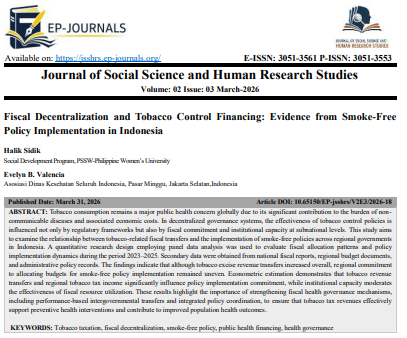
Fiscal Decentralization and Tobacco Control Financing: Evidence from Smoke-Free Policy Implementation in Indonesia
DOI:
https://doi.org/10.65150/EP-jsshrs/V2E3/2026-18Keywords:
tobacco taxation, fiscal decentralization, smoke-free policy, public health financing, health governanceAbstract
Tobacco consumption remains a major public health concern globally due to its significant contribution to the burden of non-communicable diseases and associated economic costs. In decentralized governance systems, the effectiveness of tobacco control policies is influenced not only by regulatory frameworks but also by fiscal commitment and institutional capacity at subnational levels. This study aims to examine the relationship between tobacco-related fiscal transfers and the implementation of smoke-free policies across regional governments in Indonesia. A quantitative research design employing panel data analysis was used to evaluate fiscal allocation patterns and policy implementation dynamics during the period 2023–2025. Secondary data were obtained from national fiscal reports, regional budget documents, and administrative policy records. The findings indicate that although tobacco excise revenue transfers increased overall, regional commitment to allocating budgets for smoke-free policy implementation remained uneven. Econometric estimation demonstrates that tobacco revenue transfers and regional tobacco tax income significantly influence policy implementation commitment, while institutional capacity moderates the effectiveness of fiscal resource utilization. These results highlight the importance of strengthening fiscal health governance mechanisms, including performance-based intergovernmental transfers and integrated policy coordination, to ensure that tobacco tax revenues effectively support preventive health interventions and contribute to improved population health outcomes.
References
1) Arze del Granado, F., Gupta, S., & Hajdenberg, A. (2018). Is fiscal policy the answer to rising health expenditures? Health Economics, 27(2), 287–301. https://doi.org/10.1002/hec.3569
2) Blecher, E. (2015). Taxes on tobacco, alcohol and sugar-sweetened beverages: Linkages and evidence. Health Economics, 24(S1), 22–28. https://doi.org/10.1002/hec.3156
3) Bloom, D. E., Cafiero, E., Jané-Llopis, E., Abrahams-Gessel, S., Bloom, L. R., Fathima, S., Feigl, A., Gaziano, T., Mowafi, M., Pandya, A., Prettner, K., Rosenberg, L., Seligman, B., & Weinstein, C. (2011). The global economic burden of noncommunicable diseases. World Economic Forum.
4) Bossert, T. J., & Mitchell, A. D. (2011). Health sector decentralization and local decision-making. Social Science & Medicine, 72(1), 39–48. https://doi.org/10.1016/j.socscimed.2010.10.032
5) Chaloupka, F. J., Yurekli, A., & Fong, G. T. (2012). Tobacco taxes as a tobacco control strategy. Tobacco Control, 21(2), 172–180. https://doi.org/10.1136/tobaccocontrol-2011-050417
6) Chaloupka, F. J., Powell, L. M., & Warner, K. E. (2019). The use of excise taxes to reduce tobacco consumption. Annual Review of Public Health, 40, 187–201. https://doi.org/10.1146/annurev-publhealth-040218-043816
7) Dieleman, J. L., Sadat, N., Chang, A. Y., Fullman, N., Abbafati, C., Acharya, P., & Murray, C. J. L. (2016). Trends in future health financing. The Lancet, 387(10037), 2521–2535. https://doi.org/10.1016/S0140-6736(16)30167-2
8) Fan, V. Y., Savedoff, W., & Glassman, A. (2019). Aligning health financing with health system objectives. The Lancet, 393(10175), 133–134. https://doi.org/10.1016/S0140-6736(18)32814-6
9) Faguet, J. P. (2014). Decentralization and governance. World Development, 53, 2–13. https://doi.org/10.1016/j.worlddev.2013.01.002
10) Fichtenberg, C. M., & Glantz, S. A. (2002). Effect of smoke-free workplaces on smoking behaviour. BMJ, 325(7357), 188. https://doi.org/10.1136/bmj.325.7357.188
11) Frazer, K., Callinan, J. E., McHugh, J., Van Baarsel, S., Clarke, A., Doherty, K., & Kelleher, C. (2016). Legislative smoking bans for reducing harms from second-hand smoke exposure. Cochrane Database of Systematic Reviews.
https://doi.org/10.1002/14651858.CD005992.pub3
12) GBD Tobacco Collaborators. (2020). Spatial, temporal, and demographic patterns in prevalence of smoking. The Lancet Public Health, 5(7), e398–e410. https://doi.org/10.1016/S2468-2667(20)30102-2
13) Goodchild, M., Nargis, N., & Tursan d’Espaignet, E. (2018). Global economic cost of smoking-attributable diseases. Tobacco Control, 27(1), 58–64. https://doi.org/10.1136/tobaccocontrol-2016-053305
14) Gravely, S., Giovino, G., Craig, L., Commar, A., D’Espaignet, E., Schotte, K., & Fong, G. (2017). Implementation of key demand-reduction measures. The Lancet Public Health, 2(4), e166–e174. https://doi.org/10.1016/S2468-2667(17)30032-2
15) Gruber, J., & Kőszegi, B. (2008). A modern economic view of tobacco taxation. Journal of Public Economics, 92(10–11), 1959–1987. https://doi.org/10.1016/j.jpubeco.2008.05.001
16) Hill, M., & Hupe, P. (2002). Implementing public policy. Sage Publications.
17) Hyland, A., Barnoya, J., & Corral, J. (2009). Smoke-free air policies. Tobacco Control, 18(Suppl 1), i25–i31.
https://doi.org/10.1136/tc.2008.026914
18) Islami, F., Torre, L. A., & Jemal, A. (2015). Global lung cancer trends. Cancer Epidemiology Biomarkers & Prevention, 24(1), 10–20.
https://doi.org/10.1158/1055-9965.EPI-14-1115
19) Jha, P., MacLennan, M., Chaloupka, F. J., et al. (2013). Global hazards of tobacco. New England Journal of Medicine, 368(4), 341–350.
https://doi.org/10.1056/NEJMra1201377
20) Levy, D. T., Yuan, Z., Luo, Y., & Abrams, D. B. (2018). The role of public policies. The Lancet Public Health, 3(2), e92–e101. https://doi.org/10.1016/S2468-2667(18)30001-X
21) Martinez-Vazquez, J., & McNab, R. (2003). Fiscal decentralization and economic growth. World Development, 31(9), 1597–1616. https://doi.org/10.1016/S0305-750X(03)00109-8
22) Musgrave, R. A. (1959). The theory of public finance. McGraw-Hill.
23) Nazar, G. P., Lee, J. T., Arora, M., & Millett, C. (2014). Effectiveness of smoke-free policies. Public Health, 128(6), 505–512.
https://doi.org/10.1016/j.puhe.2014.03.013
24) Oates, W. E. (1972). Fiscal federalism. Harcourt Brace.
25) Oates, W. E. (1999). An essay on fiscal federalism. Journal of Economic Literature, 37(3), 1120–1149.
https://doi.org/10.1257/jel.37.3.1120
26) Pressman, J., & Wildavsky, A. (1973). Implementation. University of California Press.
27) Prud’homme, R. (1995). The dangers of decentralization. World Bank Research Observer, 10(2), 201–220.
https://doi.org/10.1093/wbro/10.2.201
28) Reitsma, M. B., Flor, L. S., Mullany, E. C., et al. (2021). Smoking prevalence patterns. The Lancet, 397(10292), 2337–2360.
https://doi.org/10.1016/S0140-6736(21)01169-7
29) Rodden, J. (2004). Comparative federalism and decentralization. World Politics, 56(4), 481–507. https://doi.org/10.1353/wp.2004.0012
30) Sabatier, P., & Mazmanian, D. (1980). The implementation of public policy. Policy Studies Journal, 8(4), 538–560.
https://doi.org/10.1111/j.1541-0072.1980.tb01266.x
31) Sassi, F., Belloni, A., & Capobianco, C. (2013). Fiscal policies and health promotion. OECD Health Working Papers. https://doi.org/10.1787/5k3twr94kvzx-en
32) Smoke, P., Gómez, E., & Peterson, G. (2013). Decentralization in developing countries. Public Administration and Development, 33(1),
1–13. https://doi.org/10.1002/pad.1647
33) Tan, C. E., & Glantz, S. A. (2012). Smoke-free legislation and hospitalizations. American Journal of Public Health, 102(5), e73–e80. https://doi.org/10.2105/AJPH.2011.300541
34) Treisman, D. (2007). The architecture of government. Cambridge University Press.
35) World Bank. (2017). Tobacco tax reform at the crossroads of health and development. World Bank.
36) WHO. (2021). WHO report on the global tobacco epidemic. World Health Organization.
Downloads
Published
Issue
Section
License
Copyright (c) 2026 Halik Sidik, Evelyn B. Valencia (Author)

This work is licensed under a Creative Commons Attribution 4.0 International License.