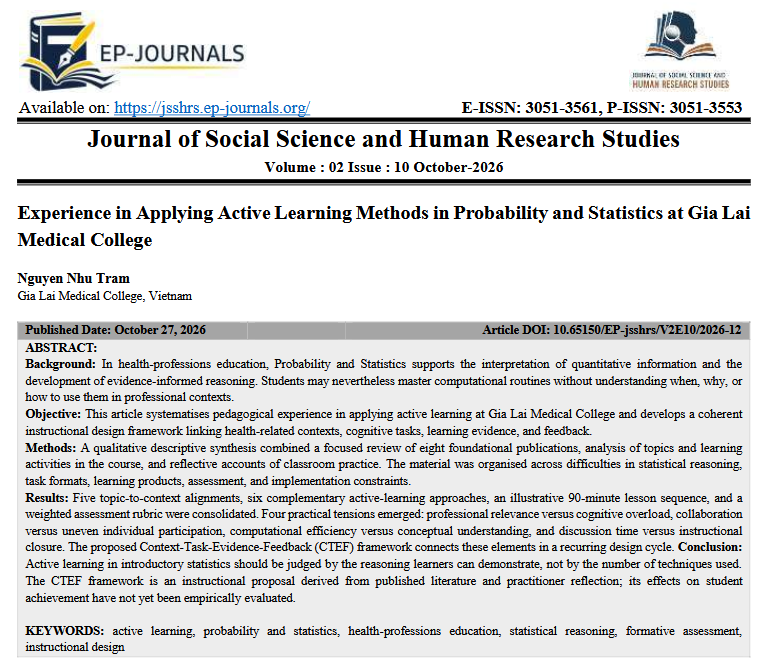
Experience in Applying Active Learning Methods in Probability and Statistics at Gia Lai Medical College
DOI:
https://doi.org/10.65150/EP-jsshrs/V2E10/2026-12Keywords:
active learning, probability and statistics, health-professions education, statistical reasoning, formative assessment, instructional designAbstract
Background: In health-professions education, Probability and Statistics supports the interpretation of quantitative information and the development of evidence-informed reasoning. Students may nevertheless master computational routines without understanding when, why, or how to use them in professional contexts.
Objective: This article systematises pedagogical experience in applying active learning at Gia Lai Medical College and develops a coherent instructional design framework linking health-related contexts, cognitive tasks, learning evidence, and feedback.
Methods: A qualitative descriptive synthesis combined a focused review of eight foundational publications, analysis of topics and learning activities in the course, and reflective accounts of classroom practice. The material was organised across difficulties in statistical reasoning, task formats, learning products, assessment, and implementation constraints.
Results: Five topic-to-context alignments, six complementary active-learning approaches, an illustrative 90-minute lesson sequence, and a weighted assessment rubric were consolidated. Four practical tensions emerged: professional relevance versus cognitive overload, collaboration versus uneven individual participation, computational efficiency versus conceptual understanding, and discussion time versus instructional closure. The proposed Context-Task-Evidence-Feedback (CTEF) framework connects these elements in a recurring design cycle. Conclusion: Active learning in introductory statistics should be judged by the reasoning learners can demonstrate, not by the number of techniques used. The CTEF framework is an instructional proposal derived from published literature and practitioner reflection; its effects on student achievement have not yet been empirically evaluated.
References
1) American Statistical Association. (2016). Guidelines for assessment and instruction in statistics education: College report 2016. American Statistical Association.
2) Biggs, J., & Tang, C. (2011). Teaching for quality learning at university (4th ed.). Open University Press.
3) Bonwell, C. C., & Eison, J. A. (1991). Active learning: Creating excitement in the classroom. The George Washington University.
4) Deslauriers, L., McCarty, L. S., Miller, K., Callaghan, K., & Kestin, G. (2019). Measuring actual learning versus feeling of learning in response to being actively engaged in the classroom. Proceedings of the National Academy of Sciences, 116(39), 19251-19257. https://doi.org/10.1073/pnas.1821936116
5) Freeman, S., Eddy, S. L., McDonough, M., Smith, M. K., Okoroafor, N., Jordt, H., & Wenderoth, M. P. (2014). Active learning increases student performance in science, engineering, and mathematics. Proceedings of the National Academy of Sciences, 111(23), 8410-8415. https://doi.org/10.1073/pnas.1319030111
6) Garfield, J. B., & Ben-Zvi, D. (2008). Developing students' statistical reasoning: Connecting research and teaching practice. Springer.
7) Prince, M. (2004). Does active learning work? A review of the research. Journal of Engineering Education, 93(3), 223-231. https://doi.org/10.1002/j.2168-9830.2004.tb00809.x
8) Theobald, E. J., Hill, M. J., Tran, E., Agrawal, S., Arroyo, E. N., Behling, S., Chambwe, N., Cintrón, D. L., Cooper, J. D., Dunster, G., Grummer, J. A., Hennessey, K., Hsiao, J., Iranon, N., Jones, L., Jordt, H., Keller, M., Lacey, M. E., Littlefield, C. E., ... Freeman, S. (2020). Active learning narrows achievement gaps for underrepresented students in undergraduate science, technology, engineering, and math. Proceedings of the National Academy of Sciences, 117(12), 6476-6483. https://doi.org/10.1073/pnas.1916903117
9) Tran, D. L. (2024a). Improving the teaching quality of sewing and cutting techniques for students of fashion design at Thanh Hoa University of Culture, Sports and Tourism [In Vietnamese]. Journal of Science, Thanh Hoa University of Culture, Sports and Tourism, (19), 117–126. https://doi.org/10.55988/2588-1264/186
10) Tran, D. L. (2024b). Student entrepreneurship at Thanh Hoa University of Culture, Sports and Tourism: Current status, international experience, and proposed solutions for promotion [In Vietnamese]. Vietnam Journal of Education, 24(Special Issue 13), 349–353. https://tcgd.tapchigiaoduc.edu.vn/index.php/tapchi/article/view/3475
Downloads
Published
Issue
Section
License
Copyright (c) 2026 Nguyen Nhu Tram (Author)

This work is licensed under a Creative Commons Attribution 4.0 International License.