The Double-Edged Sword of Digital Transformation in Cultural Scenic Areas: Heterogeneous Moderation of Qilu Cultural Genes on Technology-Value Conversion Paths
DOI:
https://doi.org/10.65150/EP-jsshrs/V2E10/2026-15Keywords:
Qilu cultural genes, cultural scenic areas, digital transformation, value co-creation, moderating effect.Abstract
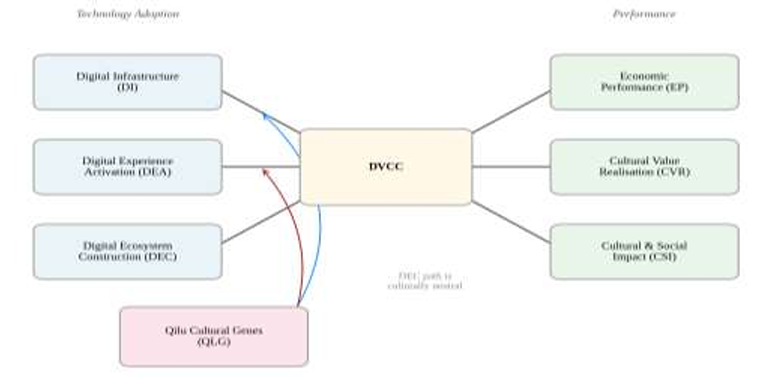
How can cultural attractions that invest similarly in digital technologies arrive at such different outcomes? We address this question by turning to regional culture. Grounded in dynamic capabilities theory and service-dominant logic, this study investigates how Qilu cultural genes, a regional cultural tradition rooted in Shandong Province, conditions the conversion of digital initiatives into value. Hypotheses were tested with PLS-SEM on visitor-level survey data from 566 visitors across ten cultural attractions in Shandong, China, with supply-side assessments from 28 managers aggregated to the scenic-area level. The results show that Qilu cultural heritage neither simply promotes nor obstructs digital transformation. Rather, it works like a selective lens, strengthening technological pathways that carry cultural meaning and weakening those that lack it. Among the three conversion paths examined, experience-activated digitalisation contributes most to visitors' digital value co-creation capability, and the slope of this path increases by 48.2% when visitors score one standard deviation above the mean on Qilu cultural gene strength. Infrastructure-focused digitalisation, the second most effective path on average, sees its conversion efficiency drop by 38.1% at the same high level of gene strength. By comparison, the ecosystem-based path shows no such cultural dependence. Taken together, these findings reveal that a single cultural tradition can simultaneously enable and constrain digital transformation. For managers, the implication is clear. Digital investment should be tailored to visitors' cultural profiles rather than spread uniformly across all initiatives.
References
1) Aiken, L.S. and West, S.G. (1991) Multiple Regression: Testing and Interpreting Interactions. Newbury Park, CA: Sage.
2) Autio, E., Nambisan, S., Thomas, L.D. and Wright, M. (2018) Digital affordances, spatial affordances, and the genesis of entrepreneurial ecosystems. Strategic Entrepreneurship Journal, 12(1), pp.72-95.
3) Buhalis, D. and Amaranggana, A. (2015) Smart tourism destinations enhancing tourism experience through personalisation of services, in Information and Communication Technologies in Tourism 2015, Cham: Springer, pp.377-389.
4) Cohen, J. (1992) A power primer. Psychological Bulletin, 112(1), pp.155-159.
5) Eisenhardt, K.M. and Martin, J.A. (2000) Dynamic capabilities: what are they? Strategic Management Journal, 21(10-11), pp.1105-1121.
6) Gretzel, U., Sigala, M., Xiang, Z. and Koo, C. (2015) Smart tourism: foundations and developments. Electronic Markets, 25(3), pp.179-188.
7) Hair, J.F., Risher, J.J., Sarstedt, M. and Ringle, C.M. (2019) When to use and how to report the results of PLS-SEM. European Business Review, 31(1), pp.2-24.
8) Henseler, J., Ringle, C.M. and Sarstedt, M. (2015) A new criterion for assessing discriminant validity in variance-based structural equation modeling. Journal of the Academy of Marketing Science, 43(1), pp.115-135.
9) Hofstede, G. (1980) Culture's Consequences: International Differences in Work-Related Values. Beverly Hills, CA: Sage.
10) Jung, T.H. and tom Dieck, M.C. (2017) Augmented reality, virtual reality and 3D printing for the co-creation of value for the visitor experience at cultural heritage places. Journal of Place Management and Development, 10(2), pp.140-151.
11) Kock, N. (2015) Common method bias in PLS-SEM: a full collinearity assessment approach. International Journal of e-Collaboration, 11(4), pp.1-10.
12) Lindell, M.K. and Whitney, D.J. (2001) Accounting for common method variance in cross-sectional research designs. Journal of Applied Psychology, 86(1), pp.114-121.
13) Orlikowski, W.J. (1992) The duality of technology: rethinking the concept of technology in organizations. Organization Science, 3(3), pp.398-427.
14) Podsakoff, P.M., MacKenzie, S.B., Lee, J.Y. and Podsakoff, N.P. (2003) Common method biases in behavioral research: a critical review of the literature and recommended remedies. Journal of Applied Psychology, 88(5), pp.879-903.
15) Prahalad, C.K. and Ramaswamy, V. (2004) Co-creation experiences: the next practice in value creation. Journal of Interactive Marketing, 18(3), pp.5-14.
16) Teece, D.J. (2007) Explicating dynamic capabilities: the nature and microfoundations of (sustainable) enterprise performance. Strategic Management Journal, 28(13), pp.1319-1350.
17) Teece, D.J., Pisano, G. and Shuen, A. (1997) Dynamic capabilities and strategic management. Strategic Management Journal, 18(7), pp.509-533.
18) Vargo, S.L. and Lusch, R.F. (2004) Evolving to a new dominant logic for marketing. Journal of Marketing, 68(1), pp.1-17.
19) Vargo, S.L. and Lusch, R.F. (2008) Service-dominant logic: continuing the evolution. Journal of the Academy of Marketing Science, 36(1), pp.1-10.
Downloads
Published
Issue
Section
License
Copyright (c) 2026 Xu Lulu, Tara Ahmed Mohammed (Author)

This work is licensed under a Creative Commons Attribution 4.0 International License.