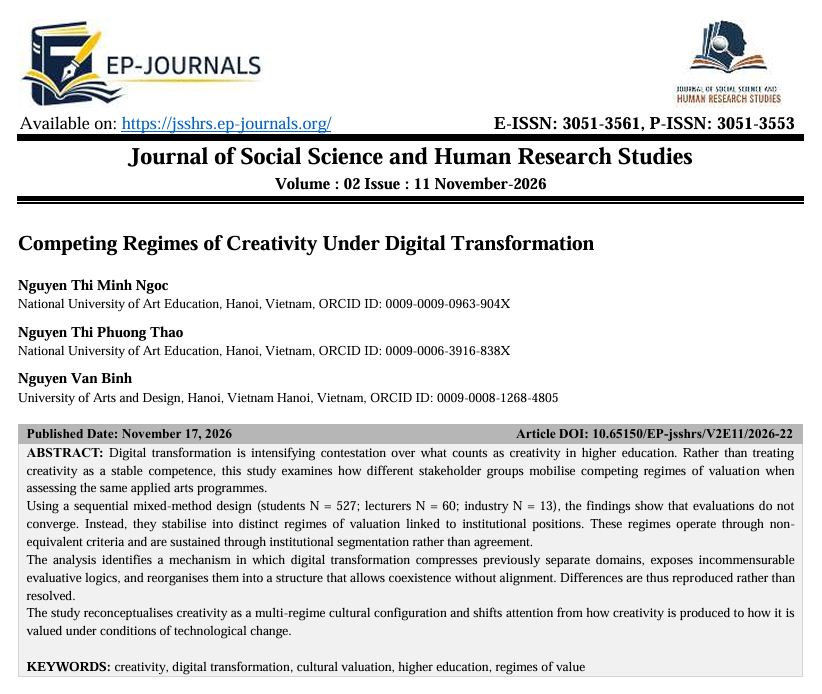
Competing Regimes of Creativity Under Digital Transformation
DOI:
https://doi.org/10.65150/EP-jsshrs/V2E11/2026-22Keywords:
creativity, digital transformation, cultural valuation, higher education, regimes of valueAbstract
Digital transformation is intensifying contestation over what counts as creativity in higher education. Rather than treating creativity as a stable competence, this study examines how different stakeholder groups mobilise competing regimes of valuation when assessing the same applied arts programmes.
Using a sequential mixed-method design (students N = 527; lecturers N = 60; industry N = 13), the findings show that evaluations do not converge. Instead, they stabilise into distinct regimes of valuation linked to institutional positions. These regimes operate through non-equivalent criteria and are sustained through institutional segmentation rather than agreement.
The analysis identifies a mechanism in which digital transformation compresses previously separate domains, exposes incommensurable evaluative logics, and reorganises them into a structure that allows coexistence without alignment. Differences are thus reproduced rather than resolved.
The study reconceptualises creativity as a multi-regime cultural configuration and shifts attention from how creativity is produced to how it is valued under conditions of technological change.
References
1) Banks, Mark, and David Hesmondhalgh. 2009. "Looking for Work in Creative Industries Policy." International Journal of Cultural Policy 15 (4): 415–430. https://doi.org/10.1080/10286630902923323.
2) Bereczki, Enikő O., and Andrea Kárpáti. 2021. "Technology-Enhanced Creativity: A Multiple Case Study of Digital Technology-Integration Expert Teachers' Beliefs and Practices." Thinking Skills and Creativity 39: 100791.https://doi.org/10.1016/j.tsc.2021.100791.
3) Bourdieu, Pierre. 1993. The Field of Cultural Production: Essays on Art and Literature. Edited by Randal Johnson. New York: Columbia University Press.
4) Chan, Janet. 2021. "Innovation and Creativity in Creative Industries." Sociology Compass 15 (12): e12956.
https://doi.org/10.1111/soc4.12956.
5) Cinar, Reza, and Lars Coenen. 2023. "Universities' Contribution to Culture and Creativity-Led Regional Development: Conflicting Institutional Demands and Hybrid Organizational Responses." International Journal of Cultural Studies 26 (2): 227–246. https://doi.org/10.1177/09504222221119736.
6) Cinar, Reza, Jens Troelsen, and Chris Bunting. 2023. "Universities' Contribution to Culture and Creativity-Led Regional Development: A Systematic Literature Review." Journal of Education Policy 38 (6): 1008–1030. https://doi.org/10.1080/02680939.2022.2119736.
7) Cojocariu, Vasile-Marian, and Ion Boghian. 2024. "A Literature Review on Digital Creativity in Higher Education—Toward a Conceptual Model." Education Sciences 14 (11): 1189. https://doi.org/10.3390/educsci14111189.
8) Corazza, George E., and Vlad Petre Glăveanu. 2020. "Potential in Creativity: Individual, Social, Material Perspectives." Creativity Research Journal 32 (4): 335–339. https://doi.org/10.1080/10400419.2020.1821561.
9) Gill, Rosalind, and Andy Pratt. 2008. "In the Social Factory? Immaterial Labour, Precariousness and Cultural Work." Theory, Culture & Society 25 (7–8): 1–30. https://doi.org/10.1177/0263276408097794.
10) Glăveanu, Vlad Petre. 2020. "A Sociocultural Theory of Creativity: Bridging the Social, the Material, and the Psychological." Review of General Psychology 24 (4): 335–354. https://doi.org/10.1177/1089268020961763.
11) Godart, Frédéric C., Sorah Seong, and Damon J. Phillips. 2020. "The Sociology of Creativity: Elements, Structures, and Audiences." Annual Review of Sociology 46: 489–510. https://doi.org/10.1146/annurev-soc-121919-054833.
12) Grau Pérez, Gemma. 2025. "Cultural and Creative Networks as Enabling Contexts for Artistic Research: A Grounded Theory Approach." European Journal of Cultural Management and Policy 15 (1). https://doi.org/10.3389/ejcmp.2024.13061.
13) Gurel, Eda. 2025. "AI-Driven Experiences in Cultural and Creative Industries." International Journal of Advertising. https://doi.org/10.1080/02642069.2025.2542822.
14) Hanquinet, Laurie, and Mike Savage, eds. 2022. Routledge International Handbook of the Sociology of Art and Culture. London: Routledge.
15) Hesmondhalgh, David, and Sarah Baker. 2011. Creative Labour: Media Work in Three Cultural Industries. London: Routledge.
16) Kim, Seonghye, and Roberta Comunian. 2024. "Higher Education and Sustainable Creative Cities: The Development of Creative and Cultural Ecosystems in the (New) Capital City of Kazakhstan." International Journal of Cultural Studies 38 (1). https://doi.org/10.1177/09504222231222258.
17) Lee, Hye-Kyung. 2022. "Rethinking Creativity: Creative Industries, AI and Everyday Life." Media, Culture & Society 44 (4): 601–612.
https://doi.org/10.1177/01634437221077009.
18) Ranczakowska, Aleksandra M., and Kristina Kuznetsova-Bogdanovitsh. 2025. "The Future Is Now: Pioneering Transformative Approaches in Higher Education within Creative Fields." European Journal of Cultural Management and Policy 15 (1).
https://doi.org/10.3389/ejcmp.2024.13171.
19) Reckwitz, Andreas. 2017. The Invention of Creativity: Modern Society and the Culture of the New. Translated by Steven Black. Cambridge: Polity Press.
20) Roberts, Lucy, John Lowe, and Simon Moreton. 2025. "Unpacking the University–Creative Economy Assemblage: The Discourses, Dynamics and Possibilities of Creative R&D Programmes." City, Culture and Society 40: 100637.https://doi.org/10.1016/j.ccs.2025.100637.
21) Sacco, Pier Luigi, Giannicola Ferilli, and Giorgio Tavano Blessi. 2025. "Culture and Creativity, Skills Building, and Growth: What Do We Know?" Humanities and Social Sciences Communications 12: Article 44. https://doi.org/10.1057/s41599-024-04200-0.
22) Salvador, Elena, and Pierre-Jean Benghozi. 2023. "The Evolving Place of the Cultural and Creative Industries in Public Policy Orientation: What Can Europe Learn from the Past?" Réseaux 241–242 (5–6): 39–76. https://doi.org/10.3917/res.241.0039.
23) Samper-Márquez, Juan José, Rafael Martínez-Roig, and Francisco Javier Serrano-Pastor. 2025. "Scoping Review on Digital Creativity: Definition, Theoretical Approaches,and Educational Implications."Education Sciences 15(2): 202. https://doi.org/10.3390/educsci15020202.
24) Setiamurti, Annisa, Arif Rahman Pratama, and Harry Budi Santoso. 2024. "Fostering Creativity in Higher Education Institutions: A Systematic Literature Review." Open Education Studies 6 (1). https://doi.org/10.1515/edu-2022-0221.
Downloads
Published
Issue
Section
License
Copyright (c) 2026 Nguyen Thi Minh Ngoc, Nguyen Thi Phuong Thao, Nguyen Van Binh (Author)

This work is licensed under a Creative Commons Attribution 4.0 International License.