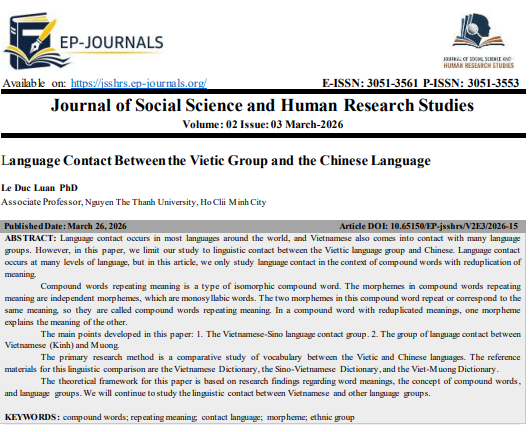
Language Contact Between the Vietic Group and the Chinese Language
DOI:
https://doi.org/10.65150/EP-jsshrs/V2E3/2026-15Keywords:
compound words; repeating meaning; contact language; morpheme; ethnic groupAbstract
Language contact occurs in most languages around the world, and Vietnamese also comes into contact with many language groups. However, in this paper, we limit our study to linguistic contact between the Viettic language group and Chinese. Language contact occurs at many levels of language, but in this article, we only study language contact in the context of compound words with reduplication of meaning.
Compound words repeating meaning is a type of isomorphic compound word. The morphemes in compound words repeating meaning are independent morphemes, which are monosyllabic words. The two morphemes in this compound word repeat or correspond to the same meaning, so they are called compound words repeating meaning. In a compound word with reduplicated meanings, one morpheme explains the meaning of the other.
The main points developed in this paper: 1. The Vietnamese-Sino language contact group. 2. The group of language contact between Vietnamese (Kinh) and Muong.
The primary research method is a comparative study of vocabulary between the Vietic and Chinese languages. The reference materials for this linguistic comparison are the Vietnamese Dictionary, the Sino-Vietnamese Dictionary, and the Viet-Muong Dictionary.
The theoretical framework for this paper is based on research findings regarding word meanings, the concept of compound words, and language groups. We will continue to study the linguistic contact between Vietnamese and other language groups.
References
1) A de Rhodes (1991), Từ điển Annam-Lusitan-Latinh (Dictionarivm Annammiticvm Lvsitanvm, et Lainvm ope), Nxb Khoa học Xã hội, Hà Nội.
2) Alves, Mark J (2018), Chinese Loanwords in Vietnamese Pronouns and Terms of Address and Reference, in Proceedings of the 29th North American Conference on Chinese Linguistics (NACCL-29), 2017, Volume 1, ed. by Marjorie K.M. Chan and Hana Kang, 286-303. Columbus, Ohio: The Ohio State University. https://www.academia.edu/33556335/Chinese_Influence_on_Vietnamese_Pronouns and terms of address and reference toa R.
3) Aj.L. Taberd (2004), Dictionarium Anamitico Latinnum, Center for National Cultural Studies, Nxb. Văn học, Trung tâm nghiên cứu Quốc học.
4) Diffloth G (1991), Vietnamese as a Mon-Khme language, Paper from the firt anual meeting of the Southeast Asian linguistics society.
5) Đặng Thanh Hòa (2005), Từ điển phương ngữ tiếng Việt [Vietnamese dialect dictionary] Nxb. Đà Nẵng-Trung tâm từ điển học.
6) Haudricout A. G. (1991), Vị trí của tiếng Việt trong các ngôn ngữ Nam Á [Location of Vietnamese in the South Asian language] Hà Nội: Ngôn ngữ, số 1.
7) Hoàng Thị Châu (2009), Phương ngữ học tiếng Việt [Vietnamese dialects] Hà Nội: Nxb. Đại học Quốc gia.
8) Hoàng Phê (editor-in-chief) (2016), Từ điển tiếng Việt [Vietnamese Dictionary] Thanh Hóa: Nxb Hồng Đức.
9) Huình, Tịnh Paulus Của (2018), Đại Nam Quấc âm tự vị, Cuốn 1 và 2 [Dai Nam Quac words, Book 1 and 2] Nxb. Tổng hợp thành phố Hồ Chí Minh.
10) Lê Đình Khẩn (2002), Từ vựng gốc Hán trong Tiếng Việt [Words of Chinese Origin in Vietnamese] Nhà xuất bản Đại học Quốc Gia Hồ Chí Minh.
11) Lê Đức Luận (2015), Tiếng Mường trong phương ngữ miền Trung [Muong language in the Central dialect] Hà Nội: Ngôn ngữ, số 11.
12) Lê Đức Luận (2019), Các yếu tố cấu tạo trong từ ghép láy nghĩa [Mechanism of meaning combination in compound words with repetition of meaning] Hà Nội: Tạp chí Ngôn ngữ và Đời sống, pp. 20-25.
13) Lê Đức Luận, Hồ Văn Hận (2025), Morpheme Repetition where two Syllables Repeat the MeaningInternational, Journal of Human Research and Social Science Studies ISSN(p): 3050-547X, ISSN(e): 3050-5488 Volume 02 Issue 11 November, 2025 DOI: https://doi.org/10.55677/ijhrsss/17-2025-Vol 02I11
14) Lê Quang Thành (2022), Đọc thơ Đường – Bàn về từ mượn tiếng Hán trong tiếng Việt, Dạy và Học ngày nay, 4/2022, p. 85
15) Nguyễn Tài Cẩn (1979), Nguồn gốc và quá trình hình thành cách đọc tiếng Hán Việt [The Origins and Process of Development of Sino-Vietnamese Readings]. Hà Nội: Nhà xuất bản Khoa học Xã hội.
16) Nguyễn Tài Cẩn (1995), Giáo trình Lịch sử ngữ âm tiếng Việt [A Text on Vietnamese Historical Phonology]. Hà Nội: Nhà xuất bản Giáo Dục.
17) Nguyễn Tài Cẩn (1996). Ngữ pháp tiếng Việt (In lần thứ 3), [Vietnamese Grammar, 3th Edition] Hà Nội: Nxb. Đại học Quốc gia.
18) Nguyễn Văn Khang (chủ biên), Bùi Chỉ, Hoàng Văn Hành (2002), Từ điển Mường – Việt [Muong - Vietnamese Dictionary] Hà Nội: Nxb. Văn hóa dân tộc.
19) Nguyễn Ngọc San (2003), Tìm hiểu tiếng Việt lịch sử [Exploring the History of the Vietnamese Language]. Hanoi: Nhà xuất bản Đại học Sư phạm.
20) Phan, John Duong (2013), Lacquered Words: The Evolution of Vietnamese under Sinitic Influences from the 1st Century bce through the 17th Century ce. Ph.D. Dissertation: Cornell University.
21) Pigneau de Behaine, P (1999), Tự vị An Nam –La tinh [Dictionrium Anamitico Latinnum], Hồng Nhuệ Nguyễn Khắc Xuyên dịch và giới thiệu, Nxb. Trẻ.
22) Trần Văn Kiệm (1989), Giúp đọc Nôm và Hán Việt [Help reading Nom and Sino-Vietnamese] Nxb. Đà Nẵng-Hội bảo tồn di sản chữ Nôm Hoa Kì
23) Viện Hàn Lâm khoa học Liên Xô (1987). Tiếng Mường (Язык Мзыонг) [Muong language] Mocквa.
24) Wáng Lì 王力 (1948). Hànyǔ Yuèyǔ Yánjiū 汉语越语研究 [Research on Chinese and Vietnamese]. 岭南学报 Língnán Xuébào [The Journal of Lingnan College] 9.1:1-96
25) Vũ Đức Nghiệu (2011), Lược khảo lịch sử từ vựng tiếng Việt [A brief survey of the history of Vietnamese vocabulary] Hà Nội: Nxb. Giáo dục.
26) Vương Lộc (2002), Từ điển từ cổ [Dictionary of ancient words] Nxb. Đà Nẵng-Trung tâm từ điển học.
27) http://www.cema.gov.vn/gioi-thieu/cong-dong-54-dan-toc.htm
Downloads
Published
Issue
Section
License
Copyright (c) 2026 Le Duc Luan PhD (Author)

This work is licensed under a Creative Commons Attribution 4.0 International License.