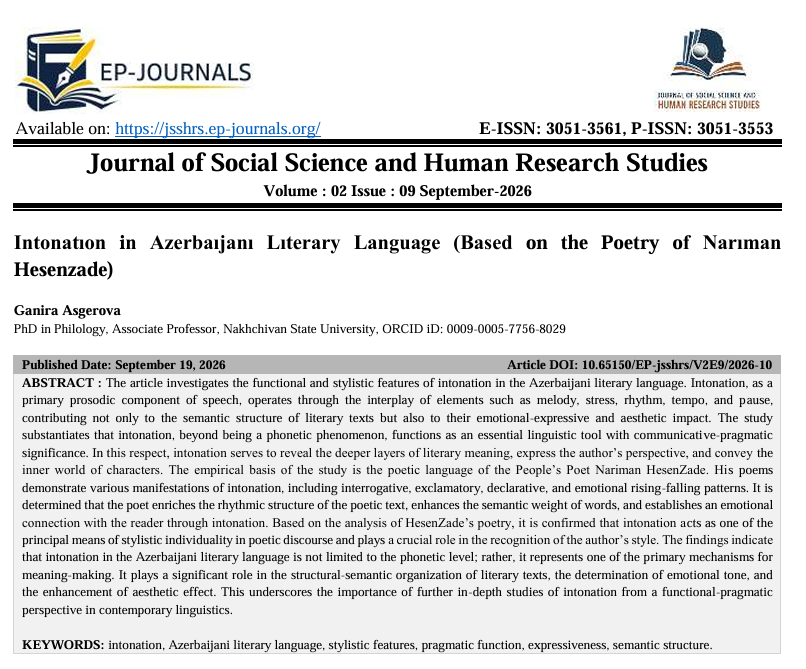
Intonatıon in Azerbaıjanı Lıterary Language (Based on the Poetry of Narıman Hesenzade)
DOI:
https://doi.org/10.65150/EP-jsshrs/V2E9/2026-10Keywords:
intonation, Azerbaijani literary language, stylistic features, pragmatic function, expressiveness, semantic structureAbstract
The article investigates the functional and stylistic features of intonation in the Azerbaijani literary language. Intonation, as a primary prosodic component of speech, operates through the interplay of elements such as melody, stress, rhythm, tempo, and pause, contributing not only to the semantic structure of literary texts but also to their emotional-expressive and aesthetic impact. The study substantiates that intonation, beyond being a phonetic phenomenon, functions as an essential linguistic tool with communicative-pragmatic significance. In this respect, intonation serves to reveal the deeper layers of literary meaning, express the author’s perspective, and convey the inner world of characters. The empirical basis of the study is the poetic language of the People’s Poet Nariman HesenZade. His poems demonstrate various manifestations of intonation, including interrogative, exclamatory, declarative, and emotional rising-falling patterns. It is determined that the poet enriches the rhythmic structure of the poetic text, enhances the semantic weight of words, and establishes an emotional connection with the reader through intonation. Based on the analysis of HesenZade’s poetry, it is confirmed that intonation acts as one of the principal means of stylistic individuality in poetic discourse and plays a crucial role in the recognition of the author’s style. The findings indicate that intonation in the Azerbaijani literary language is not limited to the phonetic level; rather, it represents one of the primary mechanisms for meaning-making. It plays a significant role in the structural-semantic organization of literary texts, the determination of emotional tone, and the enhancement of aesthetic effect. This underscores the importance of further in-depth studies of intonation from a functional-pragmatic perspective in contemporary linguistics.
References
1) Anum, L., Rahman, M., & Karim, S. (2024). The role of prosody and intonation in English phonology: Implications for speech perception and production. Bilangan Journal, 2(3), pp.160-174. https://doi.org/10.62383/bilangan.v2i3.82
2) Bassiouney, R. (2016). The importance of prosody in understanding speaker meaning. Arab World English Journal, 7(2), 300-315. https://doi.org/10.24093/awej/vol7no2.21
3) Bermúdez, F. (2023). Using prosody to express evidentiality: The role of intonation in quoted speech. Journal of Pragmatics, 213, 45-58. https://doi.org/10.1016/j.pragma.2023.05.012
4) Bögels, S., & Torreira, F. (2025). Disentanglement of prosodic meaning: Evidence from conversational speech. Proceedings of the National Academy of Sciences (PNAS), 122(10), e2500510122. https://doi.org/10.1073/pnas.2500510122
5) Cutler, A. (2015). Lexical stress and sentence prosody. Speech Communication, 68, 1-11. https://doi.org/10.1016/j.specom.2015.02.001
6) Feyzullayeva, G. (2023). İntonasiya və onun rolu. AMEA, M. Füzuli adına Əlyazmalar İnstitutu Filologiya məsələləri, № 5, 210-214.
7) Goodhue, D. (2018). Intonation, yes and no: The role of intonation in responses. Glossa: A Journal of General Linguistics, 3(1), 1-30. https://doi.org/10.5334/gjgl.497
8) Hasanova, S. (2025). Intonational Features of the Azerbaijani Poetic Language. Forum for Linguistic Studies, Volume: 7 Issue: 11, pp. 1351-1362.https://doi.org/10.30564/fls.v7i11.11256
9) Henriksen, N. (2013). Style, prosodic variation, and the social meaning of intonation. Journal of the International Phonetic Association, 43(2), 153-193. https://doi.org/10.1017/S0025100313000054
10) Hәsәnzadә, N. (2022). Seçilmiş әsәrlәri. III cild. Bakı, “Aspoliqraf”, 576 s.
11) Həsənzadə, N. (2010). Seçilmiş əsərləri, 7 cilddə 1-ci cild, Bakı, Prometey, 812 s.
12) Nəriman Həsənzadə "Gül biraz".https://share.google/uxCpIx7psglBHlgU6
13) Jun, S.-A. (Ed.). (2014). Prosodic typology II: The phonology of intonation and phrasing. Oxford University Press, 587 p.
14) Ladd, D. R. (2008). Intonational phonology and meaning. Language and Linguistics Compass, 2(5), 858–872.
https://doi.org/10.1111/j.1749-818X.2008.00082.x
15) Prieto, P. (2015). Intonational meaning. WIREs Cognitive Science, 6(4), 371-381. https://doi.org/10.1002/wcs.1352
16) Rao, R. (2010). On the phonetics of Spanish intonation. Journal of Phonetics, 38(4), 497-512. https://doi.org/10.1016/j.wocn.2010.07.001
17) Shattuck-Hufnagel, S., & Turk, A. (1996). A prosody tutorial for investigators of auditory sentence processing. Journal of Psycholinguistic Research, 25(2), 193-247. https://doi.org/10.1007/BF01708572
18) Tang, C., Hamilton, L. S., & Chang, E. F. (2017). Intonational speech prosody encoding in the human brain. Science, 357(6353), 797–801. https://doi.org/10.1126/science.aam8577
19) Xu, Y. (2005). Phonetic realization of focus in English intonation. Journal of Phonetics, 33(2), 159-197. https://doi.org/10.1016/j.wocn.2004.11.001
20) Zhou, Y., & Li, X. (2025). The prosody of emojis: Intonation patterns in digital communication. arXiv Preprint. https://arxiv.org/abs/2508.00537
Downloads
Published
Issue
Section
License
Copyright (c) 2026 Ganira Asgerova (Author)

This work is licensed under a Creative Commons Attribution 4.0 International License.