Implementation of Multi-Lingual Education in Technical Vocational Education (Tech-Voc) Schools
DOI:
https://doi.org/10.65150/EP-jsshrs/V2E5/2026-13Keywords:
Multilingual education, technical vocational schools, teacher profile, implementation, Region III, vocational specializationsAbstract
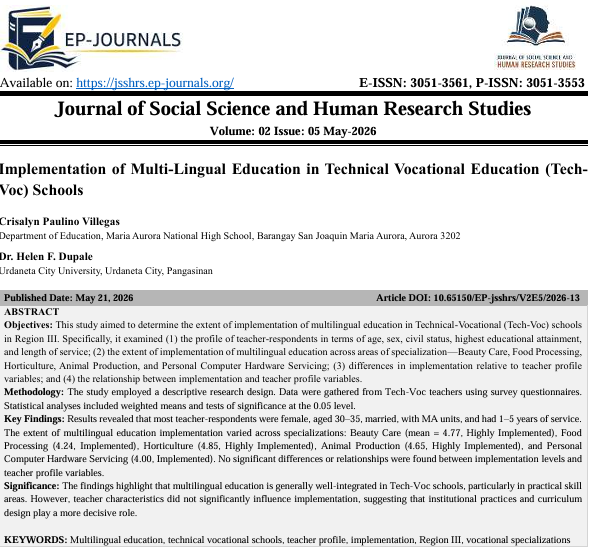
Objectives: This study aimed to determine the extent of implementation of multilingual education in Technical-Vocational (Tech-Voc) schools in Region III. Specifically, it examined (1) the profile of teacher-respondents in terms of age, sex, civil status, highest educational attainment, and length of service; (2) the extent of implementation of multilingual education across areas of specialization—Beauty Care, Food Processing, Horticulture, Animal Production, and Personal Computer Hardware Servicing; (3) differences in implementation relative to teacher profile variables; and (4) the relationship between implementation and teacher profile variables.
Methodology: The study employed a descriptive research design. Data were gathered from Tech-Voc teachers using survey questionnaires. Statistical analyses included weighted means and tests of significance at the 0.05 level.
Key Findings: Results revealed that most teacher-respondents were female, aged 30–35, married, with MA units, and had 1–5 years of service. The extent of multilingual education implementation varied across specializations: Beauty Care (mean = 4.77, Highly Implemented), Food Processing (4.24, Implemented), Horticulture (4.85, Highly Implemented), Animal Production (4.65, Highly Implemented), and Personal Computer Hardware Servicing (4.00, Implemented). No significant differences or relationships were found between implementation levels and teacher profile variables.
Significance: The findings highlight that multilingual education is generally well-integrated in Tech-Voc schools, particularly in practical skill areas. However, teacher characteristics did not significantly influence implementation, suggesting that institutional practices and curriculum design play a more decisive role.
References
1) Ambarini, R., Yuliasri, I., & others. (2020). Bilingual language learning in educational contexts: Enhancing cognitive and communicative competence. Journal of Applied Linguistics, 12(2), 45-58.
2) Ball, J. (2011). Mother tongue-based bilingual or multilingual education in the early years. University of Victoria; United Nations Educational, Scientific and Cultural Organization (UNESCO).
3) Bautista, M. F. (2012). Schools’ performance in the implementation of the strengthened technical vocational education program–competency-based curriculum (STVEP‑CBC) of public technical vocational agricultural schools in Region III (Unpublished doctoral dissertation). Araullo University.
4) Benson, C. (2013). Language issues in comparative education: Inclusive teaching and learning in non‑dominant languages and cultures. Comparative Education, 49(3), 1–18. https://doi.org/10.1080/03050068.2013.803785
5) Burton, L. (2013). Mother tongue‑based multilingual education in the Philippines: Studying top‑down policy implementation from the bottom up (Unpublished doctoral dissertation). University of Minnesota. https://hdl.handle.net/11299/152603
6) Cambridge English. (n.d.). The impact of multilingualism on global education and language learning.
https://www.cambridgeenglish.org/Images/539682-perspectives-impact-on-multilingualism.pdf
7) Cummins, J. (2000). Language, power, and pedagogy: Bilingual children in the crossfire. Multilingual Matters.
https://doi.org/10.21832/9781853596773
8) Department of Education. (2008). DepEd Order No. 60, s. 2008: Revised implementing guidelines on the use of the mother tongue as medium of instruction. DepEd.
9) Department of Education. (2009). DepEd Order No. 74, s. 2009: Institutionalizing mother tongue‑based multilingual education. DepEd.
10) Department of Education. (2012). Republic Act No. 10533: Enhanced basic education act of 2012. DepEd.
11) DepEd Tangub City. (2020). English oral proficiency of TCNHS students: Basis for a speech manual.
https://tangub.deped.gov.ph/wp-content/uploads/2024/12/X_2024_Luna_Research.pdf
12) Faraday, S., Overton, C., & Cooper, S. (2011). Effective teaching and learning in vocational education. LSIS Learning.
13) Freeman, Y. S., & Freeman, D. E. (2005). English language learners: The essential guide. Scholastic.
14) Gonzalez, A. (2003). The language planning situation in the Philippines. Journal of Multilingual and Multicultural Development, 24(6), 487–525. https://doi.org/10.1080/01434630308666509
15) Haney, R. M. (2002). Secondary students’ perceptions of vocational education (Unpublished master’s thesis). University of North Florida.
16) Hornberger, N. H. (1990). Bilingual education and English‑only: A language‑planning framework. Annals of the American Academy of Political and Social Science, 508, 12–26. https://doi.org/10.1177/0002716290508001002
17) Howard, E. R., & Sugarman, J. (2007). Realizing the vision of two‑way immersion: Fostering effective programs and classrooms. Center for Applied Linguistics.
18) Johnson, R. (2020). Challenges in modular distance learning: Interactive support and comprehension. World Journal of Education and Humanities Research.
19) Lansang, M., & Zamora, J. (2020). Linguistic scaffolding in inclusive vocational classrooms. Journal of Vocational Education, 19(3), 112-125.
20) Marschark, M., & Hauser, P. C. (2020). Cognitive and language development in modular resources. Oxford University Press.
21) Metila, R. A., Pradilla, L. A., & Williams, A. B. (2016). The ongoing narrative of mother tongue-based multilingual education in the Philippines. Moussons, (27), 783-801. https://doi.org/10.4000/moussons.3552
22) PIDS. (2020). Language of instruction and transition in education systems (LITES), Philippines. Philippine Institute for Development Studies. https://pidswebs.pids.gov.ph/CDN/document/pidsdps2556.pdf
23) PoliPapers. (n.d.). English language proficiency of senior high school students.
https://polipapers.upv.es/index.php/MUSE/article/download/16638/14941
24) Ramos, R. D. V. (2012). Implementation of the technical‑vocational program of the technical‑vocational high schools (Unpublished doctoral dissertation). Urdaneta City University.
25) Technical Education and Skills Development Authority. (2004). Training regulations for horticulture NC II. TESDA.
26) Technical Education and Skills Development Authority. (2013). Training regulations for animal production NC II. TESDA.
27) Technical Education and Skills Development Authority. (2005). Training regulations for computer hardware servicing NC II. TESDA.
28) UNESCO. (2002). Education in a multilingual world. UNESCO.
29) UNESCO. (2020). Investigating quality education in mother tongue: Ensuring children's rights to access and equity schooling. Taylor & Francis Online. https://doi.org/10.1080/2331186X.2025.2545617
30) Vygotsky, L. S. (1978). Mind in society: The development of higher psychological processes. Harvard University Press.
Downloads
Published
Issue
Section
License
Copyright (c) 2026 Crisalyn Paulino Villegas, Dr. Helen F. Dupale (Author)

This work is licensed under a Creative Commons Attribution 4.0 International License.