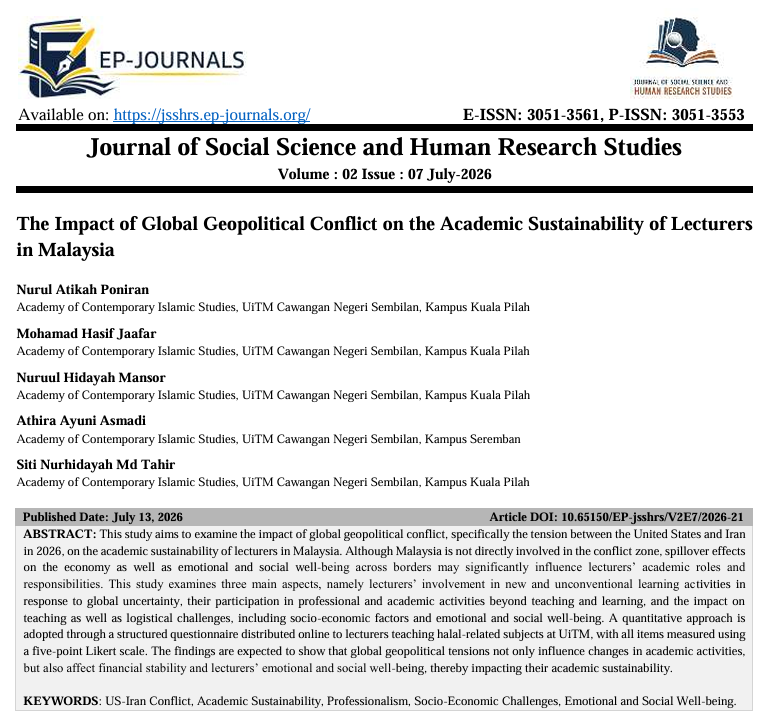
The Impact of Global Geopolitical Conflict on the Academic Sustainability of Lecturers in Malaysia
DOI:
https://doi.org/10.65150/EP-jsshrs/V2E7/2026-21Keywords:
US-Iran Conflict, Academic Sustainability, Professionalism, Socio-Economic Challenges, Emotional and Social Well-being.Abstract
This study aims to examine the impact of global geopolitical conflict, specifically the tension between the United States and Iran in 2026, on the academic sustainability of lecturers in Malaysia. Although Malaysia is not directly involved in the conflict zone, spillover effects on the economy as well as emotional and social well-being across borders may significantly influence lecturers’ academic roles and responsibilities. This study examines three main aspects, namely lecturers’ involvement in new and unconventional learning activities in response to global uncertainty, their participation in professional and academic activities beyond teaching and learning, and the impact on teaching as well as logistical challenges, including socio-economic factors and emotional and social well-being. A quantitative approach is adopted through a structured questionnaire distributed online to lecturers teaching halal-related subjects at UiTM, with all items measured using a five-point Likert scale. The findings are expected to show that global geopolitical tensions not only influence changes in academic activities, but also affect financial stability and lecturers’ emotional and social well-being, thereby impacting their academic sustainability.
References
1) Anthony Jr, B., Kamaludin, A., & Romli, A. (2023). Predicting academic staff's behaviour intention and actual use of blended learning in higher education: Model development and validation. Technology, Knowledge and Learning, 28, 1223–1269. https://doi.org/10.1007/s10758-021-09579-2
2) Chan, M. S., & Halim, H. A. (2025). Predictors of psychological well-being among academic staff in Malaysian higher education. Cogent Education, 12(1), Article 2555738. https://doi.org/10.1080/2331186X.2025.2555738
3) Choudary, E. (2024). US-Iran rivalry and its impact on Middle Eastern peace. Zenodo (CERN European Organization for Nuclear Research). https://doi.org/10.5281/zenodo.13120237
4) Fernández-Batanero, J. M., Montenegro-Rueda, M., Fernández-Cerero, J., & Tadeu, P. (2022). Online education in higher education: Emerging solutions in crisis times. Heliyon, 8(8), e10139. https://doi.org/10.1016/j.heliyon.2022.e10139
5) Fernández-Raga, M., Aleksić, D., İkiz, A. K., Markiewicz, M., & Streit, H. (2023). Development of a comprehensive process for introducing game-based learning in higher education for lecturers. Sustainability, 15(4), 3706. https://doi.org/10.3390/su15043706
6) Heilporn, G., Lakhal, S., & Bélisle, M. (2021). An examination of teachers’ strategies to foster student engagement in blended learning in higher education. International Journal of Educational Technology in Higher Education, 18(25). https://doi.org/10.1186/s41239-021-00260-3
7) Hoque, M. E., Zaidi, M. A. S., & Hassan, M. K. (2021). Geopolitical Uncertainties and Malaysian Stock Market Returns: Do Market Conditions Matter? 9(19), 2393. https://doi.org/10.3390/MATH9192393
8) Idris, A., & Yusoff, R. (2015). Malaysia’s contemporary political and economic relations with Iran.
9) Malaysia’s Anwar faces rising pressure overkey plan. (2024). Emerald Expert Briefings. https://doi.org/10.1108/oxan-db288033
10) Manokaran, K. R., Ramakrishnan, S., Sang Long, C., & Indiran, L. (2026). From policy to practice: A systematic review of ESG integration in Malaysia’s higher education sector for strategic sustainability transformation. Asian Education and Development Studies. https://doi.org/10.1108/AEDS-07-2025-0358
11) Mirata, V., Hirt, F., Bergamin, P., & van der Westhuizen, C. (2020). Challenges and contexts in establishing adaptive learning in higher education: Findings from a Delphi study. International Journal of Educational Technology in Higher Education, 17(32). https://doi.org/10.1186/s41239-020-00209-y
12) Mohamad, N. M., Amar, S. N., Samsuden, S., & Bohari, M. H. (2025). Determinants of work-life balance among lecturers at private higher learning institutions in Johor. Malaysian Journal of Higher Education, 5(1), 45–60. https://doi.org/10.13140/RG.2.2.391318848.1
13) Mohd Ali, N. H., Che’ Rus, R., & Mohd Noor, A. I. (2025). Embedding sustainability in landscape architecture education: Assessing the needs of the Malaysian industry. EDUCATUM Journal of Social Sciences, 11(2), 1–9. https://doi.org/10.37134/ejoss.vol11.2.1.2025
14) Muhamad Noor, M. F., Mamat, M. Z., & Mohamad, Z. F. (2024). Impact of engagement in campus sustainability activities to competency development: Change agents’ experiences and perspectives. Sustainability, 16(5), 1780. https://doi.org/10.3390/su16051780
15) Munusamy, S., Ramasamy, S., & Sukir, N. I. (2024). A systematic review on mental health and its associated factors among educators in Malaysia. BMC Public Health, 24(1), Article 2634. https://doi.org/10.1186/s12889-024-19855-2
16) Nazam, R. A. K., & Andasari, D. (2024). Sustainability integration in Malaysian education: A systematic literature review. Asia Pacific Journal of Business, Humanities and Education, 9(2), 100–115. https://apjbhe.segi.edu.my/index.php/segi/article/view/133
17) Radyi, S. A. M., & Usman, A. B. (2022). “Technology saves us?” Malaysian lecturers’ beliefs and readiness towards the application of technology-assisted student-centered learning. Journal of Educational Management and Instruction, 2(2), 101–111. https://doi.org/10.22515/jemin.v2i2.5960
18) Ramachandaran, S. D., Nuraini, R., & Doraisingam, P. (2024). Understanding work-life balance challenges among academic professionals in higher education: A phenomenological study. International Journal of Learning, Teaching and Educational Research, 23(12), 1–18. https://doi.org/10.26803/ijlter.23.12.8
19) Ramachandaran, S., Doraisingam, D. P. N., Nuraini, R., & Kumari, S. (2025). Harmonizing work-life equilibrium: Unveiling academicians’ perspectives in Malaysian higher education on work-life balance. Social Sciences & Humanities Open, 12, Article 101673. https://doi.org/10.1016/j.ssaho.2025.101673
20) Ratuela, H. S. P., Saerang, I. S., & Rumokoy, L. J. (2025). Analisis reaksi pasar terhadap pecahnya perang antara iran dan israel: studi kasus pada perusahaan sektor energi di wilayah ASEAN. Jurnal Ilmiah Manajemen Bisnis Dan Inovasi Universitas Sam Ratulangi, 12(2), 681–693. https://doi.org/10.35794/jmbi.v12i2.62460
21) Taylor & Francis. (2025). Rationales and factors influencing universities’ engagement with sustainability: An exploration of two Malaysian universities from stakeholders’ perspectives. Local Environment, 30(1), 1–18. https://doi.org/10.1080/24761028.2025.2471624
22) Wiyono, D., Dewi, D. A., Ambiapuri, E., Parwitasari, N. A., & Hambali, D. S. (2025). Strategic ESG-driven human resource practices: Transforming employee management for sustainable organizational growth (arXiv preprint). arXiv:2505.08201. https://arxiv.org/abs/2505.08201
23) Yeo, A. C. M. (2024). Beyond the classroom: The multifaceted role of Malaysian lecturers in higher education. Malaysian Journal of Higher Education,4(1), 1–15.https://doi.org/10.13140/RG.2.2.386495441.1
24) Yeo, A. C. M., Lim, C. Y., Tay, L. C., & Chin, M. Y. (2025). Creating an integrative sustainability framework for higher education in Malaysia: economic, environmental, social and governance (EESG) aspects. HJBPA Baltic Journal of Management and Economics, 16(1), 1–26. https://doi.org/10.2478/hjbpa-2025-0001
25) Yusoff, A. I., Remali. (n.d.). Malaysia's Contemporary Political and Economic Relations with Iran.https://doi.org/10.17265/2328-2134/2015.02.004
26) Yusoff, M. S. B., Abdul Latiff, A. R., Ong, E., Abdul Manan, H., et al. (2024). Academic workloads: Insights from medical and non-medical lecturers’ experience in Universiti Sains Malaysia. Education in Medicine Journal, 16(3), 119–139. https://doi.org/10.21315/eimj2024.16.3.10
27) Zulkifli, M. S., Hisham, N. N. B., & Razak, N. A. (2022). ESL lecturers’ adaptation to the new-norm of online teaching in Malaysia. TESOL and Technology Studies, 3(1), 15–23. https://doi.org/10.48185/tts.v3i1.334
28) Zulkifli, N. (2026). The Iran–Israel Conflagration: Geostrategic Reverberations and Policy Considerations for ASEAN. https://doi.org/10.5281/zenodo.18242525
Downloads
Published
Issue
Section
License
Copyright (c) 2026 Nurul Atikah Poniran, Mohamad Hasif Jaafar, Nuruul Hidayah Mansor, Athira Ayuni Asmadi, Siti Nurhidayah Md Tahir (Author)

This work is licensed under a Creative Commons Attribution 4.0 International License.