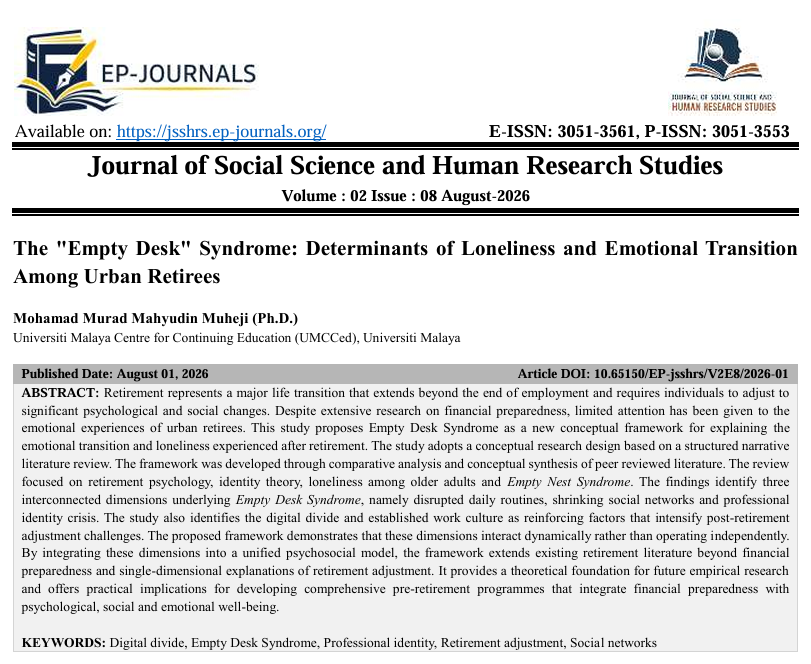
The "Empty Desk" Syndrome: Determinants of Loneliness and Emotional Transition Among Urban Retirees
DOI:
https://doi.org/10.65150/EP-jsshrs/V2E8/2026-01Keywords:
Digital divide, Empty Desk Syndrome, Professional identity, Retirement adjustment, Social networksAbstract
Retirement represents a major life transition that extends beyond the end of employment and requires individuals to adjust to significant psychological and social changes. Despite extensive research on financial preparedness, limited attention has been given to the emotional experiences of urban retirees. This study proposes Empty Desk Syndrome as a new conceptual framework for explaining the emotional transition and loneliness experienced after retirement. The study adopts a conceptual research design based on a structured narrative literature review. The framework was developed through comparative analysis and conceptual synthesis of peer reviewed literature. The review focused on retirement psychology, identity theory, loneliness among older adults and Empty Nest Syndrome. The findings identify three interconnected dimensions underlying Empty Desk Syndrome, namely disrupted daily routines, shrinking social networks and professional identity crisis. The study also identifies the digital divide and established work culture as reinforcing factors that intensify post-retirement adjustment challenges. The proposed framework demonstrates that these dimensions interact dynamically rather than operating independently. By integrating these dimensions into a unified psychosocial model, the framework extends existing retirement literature beyond financial preparedness and single-dimensional explanations of retirement adjustment. It provides a theoretical foundation for future empirical research and offers practical implications for developing comprehensive pre-retirement programmes that integrate financial preparedness with psychological, social and emotional well-being.
References
1) Abdullah, A., Salleh, Z., Zakaria, M. N., Hassan, H., Merican, R. M. A. R., Aziz, M. I., Muhammad, M. Z., & Shamma, H. (2023). Financial planning literacy among retirees: Issues and challenges. In Contributions to Management Science (pp. 541–551). Springer. https://doi.org/10.1007/978-3-031-27860-0_39
2) Alavi, Z., Abolfathi Momtaz, Y., & Alipour, F. (2023). Facilitators and barriers for successful retirement: A qualitative study. Pan African Medical Journal, 44, 111. https://doi.org/10.11604/pamj.2023.44.111.35608
3) Bartol, A., & Grah, B. (2024). Aging and work-related identity loss due to retirement. ENTRENOVA – ENTerprise REsearch InNOVAtion, 10(1). https://doi.org/10.54820/entrenova-2024-0018
4) Bougea, A., Despoti, A., & Vasilopoulos, E. (2020). Empty nest related psychosocial stress: Conceptual issues and future directions in economic crisis. Psychiatriki, 30(4), 329–336. https://doi.org/10.22365/JPSYCH.2019.304.329
5) Brugiavini, A. (2001). Early retirement in Europe. European Review, 9(4), 501–515. https://doi.org/10.1017/S106279870100045X
6) Chen, Y. R. R., & Schulz, P. J. (2016). The effect of information communication technology interventions on reducing social isolation in the elderly A systematic review. Journal of Medical Internet Research, 18(1), e18. https://doi.org/10.2196/jmir.4596
7) Comi, S. L., Cottini, E., & Lucifora, C. (2022). The effect of retirement on social relationships. German Economic Review, 23(2), 275–299. https://doi.org/10.1515/ger-2020-0109
8) Ekerdt, D. J., & Koss, C. (2016). The task of time in retirement. Ageing & Society, 36(8), 1295–1311. https://doi.org/10.1017/S0144686X15000367.
9) Fadeeva, A., Simmons, J., Thomas, L. B., Baker, K., & Ling, F. C. M. (2025). Retirement Adjustment (R-Adj) Framework: Understanding the Interplay Between Individual and Contextual Factors. Journal of Prevention and Health Promotion, 6(2), 335–361. https://doi.org/10.1177/26320770241279737
10) Froidevaux, A., Hirschi, A., & Wang, M. (2019). Identity incongruence and negotiation in the transition from work to retirement: A theoretical model. Organizational Psychology Review, 8(4). https://doi.org/10.1177/2041386619830754
11) Harpaz, I., & Snir, R. (2003). Workaholism: Its definition and nature. Human Relations, 56(3), 291–319. https://doi.org/10.1177/0018726703056003613
12) Henning-Smith, C., Moscovice, I., & Kozhimannil, K. (2019). Differences in social isolation and its relationship to health by rurality. Journal of Rural Health, 35(4), 540–549. https://doi.org/10.1111/jrh.12344
13) Jolles, D., Lamarche, V. M., Rolison, J. J., & Juanchich, M. (2023). Who will I be when I retire? The role of organizational commitment, group memberships and retirement transition framing on older workers' anticipated identity change in retirement. Current Psychology, 42(18), 15727–15741. https://doi.org/10.1007/s12144-022-02869-7
14) Kenny, L., Doherty, N., Doherty, A. S., Lawlor, B., O'Sullivan, R., & Leavey, G. (2025). The relationship between retirement, social isolation and loneliness: A longitudinal analysis using the English Longitudinal Study of Ageing. BMC Public Health, 25(1), 3733. https://doi.org/10.1186/s12889-025-24472-8
15) Kim, H.-N., Freddolino, P. P., & Greenhow, C. (2023). Older adults' technology anxiety as a barrier to digital inclusion: A scoping review. Educational Gerontology, 49(12), 1021–1038. https://doi.org/10.1080/03601277.2023.2202080
16) Kumaraguru, L., Geetha, C., & Mohidin, R. (2022). The factors influencing retirement preparation among Gen Y in Malaysia. Advanced International Journal of Banking, Accounting and Finance, 4(10), 1–12.
17) Miron, A. M., Branscombe, N. R., Ball, T. C., McFadden, S. H., & Haslam, C. (2022). An interpretative phenomenological analysis of social identity transition in academic retirement. Work, Aging and Retirement, 8(1), 82–97. https://doi.org/10.1093/workar/waab018
18) Mitchell, B. A., & Lovegreen, L. D. (2009). The empty nest syndrome in midlife families: A multimethod exploration of parental gender differences and cultural dynamics. Journal of Family Issues, 30(12), 1651–1670. https://doi.org/10.1177/0192513X09339020
19) Oldenburg, R. (1989). The great good place: Cafes, coffee shops, community centers, beauty parlors, general stores, bars, hangouts, and how they get you through the day. Paragon House.
20) Schlomann, A., Seifert, A., Zank, S., Woopen, C., & Rietz, C. (2020). Use of information and communication technology (ICT) devices among the oldest-old: Loneliness, anomie, and autonomy. Innovation in Aging, 4(2), igz050. https://doi.org/10.1093/geroni/igz050
21) Thane, P. (2006). The history of retirement. In G. L. Clark, A. H. Munnell, & J. M. Orszag (Eds.), The Oxford handbook of pensions and retirement income (pp. 33–51). Oxford University Press. https://doi.org/10.1093/oxfordhb/9780199272464.003.0003.
22) Topa, G., Lunceford, G. L., & Boyatzis, R. E. (2018). Financial planning for retirement A psychosocial perspective. Frontiers in Psychology, 8, Article 2338. https://doi.org/10.3389/fpsyg.2017.02338
23) United Nations Department of Economic and Social Affairs. (2023). World population ageing 2023: Highlights. United Nations.
24) Wang, M., Henkens, K., & Van Solinge, H. (2011). Retirement adjustment: A review of theoretical and empirical advancements. American Psychologist, 66(3), 204–213. https://doi.org/10.1037/a0022414
25) Wang, M., & Shi, J. (2014). Psychological research on retirement. Annual Review of Psychology, 65, 209–233. https://doi.org/10.1146/annurev-psych-010213-115131
26) World Health Organization. (2025). Ageing and health. https://www.who.int/news-room/fact-sheets/detail/ageing-and-health
27) Yeung, W. J. J., & Lee, Y. (2022). Aging in East Asia: New findings on retirement, health, and well being. The Journals of Gerontology: Series B, 77(3), 589–591. https://doi.org/10.1093/geronb/gbab055
28) Yeung, D. Y., & Zhou, X. (2017). Planning for retirement Longitudinal effect on retirement resources and post retirement well being. Frontiers in Psychology, 8, Article 1300. https://doi.org/10.3389/fpsyg.2017.01300
29) Zaimah Ramli, Nurulhuda Muhamad Yusof, Sarmila M. S., & Abd Hair Awang. (2023). Hubungan pengetahuan dan tingkah laku kewangan dengan perancangan kewangan persaraan dalam kalangan generasi milenial. Akademika, 93(1), 1–27. https://doi.org/10.17576/akad-2023-9301-27
30) Zhu, J., Huang, Z., Yang, S., Jiang, J., You, H., & Gao, J. (2025). Transitions of loneliness and lonely life expectancy: A longitudinal study across 24 countries. International Psychogeriatrics. https://doi.org/10.1016/j.inpsyc.2025.100134
Downloads
Published
Issue
Section
License
Copyright (c) 2026 Mohamad Murad Mahyudin Muheji (Ph.D.) (Author)

This work is licensed under a Creative Commons Attribution 4.0 International License.