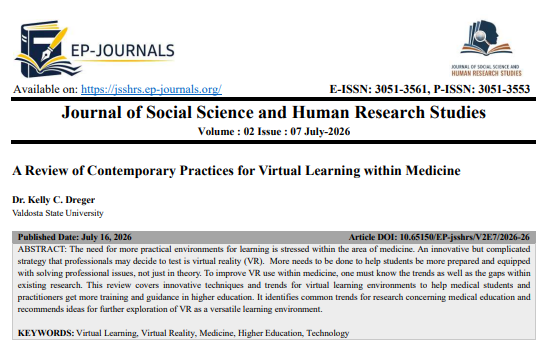
A Review of Contemporary Practices for Virtual Learning within Medicine
DOI:
https://doi.org/10.65150/EP-jsshrs/V2E7/2026-26Keywords:
Virtual Learning, Virtual Reality, Medicine, Higher Education, TechnologyAbstract
The need for more practical environments for learning is stressed within the area of medicine. An innovative but complicated strategy that professionals may decide to test is virtual reality (VR). More needs to be done to help students be more prepared and equipped with solving professional issues, not just in theory. To improve VR use within medicine, one must know the trends as well as the gaps within existing research. This review covers innovative techniques and trends for virtual learning environments to help medical students and practitioners get more training and guidance in higher education. It identifies common trends for research concerning medical education and recommends ideas for further exploration of VR as a versatile learning environment
References
1) Abuhammad, A., Falah, J., Alfalah, S. F. M., Abu-Tarboush, M., Tarawneh, R. T., Drikakis, D., & Charissis, V. (2021). “MedChemVR”: A virtual reality game to enhance medicinal chemistry education. Multimodal Technologies and Interaction, 5(3),10. https://doi.org/10.3390/mti5030010
2) Alaraj, A., Luciano, C. J., Bailey, D. P., Elsenousi, A., Roitberg, B. Z., Bernardo, A., Banerjee, P. P., & Charbel, F. T. (2015). Virtual reality cerebral aneurysm clipping simulation with real-time haptic feedback. Neurosurgery, 11 Suppl 2(0 2), 52–58. https://doi.org/10.1227/NEU.0000000000000583
3) Almousa, O., Prates, J., Yeslam, N., Mac Gregor, D., Zhang, J., Phan, V., Nielsen, M., Smith, R., & Qayumi, K. (2019). Virtual reality simulation technology for cardiopulmonary resuscitation training: An innovative hybrid system with haptic feedback. Simulation & Gaming, 50(1), 6-22. https://doi.org/10.1177/1046878118820905
4) Botden, S. M. B. I., Buzink, S. N., Schijven, M. P., & Jakimowicz, J. J. (2007). Augmented versus virtual reality laparoscopic simulation: What is the difference?: A comparison of the ProMIS augmented reality laparoscopic simulator versus LapSim virtual reality laparoscopic simulator. World Journal of Surgery, 31(4), 764-772. https://doi.org/10.1007/s00268-006-0724-y
5) Cesa, G. L., Manzoni, G. M., Bacchetta, M., Castelnuovo, G., Conti, S., Gaggioli, A., Mantovani, F., Molinari, E., Cárdenas-López, G., & Riva, G. (2013). Virtual reality for enhancing the cognitive behavioral treatment of obesity with binge eating disorder: Randomized controlled study with one-year follow-up. Journal of Medical Internet Research, 15(6), 1-23. https://doi.org/10.2196/jmir.2441
6) Chang, Y. S. (2021). Effects of virtual reality application on skill learning for optical‐fibre fusion splicing. British Journal of Educational Technology, 52(6), 2209-2226. https://doi.org/10.1111/bjet.13118
7) De Faria, J. W. V., Teixeira, M. J., Júnior, L. D. M. S., Otoch, J. P., & Figueiredo, E. G. (2016). Virtual and stereoscopic anatomy: When virtual reality meets medical education. Journal of Neurosurgery, 125(5), 1105-1111. https://doi.org/10.3171/2015.8.JNS141563
8) Detyna, M., & Kadiri, M. (2020). Virtual reality in the HE classroom: Feasibility, and the potential to embed in the curriculum. Journal of Geography in Higher Education, 44(3), 474-485. https://doi.org/10.1080/03098265.2019.1700486
9) Djellal, F., & Gallouj, F. (2005). Mapping innovation dynamics in hospitals. Res. Policy, 34, 817–835. https://doi.org/10.1016/j.respol.2005.04.007
10) Fabris, C. P., Rathner, J. A., Fong, A. Y., & Sevigny, C. P. (2019). Virtual reality in higher education. International Journal of Innovation and Science and Mathematics Education, 27(8), 69-80. https://doi.org/10.30722/IJISME.27.08.006
11) Fernández-Arias, P., Antón-Sancho, Á., Sánchez-Jiménez, M., & Vergara, D. (2023). Statistical analysis of professors’ assessment regarding the didactic use of virtual reality: Engineering vs. Health. Electronics, 12(6), 1-13. https://doi.org/10.3390/electronics12061366
12) Frederiksen, J. G., Sørensen, S. M., Konge, L., Svendsen, M. B. S., Nobel-Jørgensen, M., Bjerrum, F., & Andersen, S. A. W. (2020). Cognitive load and performance in immersive virtual reality versus conventional virtual reality simulation training of laparoscopic surgery: A randomized trial. Surgical Endoscopy, 34(3), 1244-1252. https://doi.org/10.1007/s00464-019-06887-8
13) García Fierros, F. J., Jesús Jaime, M. E., Gabriel Sepúlveda Cervantes, G., Oswaldo, M. M., & Padilla, R. T. (2021). Virtual reality mobile application for training in cardiopulmonary resuscitation techniques. Sensors, 21(7), 2504. https://doi.org/10.3390/s21072504
14) Gunn, T., Rowntree, P., Starkey, D., & Nissen, L. (2021). The use of virtual reality computed tomography simulation within a medical imaging and a radiation therapy undergraduate programme. Journal of Medical Radiation Sciences, 68(1), 28-36.
15) Haluck, R. S., & Krummel, T. M. (2000). Computers and virtual reality for surgical education in the 21st century. Archives of Surgery, 135(7), 786-792.
16) Heid, S., & Kretschmer, T. (2009). LLL3D’s contribution to teaching and learning with 3-D MUVEs in higher education. British Journal of Educational Technology, 40(3), 568-571. https://doi.org/10.1111/j.1467-8535.2009.00946.x
17) Hoffman, H. G., Chambers, G. T., Meyer, W. J., Arceneaux, L. L., Russell, W. J., Seibel, E. J., Richards, T. L., Sharar, S. R., & Patterson, D. R. (2011). Virtual reality as an adjunctive non-pharmacologic analgesic for acute burn pain during medical procedures. Annals of Behavioral Medicine, 41(2), 183-191. https://doi.org/10.1007/s12160-010-9248-7
18) Howard, M. C., & Van Zandt, E. C. (2021). A meta-analysis of the virtual reality problem: Unequal effects of virtual reality sickness across individual differences. Virtual Reality, 25(4), 1221-1246. https://doi.org/10.1007/s10055-021-00524-3
19) Howard, S., Taylor, M., Lee, S., & Mary, A. (2026). Virtual reality in health information and patient outcomes: A literature review. Computers, Informatics, Nursing, 44(6), e01391. https://doi.org/10.1097/CIN.0000000000001391
20) Iqbal, A. I., Aamir, A., Hammad, A., Hafsa, H., Basit, A., Oduoye, M. O., Anis, M. W., Ahmed, S., Younus, M. I., & Jabeen, S. (2024). Immersive technologies in healthcare: An in-depth exploration of virtual reality and augmented reality in enhancing patient care, medical education, and training paradigms. Journal of Primary Care & Community Health, 15, 21501319241293311. https://doi.org/10.1177/21501319241293311
21) Johnson, C. M., Vorderstrasse, A. A., & Shaw, R. (2009). Virtual worlds in health care higher education. Journal for Virtual Worlds Research, 2(2), 1-12.
22) Kafes, M., & Ileri, Y.Y. (2025). Current status of virtual reality researches at healthcare: thematic and bibliometric analysis. Frontiers in Virtual Reality, 6, 1-19. https://doi.org/10.3389/frvir.2025.1411075
23) Kourtesis, P., Collina, S., Doumas, L. A., & MacPherson, S. E. (2021). Validation of the virtual reality everyday assessment lab (VR-EAL): An immersive virtual reality neuropsychological battery with enhanced ecological validity. Journal of the International Neuropsychological Society: JINS, 27(2), 181-196. https://doi.org/10.1017/S1355617720000764
24) Kourtesis, P., Collina, S., Doumas, L.A., & MacPherson, S.E. (2019). Validation of the virtual reality neuroscience questionnaire: Maximum duration of immersive virtual reality sessions without the presence of pertinent adverse symptomatology. Frontiers in Human Neuroscience, 13 (417), 1-13. https://doi.org/10.3389/fnhum.2019.00417
25) Kapoor, M. P., Swamiyappan, S. S., Dubey, N., & Visveswaran, V. (2025). Virtual reality-an innovative tool in medical education. BMC medical education, 26(1), 1-6. https://doi.org/10.1186/s12909-025-08346-6
26) Kumar, A., Srinivasan, B., Saudagar, A. K. J., AlTameem, A., Alkhathami, M., Alsamani, B., Khan, M. B., Ahmed, Z. H., Kumar, A., & Singh, K. U. (2023). Next-Gen mulsemedia: Virtual reality haptic simulator’s impact on medical practitioner for higher education institutions. Electronics, 12(2), 1-20. https://doi.org/10.3390/electronics12020356
27) Lee, H., Choi, J., Jung, D., Hur, J. W., & Cho, C. (2021). The effects of virtual reality treatment on prefrontal cortex activity in patients with social anxiety disorder: Participatory and interactive virtual reality treatment study. Journal of Medical Internet Research, 23(12), e31844. https://doi.org/10.2196/31844
28) Lemole, G. M., Banerjee, P. P., Luciano, C., Neckrysh, S., & Charbel, F. T. (2007). Virtual reality in neurosurgical education: Part-task ventriculostomy simulation with dynamic visual and haptic feedback. Neurosurgery, 61(1), 142-149. https://doi.org/10.1227/01.neu.0000279734.22931.21
29) Lobbestael, J., & Cima, M. J. (2021). Virtual reality for aggression assessment: The development and preliminary results of two virtual reality tasks to assess reactive and proactive aggression in males. Brain Sciences, 11(12), 1653. https://doi.org/10.3390/brainsci11121653
30) Malińska, M., Zużewicz, K., Bugajska, J., & Grabowski, A. (2015). Heart rate variability (HRV) during virtual reality immersion. International Journal of Occupational Safety and Ergonomics, 21(1), 47-54. http://dx.doi.org/10.1080/10803548.2015.1017964
31) Martirosov, S., Bureš, M., & Zítka, T. (2022). Cyber sickness in low-immersive, semi-immersive, and fully immersive virtual reality. Virtual Reality, 26, 15-32. https://doi.org/10.1007/s10055-021-00507-4
32) Mayrink, N. N. V., Alcoforado, L., Chioro, A., Fernandes, F., Lima, T. S., Camargo, E. B., & Valentim, R. A. M. (2022). Translational research in health technologies: A scoping review. Frontiers in digital health, 4, 1-13. https://doi.org/10.3389/fdgth.2022.957367
33) McFaul, H., & FitzGerald, E. (2019). A realist evaluation of student use of a virtual reality smartphone application in undergraduate legal education. British Journal of Educational Technology, 52(2), 572-589. https://doi.org/10.1111/bjet.12850
34) Modrego-Alarcón, M., López-Del-Hoyo, Y., García-Campayo, J., Pérez-Aranda, A., Navarro-Gil, M., Beltrán-Ruiz, M., Morillo, H., Delgado-Suarez, I., Oliván-Arévalo, R., & Montero-Marin, J. (2021). Efficacy of a mindfulness-based programme with and without virtual reality support to reduce stress in university students: A randomized controlled trial. Behaviour Research and Therapy, 142, 103866. https://doi.org/10.1016/j.brat.2021.103866
35) Morimoto, T., Kobayashi, T., Hirata, H., Otani, K., Sugimoto, M., Tsukamoto, M., Yoshihara, T., Ueno, M., & Mawatari, M. (2022). XR (Extended Reality: Virtual Reality, Augmented Reality, Mixed Reality) Technology in Spine Medicine: Status Quo and Quo Vadis. Journal of Clinical Medicine, 11(2), 1-23. https://doi.org/10.3390/jcm11020470
36) Moro, C., Štromberga, Z., & Stirling, A. (2017). Virtualisation devices for student learning: Comparison between desktop-based (Oculus Rift) and mobile-based (Gear VR) virtual reality in medical and health science education. Australasian Journal of Educational Technology, 33(6), 1-10. https://doi.org/10.14742/ajet.3840
37) Napa, S., Moore, M., & Bardyn, T. (2019). Advancing cardiac surgery case planning and case review conferences using virtual reality in medical libraries: Evaluation of the usability of two virtual reality apps. JMIR Human Factors, 6(1), e12008. https://doi.org/10.2196/12008
38) Sancho, P., Moreno-Ger, P., Fuentes-Fernández, R., & Fernández-Manjón, B. (2009). Adaptive role playing games: An immersive approach for problem based learning. Educational Technology & Society, 12(4), 110-124.
39) Sapkaroski, D., Baird, M., McInerney, J., & Dimmock, M. R. (2018). The implementation of a haptic feedback virtual reality simulation clinic with dynamic patient interaction and communication for medical imaging students. Journal of Medical Radiation Sciences, 65(3), 218–225. https://doi.org/10.1002/jmrs.288
40) Singleton, H., James, J., Falconer, L., Holley, D., Priego-Hernandez, J., Beavis, J. Burden, D., & Penfold, S. (2022). Effect of non-immersive virtual reality simulation on Type 2 Diabetes education for nursing students: A randomised controlled trial. Clinical Simulation in Nursing, 66, 50-57. https://doi.org/10.1016/j.ecns.2022.02.009
41) Tacgin, Z. (2020). Immersive virtual reality as an action: Measuring approach and learning status of learners after planning myVOR. Educational Media International, 57(4), 353-371. https://doi.org/10.1080/09523987.2020.1848509
42) Tolsgaard, M. G., Madsen, M. E., Ringsted, C., Oxlund, B. S., Oldenburg, A., Sorensen, J. L., Ottesen, B., & Tabor, A. (2015). The effect of dyad versus individual simulation-based ultrasound training on skills transfer. Medical Education, 49(3), 286-295. https://doi.org/10.1111/medu.12624
43) Tractenberg, R., Chaterji, R., & Haramati, A. (2007). Assessing and analyzing change in attitudes in the classroom. Assessment & Evaluation in Higher Education, 32(2), 107-120. https://doi.org/10.1080/02602930600800854
44) Våpenstad, C., Hofstad, E. F., Bø, L. E., Chmarra, M. K., Kuhry, E., Johnsen, G., Marvik, R., & Langø, T. (2013). Limitations of haptic feedback devices on construct validity of the LapSim® virtual reality simulator. Surgical Endoscopy, 27, 1386-1396. https://doi.org/10.1007/s00464-012-2621-9
45) Vea, T. (2019). The ethical sensations of im‐mediacy: Embodiment and multiple literacies in animal rights activists’ learning with media technologies. British Journal of Educational Technology, 50(4), 1589-1602. https://doi.org/10.1111/bjet.12809
46) Zhou, M., Tse, S., Derevianko, A., Jones, D. B., Schwaitzberg, S. D., & Cao, C. G. L. (2012). Effect of haptic feedback in laparoscopic surgery skill acquisition. Surgical Endoscopy, 26, 1128-1134.
Downloads
Published
Issue
Section
License
Copyright (c) 2026 Dr. Kelly C. Dreger (Author)

This work is licensed under a Creative Commons Attribution 4.0 International License.