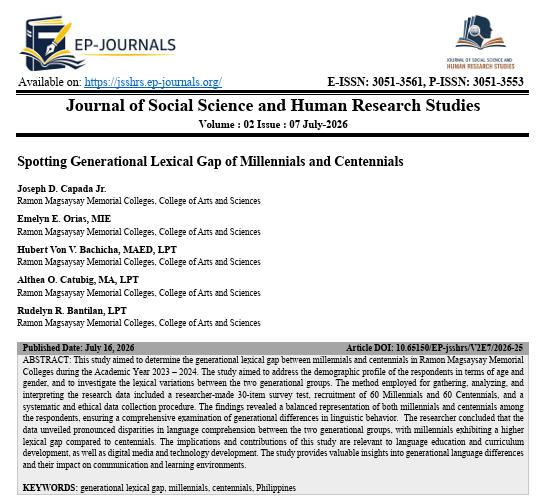
Spotting Generational Lexical Gap of Millennials and Centennials
DOI:
https://doi.org/10.65150/EP-jsshrs/V2E7/2026-25Keywords:
generational lexical gap, millennials, centennials, PhilippinesAbstract
This study aimed to determine the generational lexical gap between millennials and centennials in Ramon Magsaysay Memorial Colleges during the Academic Year 2023 – 2024. The study aimed to address the demographic profile of the respondents in terms of age and gender, and to investigate the lexical variations between the two generational groups. The method employed for gathering, analyzing, and interpreting the research data included a researcher-made 30-item survey test, recruitment of 60 Millennials and 60 Centennials, and a systematic and ethical data collection procedure. The findings revealed a balanced representation of both millennials and centennials among the respondents, ensuring a comprehensive examination of generational differences in linguistic behavior. The researcher concluded that the data unveiled pronounced disparities in language comprehension between the two generational groups, with millennials exhibiting a higher lexical gap compared to centennials. The implications and contributions of this study are relevant to language education and curriculum development, as well as digital media and technology development. The study provides valuable insights into generational language differences and their impact on communication and learning environments.
References
1) Bader, Y. F., & Al-Shatnawi, S. F. (2021, March 1). Lexical Variation in the Rural North Jordanian Dialect. Studies in Linguistics and Literature, 5(1), p94. https://doi.org/10.22158/sll.v5n1p94
2) Bevilacqua, M., Maru, M., & Navigli, R. (2020). Generationary or “How We Went beyond Word Sense Inventories and Learned to Gloss.” Proceedings of the 2020 Conference on Empirical Methods in Natural Language Processing (EMNLP). https://doi.org/10.18653/v1/2020.emnlp-main.585
3) Bisht, R. (2024, April 24). What Are Sampling Methods? Techniques, Types, and Examples | Researcher Life. https://researcher.life/blog/article/what-are-sampling-methods-techniques-types-and-examples/?fbclid=IwZXh0bgNhZW0CMTAAAR2HplluqGZDwDS9xEWbU4XPNBHTzYzPXpwr-z6cFtUi8MUWKwLREgFHVTk_aem_Af5Ooptd5xPHNKYXv-8VoA0n75N48dtAfJqFo8gr-Y03-z8TIx38JJ7J5jSCBnf9mnbuwX2s9bL3YfdN2X4HhQEr
4) Corballis, M. C. (2017). Language Evolution: A Changing Perspective. Trends in Cognitive Sciences, 21(4), 229–236. doi:10.1016/j.tics.2017.01.013
5) D’Ulizia, A., Ferri, F., & Grifoni, P. (2019, November 25). A Survey on Modeling Language Evolution in the New Millennium. New Generation Computing, 38(1), 97–124. https://doi.org/10.1007/s00354-019-00079-7
6) Davis, D. (2017). The Impact of Social Media on Language Use Among Millennials and Centennials. Journal of Linguistic Evolution, 5(2), 123-145.
7) Davis, D. M. (2020, March 23). 9 slang words teens and Gen Zers are using in 2020 — and their boomer equivalents. Business Insider. https://www.businessinsider.com/gen-z-teens-slang-words-boomer-equivalents?fbclid=IwAR2lUb1P1ngRrlulzsu32lnUstc098LUMPs2bO-zmQY12Y9StxX_zSJO76w
8) Deguma, G. E. (2021, July 8). New Terminologies among Millennials: Upshot of Coin age. International Journal of Social Science and Human Research, 04(07). https://doi.org/10.47191/ijsshr/v4-i7-22
9) Dimock, M. (2019) “Defining Generations Where Millennials End and Generation Z Begins | Pew Research Center. https://www.pewresearch.org/short-reads/2019/01/17/where-millennials-end-and-generation-z-begins/
10) Emha, R. J., & Fatinova, D. (2021, April 22). Indonesian Lingual Variation Use Among Millennials In The Industrial Revolution Era 4.0. JURNAL ARBITRER, 8(1), 35–45. https://doi.org/10.25077/ar.8.1.35-45.2021
11) Greenhill, S. J., Wu, C. H., Hua, X., Dunn, M., Levinson, S. C., & Gray, R. D. (2017, October 4). Evolutionary dynamics of language systems. Proceedings of the National Academy of Sciences, 114(42). https://doi.org/10.1073/pnas.1700388114
12) Hakami, F. A. (2022, September 27). Lexical gap between old and new generations in a Jizani dialect: a sociolinguistic mixed method study. Saudi Journal of Language Studies, 2(4), 220–235. https://doi.org/10.1108/sjls-06-2022-0054
13) Howe, N., & Strauss, W. (1991). Generations: The History of America's Future, 1584 to 2069. William Morrow and Company.
14) Jeresano, E. M., & Careterro, M. D. (2022). Digital Culture and Social Media Slang of Gen Z. United International Journal for Research & Technology, 3(4), 11-25. doi:10.1314/RG.2.2.36361.93285.
15) Johnson, A. B., & Twenge, J. M. (2018). Generational Differences in Language Use: An Exploratory Study. Language and Communication, 58, 12-20.
16) Labov, W. (1972). Sociolinguistic Patterns. University of Pennsylvania Press.
17) Lestarina, A. P. (2022, July 14). Transglossic Language Practice of Generation Z on Instagram in Indonesia. ENLIT Journal, 2(1), 1–10. https://doi.org/10.33654/enlit.v2i1.1476
18) Nordquist, R. (2017, October 9). Examples of Lexicon. ThoughtCo. https://www.thoughtco.com/what-is-a-lexicon-1691231
19) Raviv, L., Meyer, A., & Lev-Ari, S. (2019). Compositional structure can emerge without generational transmission. Cognition, 182, 151–164. doi:10.1016/j.cognition.2018.09.010
20) Roels, L., & Enghels, R. (2020, December). Age-based variation and patterns of recent language change: A case-study of morphological and lexical intensifiers in Spanish. Journal of Pragmatics, 170, 125–138. https://doi.org/10.1016/j.pragma.2020.08.017
21) Roivainen, E. (2018). Generational Changes in Personality: The Evidence From Corpus Linguistics. Psychological Reports, 003329411880593. doi:10.1177/0033294118805937
Rue, P. (2018, July). Make Way, Millennials, Here Comes Gen Z. About Campus: Enriching the Student Learning Experience, 23(3), 5–12. https://doi.org/10.1177/1086482218804251
22) Sirisilla, S., & Sirisilla, S. (2023, February 20). Bridging the Gap: Overcome these 7 flaws in descriptive research design. Enago Academy. https://www.enago.com/academy/descriptive-research-design/#:~:text=Descriptive%20research%20design%20is%20a,a%20particular%20population%20or%20subject.
23) Sophomore Talle Vacalares, Angel Faith R. Salas, Bherna Jane S. Babac, Analyn L. Cagalawan, & Christine D. Calimpong. (2023, June 30). The intelligibility of internet slangs between millennials and Gen Zers: A comparative study. International Journal of Science and Research Archive, 9(1), 400–409. https://doi.org/10.30574/ijsra.2023.9.1.0456
24) Tannen, D. (1990) "You Just Don't Understand: Women and Men in Conversation." William Morrow Paperbacks.
25) Vidales, N. L. (2021). Tendencias de cambio en el comportamiento juvenil ante los media: Millennials vs Generación Z. https://www.semanticscholar.org/paper/Tendencias-de-cambio-en-el-comportamiento-juvenil-Z-Vidales-Rubio/67245da6d2470ff8502989cfe50f48ca5d50eea1
26) White, A., Storms, G., Malt, B. C., & Verheyen, S. (2018, February). Mind the generation gap: Differences between young and old in everyday lexical categories. Journal of Memory and Language, 98, 12–25. https://doi.org/10.1016/j.jml.2017.09.001
Downloads
Published
Issue
Section
License
Copyright (c) 2026 Joseph D. Capada Jr., Emelyn E. Orias MIE, Hubert Von V. Bachicha, MAED LPT, Althea O. Catubig, MA LPT , Rudelyn R. Bantilan LPT (Author)

This work is licensed under a Creative Commons Attribution 4.0 International License.