Dreams of Former Romantic Partners: A Critical Narrative Review of Memory, Attachment, And Psychological Closure
DOI:
https://doi.org/10.65150/EP-jsshrs/V2E9/2026-06Keywords:
attachment, autobiographical memory, dreaming, emotional processing, psychological closure, relationship dissolutionAbstract
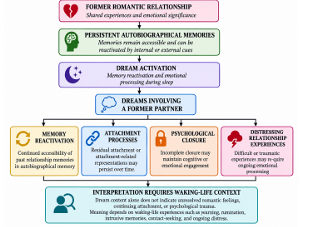
This article examines why former romantic partners may continue to appear in dreams long after a relationship has ended, particularly when individuals perceive themselves as having moved forward in their lives. A critical narrative review was conducted to examine existing research on dreaming, autobiographical memory, emotional processing, romantic relationship dissolution, attachment, psychological closure, and traumatic loss. The review indicates that former-partner dreams may arise from the continued accessibility or reactivation of autobiographical memories associated with emotionally significant relationships. Attachment processes, incomplete psychological closure, and distress following particularly difficult relationship experiences may also contribute in some circumstances. However, the occurrence of a former-partner dream alone does not establish unresolved romantic feelings, continuing attachment, or psychological trauma. Greater interpretive value lies in the individual's waking experiences, particularly persistent yearning, rumination, intrusive memories, contact-seeking, or continuing distress. The article therefore argues that former-partner dreams should not be interpreted through a single psychological explanation. Their significance is better understood through the interaction between memory, emotion, attachment, personal meaning, and present psychological functioning. This perspective offers a more cautious and nuanced understanding of why a former romantic partner may reappear in dreams years after a relationship has ended.
References
1) Chong, J. Y., & Fraley, R. C. (2026). The long-term stability of affective bonds after romantic separation: Do attachments simply fade away? Social Psychological and Personality Science, 17(1), 120–133. https://doi.org/10.1177/19485506251323624
2) Cunningham, T. J., Stickgold, R., & Kensinger, E. A. (2022). Investigating the effects of sleep and sleep loss on the different stages of episodic emotional memory: A narrative review and guide to the future. Frontiers in Behavioral Neuroscience, 16, 910317. https://doi.org/10.3389/fnbeh.2022.910317
3) du Plessis, L., & Lipinska, G. (2023). The modulation of emotional memory consolidation by dream affect. Frontiers in Sleep, 2, 1239530. https://doi.org/10.3389/frsle.2023.1239530
4) Eisma, M. C., Tõnus, D., & de Jong, P. J. (2022). Desired attachment and breakup distress relate to automatic approach of the ex-partner. Journal of Behavior Therapy and Experimental Psychiatry, 75, 101713. https://doi.org/10.1016/j.jbtep.2021.101713
5) Farber, B. A., Roe, D., & Cherner, R. (2025). Remembrances of things past: Toward a clinical understanding of representations of ex-romantic partners. Counselling Psychology Quarterly, 38(4), 1038–1060. https://doi.org/10.1080/09515070.2025.2517011
6) Hayuni, M., Lukman, Z. M., & Norshahira, O. (2023). Bridging income gaps: Empowering small ruminant farmers. International Journal of Research and Innovation in Social Science, 7(8), 1519–1525. https://doi.org/10.47772/IJRISS.2023.7916
7) Hudachek, L., & Wamsley, E. J. (2023). A meta-analysis of the relation between dream content and memory consolidation. Sleep, 46(12), zsad111. https://doi.org/10.1093/sleep/zsad111
8) Norshahira, O., Abdul Razak, A., Lukman, Z. M., & Hayuni, M. (2023). Measuring suicidal ideation among drug addicts in the rehabilitation center. Asian People Journal, 6(1), 133–142. https://doi.org/10.37231/apj.2023.6.1.412
9) Roe, D., Farber, B. A., Yaniv, H., & Anderson, N. (2026). What’s left after a romantic breakup? The vicissitudes of closure. University of Haifa.
10) Schredl, M., Cadiñanos Echevarria, N., Saint Macary, L., & Weiss, A. F. (2020). Partners and ex-partners in dreams: An online survey. International Journal of Dream Research, 13(2), 274–280. https://doi.org/10.11588/ijodr.2020.2.75338
11) Schredl, M., & Wood, L. C. (2021). Partners and ex-partners in dreams: A diary study. Clocks & Sleep, 3(2), 289–297. https://doi.org/10.3390/clockssleep3020018
12) van der Watt, A. S. J., Kidd, M., Roos, A., Lesch, E., & Seedat, S. (2023). Romantic relationship dissolutions are significantly associated with posttraumatic stress symptoms as compared to a DSM-5 Criterion A event: A case-case–control comparison. European Journal of Psychotraumatology, 14(2), 2238585. https://doi.org/10.1080/20008066.2023.2238585
13) Wang, J., Li, X., He, J., Ma, H., Bin, T., Wan, J., Feng, X., Zemmelman, S., & Shen, H. (2021). Integration of waking experience through dreams considered in light of individual differences in implicit learning ability. Journal of Sleep Research, 30(3), e13171. https://doi.org/10.1111/jsr.13171
Downloads
Published
Issue
Section
License
Copyright (c) 2026 Hayuni Mazlan, Lukman Zawawi Mohamad, Norshahira Osman, Ateerah Abdul Razak (Author)

This work is licensed under a Creative Commons Attribution 4.0 International License.