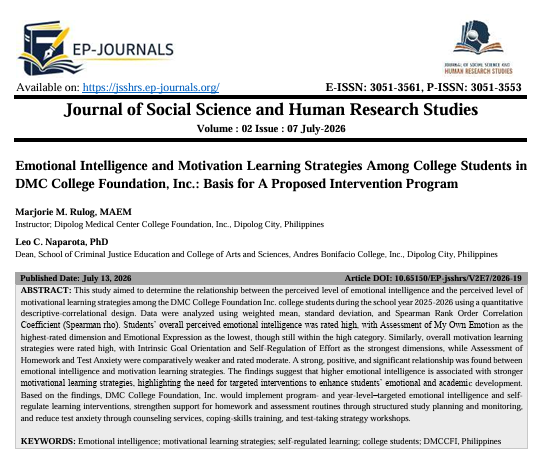
Emotional Intelligence and Motivation Learning Strategies Among College Students in DMC College Foundation, Inc.: Basis for A Proposed Intervention Program
DOI:
https://doi.org/10.65150/EP-jsshrs/V2E7/2026-19Keywords:
Emotional intelligence, motivational learning strategies, self-regulated learning, college students, DMCCFI, PhilippinesAbstract
This study aimed to determine the relationship between the perceived level of emotional intelligence and the perceived level of motivational learning strategies among the DMC College Foundation Inc. college students during the school year 2025-2026 using a quantitative descriptive-correlational design. Data were analyzed using weighted mean, standard deviation, and Spearman Rank Order Correlation Coefficient (Spearman rho). Students’ overall perceived emotional intelligence was rated high, with Assessment of My Own Emotion as the highest-rated dimension and Emotional Expression as the lowest, though still within the high category. Similarly, overall motivation learning strategies were rated high, with Intrinsic Goal Orientation and Self-Regulation of Effort as the strongest dimensions, while Assessment of Homework and Test Anxiety were comparatively weaker and rated moderate. A strong, positive, and significant relationship was found between emotional intelligence and motivation learning strategies. The findings suggest that higher emotional intelligence is associated with stronger motivational learning strategies, highlighting the need for targeted interventions to enhance students’ emotional and academic development. Based on the findings, DMC College Foundation, Inc. would implement program- and year-level–targeted emotional intelligence and self-regulate learning interventions, strengthen support for homework and assessment routines through structured study planning and monitoring, and reduce test anxiety through counseling services, coping-skills training, and test-taking strategy workshops.
References
1) Albani, G., Schimmenti, A., La Marca, L., & Granieri, A. (2022). Emotional intelligence, stress, and self-regulated learning in university students: A moderated mediation model. Frontiers in Psychology, 13, 940837. https://doi.org/10.3389/fpsyg.2022.940837
2) Bance, L. O., & Acopio, J. R. B. (2016). Exploring emotional intelligence and academic performance of Filipino university academic achievers. International Journal of Psychological Studies, 8(3), 164–174. https://doi.org/10.5539/ijps.v8n3p164
3) Beumann, S., & Wegner, E. (2018). Self-assessment of homework: A formative assessment approach to support self-regulated learning. Assessment in Education: Principles, Policy & Practice, 25(4), 1–19.
4) Bordbar, S., Hasannejad Mogadammorki, S., Atashbahar, O., Bahmaei, J., Vejdani, M., & Yusefi, A. R. (2025a). The effect of emotional intelligence on academic performance perceptions: The mediating role of academic self-regulation. Discover Education.
5) Bordbar, S., Rad, H. F., Bahmaei, J., & Vejdani, M. (2025b). The effect of emotional intelligence on academic performance with the mediating role of academic self-regulation: Evidence from college students. Current Psychology.https://doi.org/10.1007/s44217-025-00952-2
6) Brouwer, J., Jansen, E., Severiens, S., & Meeuwisse, M. (2025). Examining the factor structure of the MSLQ in higher education: Evidence for refinement and context sensitivity. Higher Education Research & Development.
7) Chang, M., Lee, J., & Kim, S. (2022). Emotional intelligence and self-regulated learning in college students: Links to motivation and academic engagement. Educational Psychology, 42(7), 1–18.
8) Check, J., & Schutt, R. K. (2012). Research methods in education. SAGE Publications.
9) Chen, X. (2025). Differences in emotional expression among college students: A study on Integrating psychometric methods and algorithm optimization. BMC Psychology, 13, Article 280. https://doi.org/10.1186/s40359-025-02506-5
10) Cook, D. A., Thompson, W. G., & Thomas, K. G. (2011). The Motivated Strategies for Learning Questionnaire: Score validity among medicine residents. Medical Education, 45(12), 1230–1240.
11) Coronado-Maldonado, I., Díaz-Muñoz, R., & González Sodis, J. L. (2025). Emotional intelligence, motivation and learning strategies: The SSREI and MSLQ-SF questionnaires.
12) Credé, M., & Phillips, L. A. (2011). A meta-analytic review of the Motivated Strategies for Learning Questionnaire. Learning and Individual Differences, 21(4), 337–346. https://doi.org/10.1016/j.lindif.2011.03.002
13) Creswell, J. W., & Guetterman, T. C. (2019). Educational research: Planning, conducting, and evaluating quantitative and qualitative research (6th ed.). Pearson.
14) Dåderman, A. M., Albinsson, J., & Jönsson, P. (2025). Refining the Trait Emotional Intelligence Questionnaire–Short Form: An item response theory approach. BMC Psychology, 13, Article 271. https://doi.org/10.1186/s40359-025-03271-1
15) Dayel, A. E., Al-Mobaireek, K. F., Al-Achkar, M. A., & Al-Ajlan, M. S. (2018). Psychometric properties of the Motivated Strategies for Learning Questionnaire among medical students. BMC Medical Education, 18, Article 198.
16) de Araujo, A. M., de Almeida, L. S., & Núñez, J. C. (2023). Validity evidence for the MSLQ in higher education: A contemporary measurement review. Frontiers in Psychology, 14, 1–15.
17) Diseth, Å. (2025). Motivation and learning strategies across academic levels: Differences in intrinsic goals, organization, and effort management. Educational Psychology, 45(2), 1– 20.
18) Elshaer, I. A., Azazz, A. M. S., & Fayyad, M. (2025). Emotional intelligence, social functioning, and academic adjustment among university students: Evidence from a higher education context. BMC Psychology, 13, Article 100.
19) Golden, C. (2023). Fostering critical thinking in higher education through reflective and dialogic practices. Teaching in Higher Education, 28(5), 1–16.
20) Güvendir, M. A. (2022). Item misfit and “uncategorized” responses in scale development: Implications for construct clarity and validity. Educational Measurement: Issues and Practice, 41(3), 1–10.
21) Hemmler, Y. M., & Ifenthaler, D. (2024). Self-regulated learning strategies in continuing education: A systematic review and meta-analysis. Educational Research Review, 45, 100629. https://doi.org/10.1016/j.edurev.2024.100629
22) Hodzic, S., Scharfen, J., Ripoll, P., Holling, H., & Zenasni, F. (2018). How efficient are emotional intelligence trainings? A meta-analysis. Emotion Review, 10(2), 138–148.
23) Huntley, C. D., Young, B., Jha, V., & Fisher, P. L. (2019). The efficacy of interventions for test-anxious university students: A meta-analysis. Journal of Anxiety Disorders, 64, 36–50.
24) Jarso, J. A., & Jaiswal, A. (2024). Test anxiety in higher education: A contemporary review of cognitive and affective mechanisms. Educational Psychology Review, 36(1), 1–25.
25) Kassaw, C., Mekonnen, A., & Workneh, B. (2024). Test anxiety and academic performance among university students: A cross-sectional study. BMC Psychology, 12, Article 240.
26) Kim, Y., Fong, C. J., & Gonzales, C. (2020a). Motivation regulation and learning strategy regulation as pathways to achievement in higher education. Journal of Educational Psychology, 112(6), 1–15.
27) Kim, Y., Wang, Y., Ahn, H. S., & Bong, M. (2020b). College students’ regulation of cognition, motivation, behavior, and context: Distinct or overlapping processes? Learning and Individual Differences, 84, 101973.
28) MacCann, C., Jiang, Y., Brown, L. E. R., Double, K. S., Bucich, M., & Minbashian, A. (2020). Emotional intelligence predicts academic performance: A meta-analysis. Psychological Bulletin, 146(2), 150–186. https://doi.org/10.1037/bul0000219
29) McFarland, S., & Hay, A. (2022). Digital and in-person interpersonal emotion regulation: The role of anxiety, depression, and stress. Journal of Psychopathology and Behavioral Assessment.
30) Merlin, C., Rinaldi, C., & Riva, P. (2024). Emotional self-awareness in university students: Foundations for emotion regulation and adaptive functioning. Frontiers in Psychology, 15, 1–12.
31) Muwonge, C. M., Ssenyonga, J., & Kibedi, H. (2020). Self-regulated learning and critical thinking among university students: A cross-sectional study. Heliyon, 6(8), e04776.
32) Niven, K. (2017). The four key characteristics of interpersonal emotion regulation. Current Opinion in Psychology, 17, 89–93. https://doi.org/10.1016/j.copsyc.2017.06.014
33) Panadero, E. (2017). A review of self-regulated learning: Six models and four directions for research. Frontiers in Psychology, 8, Article 422.
34) Pintrich, P. R., Smith, D. A. F., García, T., & McKeachie, W. J. (1991). A manual for the use of the Motivated Strategies for Learning Questionnaire. National Center for Research to Improve Postsecondary Teaching and Learning, University of Michigan.
35) Quílez-Robres, A., Moyano, N., Cortés Pascual, A., & Romero-Pérez, E. (2023a). Emotional intelligence and academic performance: A systematic review and meta-analysis. Learning and Individual Differences, 101, 102229.
36) Quílez-Robres, A., Usán, P., Lozano-Blasco, R., & Salavera, C. (2023b). Emotional intelligence and academic performance: A systematic review and meta-analysis. Thinking Skills andCreativity, 50, 101355. https://doi.org/10.1016/j.tsc.2023.101355
37) Refugio, C. N., Galleto, J. D., & Torres, M. A. (2019). Interpreting variability in survey-based educational research: Practical guidance on standard deviation reporting. Asia Pacific Journal of Multidisciplinary Research, 7(2), 1–8.
38) Sánchez-Álvarez, N., Berrios Martos, M. P., & Extremera, N. (2020). A meta-analysis of the relationship between emotional intelligence and academic performance in secondary education: A multi-stream comparison. Frontiers in Psychology, 11, Article 1517.https://doi.org/10.3389/fpsyg.2020.01517
39) Sheikhbardsiri, H., Sheikhasadi, H., Mahani, S. A., & Doust Mohamadi, M. M. (2020). Emotional intelligence and learning strategies of postgraduate students at Kerman University of Medical Sciences in the southeast of Iran. Journal of Education and Health Promotion, 9, 1–7.
40) Svartdal, F., Sæle, R. G., Dahl, T. I., Nemtcan, E., & Gamst-Klaussen, T. (2022). Study habits and procrastination: The role of academic self-efficacy. Scandinavian Journal of Educational Research.
41) Theobald, M. (2021a). Self-regulated learning training programs enhance academic performance,self-regulated learning strategies, and motivation: A meta-analysis. Learning and Instruction, 71, 101397.
42) Theobald, M. (2021b). Self-regulated learning training programs enhance university students’ academic performance, self-regulated learning strategies, and motivation: A meta-analysis. Contemporary Educational Psychology, 66, 101976.
43) Ukaul, M., Guntur, M., & Purnomo, E. (2024). A meta-analysis of self-regulated learning intervention studies on learning outcomes in online and blended environments. Online Learning Journal, 28(3), 557–590.
44) von Keyserlingk, L., Schwerter, J., Kunina-Habenicht, O., & Lauermann, F. (2025). Motivation and self-regulated learning as predictors of learning-resource use in learning-management systems in higher education. Educational Psychology.https://doi.org/10.1080/01443410.2025.2564891
45) Xu, L., Chen, G., & Wang, Q. (2022a). The impact of self-regulated learning strategies on academic performance in online learning. Frontiers in Psychology, 13, 1047680.
46) Xu, Z., Zhao, Y., Zhang, B., Liew, J., & Kogut, A. (2022b). A meta-analysis of the efficacy of self- regulated learning interventions on academic achievement in online and blended environments in K–12 and higher education. Behaviour & Information Technology, 42(16), 2911–2931. https://doi.org/10.1080/0144929X.2022.2151935
47) Yan, Z. (2020). Self-assessment in learning: A review of effects on self-regulated learning and achievement. Educational Research Review, 30, 00308.
48) Ye, S., Ho, K. K. W., Wakabayashi, K., et al. (2023). Relationship between university students’ emotional expression on tweets and subjective well-being: Considering the effects of their self-presentation and online communication skills. BMC Public Health, 23, Article 594. https://doi.org/10.1186/s12889-023-15485-2
49) Zhao, X., Li, Y., & Wang, H. (2025). Self-regulated learning strategies in online learning: A systematic review of predictors and outcomes. Frontiers in Psychology, 16, 1–18.
50) Zhao, Y., Xu, Z., & Liew, J. (2026). Emotion-regulation habits and student well-being in demanding learning contexts: Implications for persistence and study engagement. Educational Psychology Review, 38(1), 1–22.
Downloads
Published
Issue
Section
License
Copyright (c) 2026 Marjorie M. Rulog, MAEM, Leo C. Naparota, PhD (Author)

This work is licensed under a Creative Commons Attribution 4.0 International License.