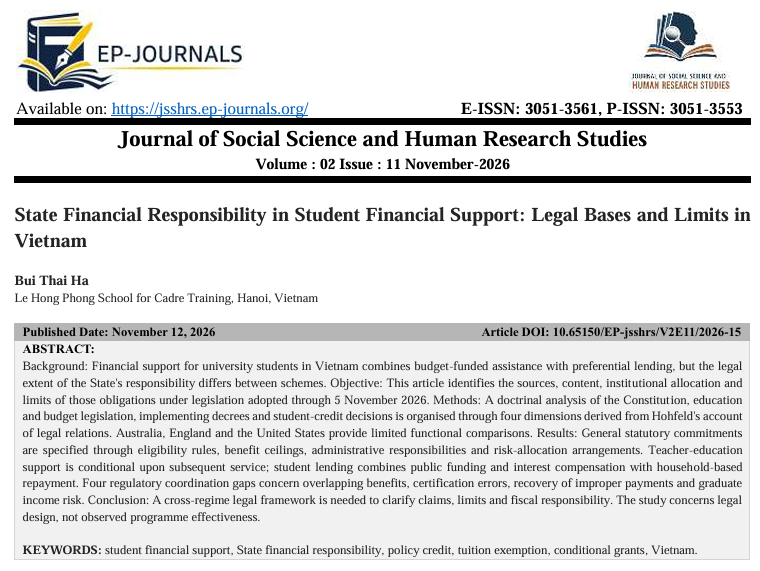
State Financial Responsibility in Student Financial Support: Legal Bases and Limits in Vietnam
DOI:
https://doi.org/10.65150/EP-jsshrs/V2E11/2026-15Keywords:
student financial support, State financial responsibility, policy credit, tuition exemption, conditional grants, Vietnam.Abstract
Background: Financial support for university students in Vietnam combines budget-funded assistance with preferential lending, but the legal extent of the State's responsibility differs between schemes. Objective: This article identifies the sources, content, institutional allocation and limits of those obligations under legislation adopted through 5 November 2026. Methods: A doctrinal analysis of the Constitution, education and budget legislation, implementing decrees and student-credit decisions is organised through four dimensions derived from Hohfeld's account of legal relations. Australia, England and the United States provide limited functional comparisons. Results: General statutory commitments are specified through eligibility rules, benefit ceilings, administrative responsibilities and risk-allocation arrangements. Teacher-education support is conditional upon subsequent service; student lending combines public funding and interest compensation with household-based repayment. Four regulatory coordination gaps concern overlapping benefits, certification errors, recovery of improper payments and graduate income risk. Conclusion: A cross-regime legal framework is needed to clarify claims, limits and fiscal responsibility. The study concerns legal design, not observed programme effectiveness.
References
1) Barr, N., Chapman, B., Dearden, L., & Dynarski, S. (2019). The US college loans system: Lessons from Australia and England. Economics of Education Review, 71, 32-48.
2) Bolhaar, J., Kuijpers, S., Webbink, D., & Zumbuehl, M. (2024). Does replacing grants by income-contingent loans harm enrolment? New evidence from a reform in Dutch higher education. Economics of Education Review, 101, 102546. https://doi.org/10.1016/j.econedurev.2024.102546
3) Britton, J., van der Erve, L., & Higgins, T. (2019). Income contingent student loan design: Lessons from around the world. Economics of Education Review, 71, 65-82.
4) Brooks, J. R., & Levitin, A. J. (2020). Redesigning education finance: How student loans outgrew the "debt" paradigm. The Georgetown Law Journal, 109(1).
5) Chapman, B. (2006). Income contingent loans for higher education: International reforms. In E. A. Hanushek & F. Welch (Eds.), Handbook of the economics of education (Vol. 2, pp. 1435-1503). Elsevier. https://doi.org/10.1016/S1574-0692(06)02025-3
6) Chapman, B., & Liu, A. Y. C. (2013). Repayment burdens of student loans for Vietnamese higher education. Economics of Education Review, 37, 298-308. https://doi.org/10.1016/j.econedurev.2013.06.009
7) Committee on Economic, Social and Cultural Rights. (1999). General Comment No. 13: The right to education (Article 13 of the Covenant) (E/C.12/1999/10). United Nations.
8) Czarnecki, K., Korpi, T., & Nelson, K. (2021). Student support and tuition fee systems in comparative perspective. Studies in Higher Education, 46(11). https://doi.org/10.1080/03075079.2020.1716316
9) de Gayardon, A., & Callender, C. (2025). What is the impact of repaying income-contingent student loan debt on graduates' lives? Lessons from England. Policy Reviews in Higher Education, 9(2), 196-219. https://doi.org/10.1080/23322969.2025.2477574
10) de Silva, T. (2025). Insurance versus moral hazard in income-contingent student loan repayment. The Quarterly Journal of Economics, 140(4), 2851-2905. https://doi.org/10.1093/qje/qjaf036
11) Doan, D., Kang, J., & Zhu, Y. (2020). Financing higher education in Vietnam: Student loan reform (Working Paper No. 51). Centre for Global Higher Education.
12) Herbaut, E., & Geven, K. (2020). What works to reduce inequalities in higher education? A systematic review of the (quasi-)experimental literature on outreach and financial aid. Research in Social Stratification and Mobility, 65, 100442.
https://doi.org/10.1016/j.rssm.2019.100442
13) Hoang, T. T. H., Nguyen, T. K. P., & Tran, N. K. N. (2021). Factors affecting repayment capacity in the student loan programme at the Vietnam Bank for Social Policies in Ho Chi Minh City [in Vietnamese]. Asian Journal of Economics and Banking, (187).
14) Hohfeld, W. N. (1913). Some fundamental legal conceptions as applied in judicial reasoning. The Yale Law Journal, 23(1), 16-59.
15) Johnstone, D. B. (2004). The economics and politics of cost sharing in higher education: Comparative perspectives. Economics of Education Review, 23(4), 403-410. https://doi.org/10.1016/j.econedurev.2003.09.004
16) Lochner, L., & Monge-Naranjo, A. (2012). Credit constraints in education. Annual Review of Economics, 4, 225-256. https://doi.org/10.1146/annurev-economics-080511-110920
17) Marx, B. M., & Turner, L. J. (2018). Borrowing trouble? Human capital investment with opt-in costs and implications for the effectiveness of grant aid. American Economic Journal: Applied Economics, 10(2), 163-201. https://doi.org/10.1257/app.20160127
18) Ministry of Finance. (2026). Draft review report on the implementation of legislation relating to the Prime Minister's proposed decision on credit for pupils and students [in Vietnamese]. Government Portal of Vietnam.
19) Musgrave, R. A. (1959). The theory of public finance: A study in public economy. McGraw-Hill.
20) Nguyen, H., Ho, T. Y. L., & Do, T. B. H. (2024). Implementation results of the student credit policy at the Vietnam Bank for Social Policies [in Vietnamese]. Journal of Science, Ba Ria - Vung Tau University, (4).
21) Nguyen, T. L. (2026). Improving the legal framework for the Vietnam Bank for Social Policies in the context of sustainable development [in Vietnamese]. Banking Review.
22) Nguyen, T. T. M., & Nguyen, H. T. (2021). Solutions to improve the implementation of credit policy for pupils and students [in Vietnamese]. HNUE Journal of Science: Educational Sciences, 66(2), 132-140. https://doi.org/10.18173/2354-1075.2021-0028
23) Nguyen, T. T. T., & Nguyen, T. T. (2025). The law on social policy credit toward women: International experiences and recommendations for Vietnam. Journal of Legal Science, (6).
24) Ninh, T. H. L. (2025). Improving financial support policy for university students in Vietnam: Policy suggestions [in Vietnamese]. Industry and Trade Review, (14).
25) Stiglitz, J. E., & Weiss, A. (1981). Credit rationing in markets with imperfect information. The American Economic Review, 71(3), 393-410.
26) Tran, N. A., Dao, H. T., Banh, T. H., & Vo, D. K. (2023). Higher education financing in Vietnam: Strategic priorities and policy options (Policy note). World Bank.
Downloads
Published
Issue
Section
License
Copyright (c) 2026 Bui Thai Ha (Author)

This work is licensed under a Creative Commons Attribution 4.0 International License.