Exploring the Integration of Language Literacy and Numeracy in Junior High School Students' Conceptual Understanding of Geometry Based on Pirie-Kieren Theory
DOI:
https://doi.org/10.65150/EP-jsshrs/V2E9/2026-05Keywords:
language literacy, numeracy, conceptual understanding, geometry, Pirie-Kieren theory, junior high schoolAbstract
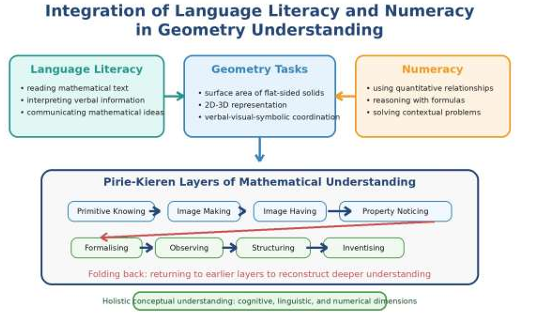
This article presents an exploratory qualitative study designed to examine how language literacy and numeracy are integrated in junior high school students' conceptual understanding of geometry through the lens of Pirie-Kieren theory. The study is motivated by persistent difficulties among students in understanding geometric concepts, connecting mathematical representations, and communicating mathematical ideas in a logical and systematic manner. In geometry learning, students are required not only to perform numerical procedures but also to read mathematical texts, interpret symbols, coordinate visual representations, and construct meaning from verbal, symbolic, and spatial information. The study uses a descriptive-exploratory qualitative design involving seventh-grade students at SMPN 21 Pontianak. At the initial stage, 60 students are involved in a conceptual understanding test and classroom observation on the topic of surface area of flat-sided solid figures. Six students are then selected purposively for in-depth analysis based on variations in their conceptual understanding. Data are collected through conceptual understanding tests, literacy-based tasks, classroom observation, semi-structured interviews, and students' written artifacts. Data analysis is conducted through data reduction, open coding, axial coding, selective coding, interpretation, and triangulation based on the eight layers of Pirie-Kieren mathematical understanding. The expected contribution of this study is a conceptual model explaining the interaction between language literacy, numeracy, and students' geometric understanding, including the identification of conceptual and linguistic obstacles that emerge during geometry learning.
References
1) Battista, M. T. (2017). Geometry and geometric reasoning. In J. Cai (Ed.), Compendium for research in mathematics education (pp. 584-613). National Council of Teachers of Mathematics.
2) Creswell, J. W. (2012). Research design: Qualitative, quantitative, and mixed methods approaches (4th ed.). SAGE Publications.
3) Fraenkel, J. R., Wallen, N. E., & Hyun, H. H. (2012). How to design and evaluate research in education (8th ed.). McGraw-Hill.
4) Gulkilik, H., Moyer-Packenham, P. S., Ugurlu, H. H., & Yuruk, N. (2020). Examining students' mathematical understanding through PirieKieren theory. International Journal of Mathematical Education in Science and Technology, 51(7), 1031-1048. https://doi.org/10.1080/0020739X.2019.1672901
5) Harel, G. (2008). What is mathematics? A pedagogical answer to a philosophical question. In B. Gold & R. A. Simons (Eds.), Current issues in the philosophy of mathematics from the perspective of mathematicians. Mathematical Association of America.
6) Hatch, J. A. (2002). Doing qualitative research in education settings. State University of New York Press.
7) Hiebert, J., & Grouws, D. A. (2007). The effects of classroom mathematics teaching on students' learning. In F. K. Lester Jr. (Ed.), Second handbook of research on mathematics teaching and learning (pp. 371-404). Information Age Publishing.
8) Kementerian Pendidikan, Kebudayaan, Riset, dan Teknologi. (2022). Kurikulum Merdeka: Panduan pembelajaran dan asesmen. Kemendikbudristek.
9) Kieren, T., & Pirie, S. (2019). Growth of mathematical understanding: How can we characterize it and how can we represent it? Journal of Mathematical Behavior, 55, 100687.
10) Marshall, C., & Rossman, G. B. (2016). Designing qualitative research (6th ed.). SAGE Publications.
11) Moschkovich, J. N. (2015). Academic literacy in mathematics for English learners. Journal of Mathematical Behavior, 40, 43-62.
12) Nabilah, W., Faradiba, S. S., Fuat, F., Risalah, D., & Widjajanti, K. (2024). Profile of students' mathematical literacy based on level of mathematical connection ability. Journal Mathematics of Education, 9(1), 89-107. https://doi.org/10.31327/jme.v9i1.2020 13) National Council of Teachers of Mathematics. (2020). Catalyzing change in middle school mathematics. NCTM.
13) OECD. (2019). PISA 2018 results (Volume I): What students know and can do. OECD Publishing.
14) Pirie, S., & Kieren, T. (1994). Growth in mathematical understanding: How can we characterize it and how can we represent it? Educational Studies in Mathematics, 26(2-3), 165-190. https://doi.org/10.1007/BF01273662
15) Prediger, S., & Wessel, L. (2018). Braiding language and mathematics education: Conceptual framework and examples. Journal of Mathematics Education, 11(1), 1-21.
16) Sfard, A. (2018). Thinking as communicating: Human development, the growth of discourses, and mathematizing. Cambridge University Press.
17) Stacey, K. (2015). The international assessment of mathematical literacy: PISA 2012 framework. Journal of Research in Mathematics Education, 46(5), 523-536.
18) Suryadi, D. (2019). Landasan filosofis penelitian desain didaktis (DDR). Pusat Pengembangan DDR Indonesia. 20) Wijaya, A. (2017). Context-based mathematics tasks in Indonesia. Springer.
Downloads
Published
Issue
Section
License
Copyright (c) 2026 Muchtadi, Dewi Risalah, Hariyadi, Syarifah Fadillah Alhadad , Safuan (Author)

This work is licensed under a Creative Commons Attribution 4.0 International License.