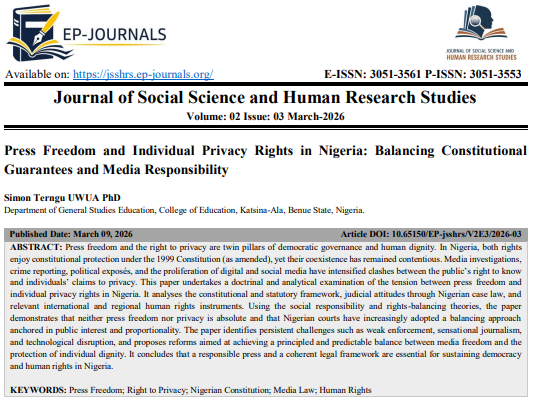
Press Freedom and Individual Privacy Rights in Nigeria: Balancing Constitutional Guarantees and Media Responsibility
DOI:
https://doi.org/10.65150/EP-jsshrs/V2E3/2026-03Keywords:
Press Freedom; Right to Privacy; Nigerian Constitution; Media Law; Human RightsAbstract
Press freedom and the right to privacy are twin pillars of democratic governance and human dignity. In Nigeria, both rights enjoy constitutional protection under the 1999 Constitution (as amended), yet their coexistence has remained contentious. Media investigations, crime reporting, political exposés, and the proliferation of digital and social media have intensified clashes between the public’s right to know and individuals’ claims to privacy. This paper undertakes a doctrinal and analytical examination of the tension between press freedom and individual privacy rights in Nigeria. It analyses the constitutional and statutory framework, judicial attitudes through Nigerian case law, and relevant international and regional human rights instruments. Using the social responsibility and rights-balancing theories, the paper demonstrates that neither press freedom nor privacy is absolute and that Nigerian courts have increasingly adopted a balancing approach anchored in public interest and proportionality. The paper identifies persistent challenges such as weak enforcement, sensational journalism, and technological disruption, and proposes reforms aimed at achieving a principled and predictable balance between media freedom and the protection of individual dignity. It concludes that a responsible press and a coherent legal framework are essential for sustaining democracy and human rights in Nigeria.
References
1) Abacha v. Fawehinmi (2000) 6 NWLR (Pt. 660) 228.
2) Akanbi, M. (2019). Media law and practice in Nigeria. Lagos: Princeton Publishing.
3) Akintola, A., & Olatunji, R. (2020). Digital media and privacy rights in Nigeria. Nigerian Journal of Communication, 17(2), 45–63.
4) Alexy, R. (2002). A theory of constitutional rights. Oxford: Oxford University Press.
5) Constitution of the Federal Republic of Nigeria 1999 (as amended).
6) Cybercrimes (Prohibition, Prevention, etc.) Act 2015.
7) Freedom of Information Act 2011.
8) International Covenant on Civil and Political Rights, 1966.
9) McQuail, D. (2010). McQuail’s mass communication theory (6th ed.). London: Sage.
10) Medical and Dental Practitioners Disciplinary Tribunal v. Okonkwo (2001) 7 NWLR (Pt. 711) 206.
11) Ogbondah, C. (2003). State, press and politics in Nigeria. Ibadan: Stirling-Horden.
12) Ojo, E. O. (2011). Press freedom and democracy in Nigeria. African Studies Review, 54(2), 63–78.
13) Okonkwo v. Guinness (Nig.) Plc (1980) 1 NCR 212.
14) Onagoruwa v. Inspector-General of Police (1991) 5 NWLR (Pt. 193) 593.
15) R v. Amalgamated Press of Nigeria Ltd (1961) All NLR 199.
16) Siebert, F. S., Peterson, T., & Schramm, W. (1956). Four theories of the press. Urbana: University of Illinois Press.
17) Solove, D. J. (2008). Understanding privacy. Cambridge, MA: Harvard University Press.
18) Tony Momoh v. Senate of the National Assembly (1981) 1 NCLR 105.
19) Universal Declaration of Human Rights, 1948.
20) Warren, S. D., & Brandeis, L. D. (1890). The right to privacy. Harvard Law Review, 4(5), 193–220.
Downloads
Published
Issue
Section
License
Copyright (c) 2026 Simon Terngu UWUA PhD (Author)

This work is licensed under a Creative Commons Attribution 4.0 International License.