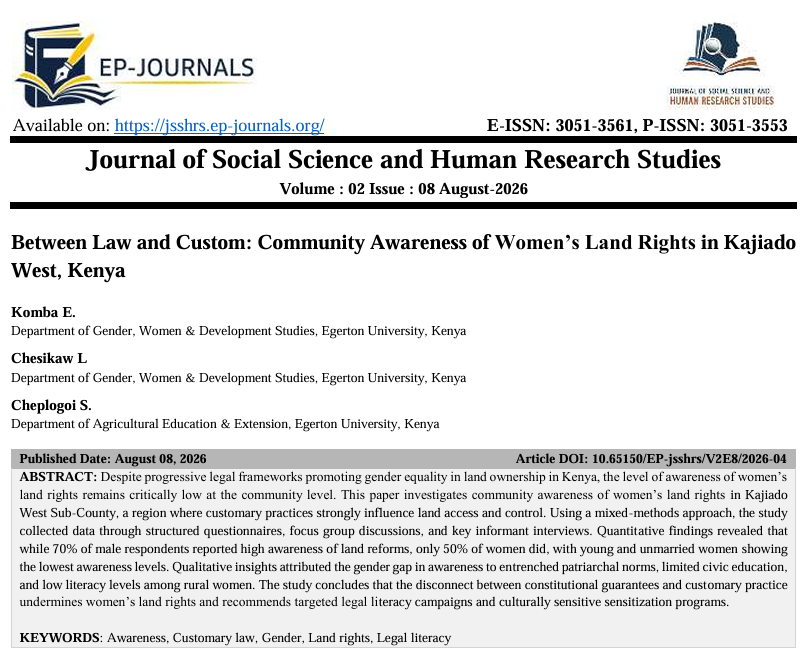
Between Law and Custom: Community Awareness of Women’s Land Rights in Kajiado West, Kenya
DOI:
https://doi.org/10.65150/EP-jsshrs/V2E8/2026-04Keywords:
Awareness, Customary law, Gender, Land rights, Legal literacyAbstract
Despite progressive legal frameworks promoting gender equality in land ownership in Kenya, the level of awareness of women’s land rights remains critically low at the community level. This paper investigates community awareness of women’s land rights in Kajiado West Sub-County, a region where customary practices strongly influence land access and control. Using a mixed-methods approach, the study collected data through structured questionnaires, focus group discussions, and key informant interviews. Quantitative findings revealed that while 70% of male respondents reported high awareness of land reforms, only 50% of women did, with young and unmarried women showing the lowest awareness levels. Qualitative insights attributed the gender gap in awareness to entrenched patriarchal norms, limited civic education, and low literacy levels among rural women. The study concludes that the disconnect between constitutional guarantees and customary practice undermines women’s land rights and recommends targeted legal literacy campaigns and culturally sensitive sensitization programs.
References
1) Chimhowu, A., & Woodhouse, P. (2006). Customary vs private property rights? Dynamics and trajectories of vernacular land markets in sub-Saharan Africa. Journal of Agrarian Change, 6(3), 346-371. https://doi.org/10.1111/j.1471-0366.2006.00125.x
2) Dawson, N. M., Bhardwaj, A., Coolsaet B., Scherl, L. M., Massarella, K., Ndoinyo, Y., Oliva, M., Suich, H., & Worsdell, T. (Eds.) (2023). Journeys to more equitable and effective conservation: the central role of Indigenous peoples and local communities. Policy Matters. Issue No. 23. Gland, Switzerland: IUCN.
3) Gaafar, R. (2014). Women and land rights in Kenya: Challenges and opportunities. Journal of Eastern African Studies, 8(1), 29-45.
4) Kabeer, N. (1994). Reversed realities: Gender hierarchies in development thought. Verso.
5) Julius, L. W. (2025) Navigating the Crossroads: Patriarchy and Women’s Rights in Kenya’s Legal Landscape. Beijing Law Review, 16, 201-226. doi: 10.4236/blr.2025.161010.
6) Mbote, P. K. (2005). Gender land rights in Kenya: Problems and prospects. Law Development Review, 8(1), 69–85.
7) Mutangiri, J. (2023). Empowering women through legal literacy: Evidence from rural Kenya. Journal of African Governance,12(1),45–60.
8) Empowering women : legal rights and economic opportunities in Africa (English). Washington, DC: World Bank.
http://documents.worldbank.org/curated/en/486741468204841288
9) Harari, M. (2019). Women’s Inheritance Rights and Bargaining Power: Evidence from Kenya. Economic Development and Cultural Change, 68(1), 189–238. https://www.jstor.org/stable/26844952
10) Njeru, L. K., & Mwangi, J. G. (2017), “Influence of gender differences on youth participation in agriculture in Kajiado North Sub County, Kenya”, International Journal of Development and Sustainability, Vol. 6 No. 8, pp. 851-861.
11) Njeru, P. (2018). Land, gender, and customary norms in Kenya. Rural Gender Studies, 6(3), 101–118.
12) Njue, M., & Kabira, W. (2021). Legal empowerment and gendered land access in Kenya. Gender & Development, 29(1), 55–72.
13) Mutida, A. K. (2011). A Study on the effect of Kenya's land policies on the land rights of Kenyan women (Doctoral dissertation, KDI School)
14) Kenya Human Rights Commission. (2011). Position Paper on Engendered and Rights-Based Land Reforms in Kenya. Kenya Human Rights Commission. Nairobi: KHRC.
15) Olomi, K. (2023). Maasai women and land rights: Continuity and change in Kajiado County. Nomadic Studies, 15(1), 77–93.
16) Nanyamal, W. T. (2023). Effects of Land Subdivision on Sustainable Livestock Production in Mbirikani Ward, Kajiado County, Kenya (Doctoral dissertation, University of Nairobi).
17) Mwangi, A. W. (2018). Determinants of changing gender roles among the Maasai women living in Ngong town, Kajiado County, Kenya (Doctoral dissertation, University of Nairobi).
18) Tajirika, L., & Owuor, J. (2022). Pastoralism and the struggle for land equity in Kenya. Pastoralist Journal of Development, 9(2), 33–50.
19) Waweru, Jerusha. (2023). Contribution of Land Tenure Changes in Empowering Maasai Women Pastoralists in Resources Management: A Case Study of Elangatwuas Ward, Kajiado County, Kenya. The International Journal of Humanities & Social Studies. 10.24940/theijhss/2023/v11/i5/HS2305-036.
20) UN Women. (2020). Progress of the world’s women 2019-2020: Families in a changing world. United Nations Entity for Gender Equality and the Empowerment of Women.
21) Waiganjo, E., Wanjala, S., & Musyoka, M. (2001). Land tenure and sustainable use in Kenya: Towards innovative land management. Institute for Law and Environmental Governance.
22) Waiganjo, C., & Ngugi, P. E. N. (2001, October 2–5). The Effects of Existing Land Tenure Systems on Land Use in Kenya Today.
International Conference on Spatial Information for Sustainable Development, Nairobi, Kenya
23) Wangari, N. (2020). Land reform awareness and civic participation in Kenya. African Public Law Review, 5(4), 220–238.
24) Wangari, E., Kamau, W., & Kinyau, A. M. (2005). Globalization in the Third World: Impact on Women's Land Rights and Education in Kenya. In Forum on Public Policy (Vol. 1, No. 3, pp. 290-304).
Downloads
Published
Issue
Section
License
Copyright (c) 2026 Komba E., Chesikaw L, Cheplogoi S. (Author)

This work is licensed under a Creative Commons Attribution 4.0 International License.