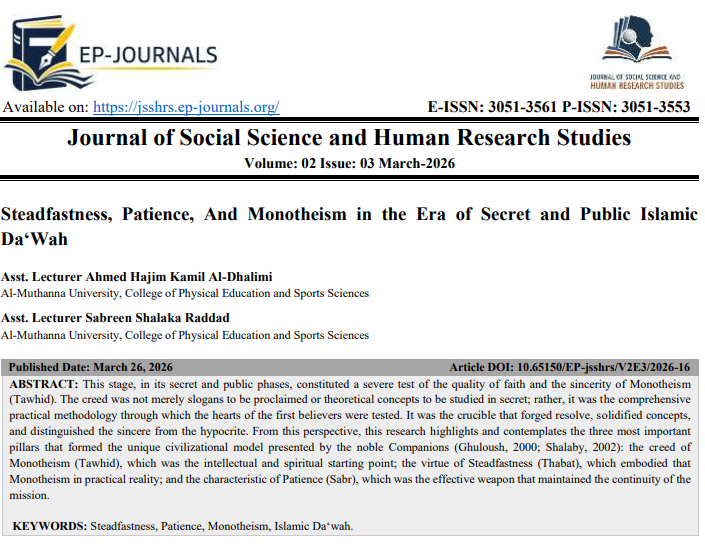
Steadfastness, Patience, And Monotheism in the Era of Secret and Public Islamic Da‘Wah
DOI:
https://doi.org/10.65150/EP-jsshrs/V2E3/2026-16Keywords:
Steadfastness, Patience, Monotheism, Islamic Da‘wah.Abstract
This stage, in its secret and public phases, constituted a severe test of the quality of faith and the sincerity of Monotheism (Tawhid). The creed was not merely slogans to be proclaimed or theoretical concepts to be studied in secret; rather, it was the comprehensive practical methodology through which the hearts of the first believers were tested. It was the crucible that forged resolve, solidified concepts, and distinguished the sincere from the hypocrite. From this perspective, this research highlights and contemplates the three most important pillars that formed the unique civilizational model presented by the noble Companions (Ghuloush, 2000; Shalaby, 2002): the creed of Monotheism (Tawhid), which was the intellectual and spiritual starting point; the virtue of Steadfastness (Thabat), which embodied that Monotheism in practical reality; and the characteristic of Patience (Sabr), which was the effective weapon that maintained the continuity of the mission.
References
1) Ibn Hanbal, Ahmad bin Muhammad. (2001). Al-Musnad (Investigated by Shu'ayb Al-Arna'ut et al.). Beirut: Mu'assasat Al-Risalah.
2) Ibn Sa'd, Muhammad bin Sa'd. (1990). Al-Tabaqat Al-Kubra (Investigated by Muhammad Abdul-Qadir 'Ata). Beirut: Dar Al-Kutub Al-'Ilmiyyah.
3) Ibn Kathir, Isma'il bin 'Umar. (1988). Al-Bidayah wa Al-Nihayah. Beirut: Dar Al-Fikr.
4) Ibn Kathir, Isma'il bin 'Umar. (1999). Tafsir Al-Quran Al-'Azim (Investigated by Sami bin Muhammad Al-Salamah). Riyadh: Dar Taybah for Publishing and Distribution.
5) Ibn Hisham, 'Abd Al-Malik. (n.d.). Al-Sirah Al-Nabawiyyah (Investigated by Mustafa Al-Saqqa et al.). Dar Al-Khayr.
6) Ibn Taymiyyah, Ahmad bin 'Abd Al-Halim. (1995). Al-Amr bi Al-Ma'ruf wa Al-Nahy 'an Al-Munkar (Investigated by Salah Al-Din Al-Munajjid). Beirut: Dar Al-Kitab Al-'Arabi.
7) Bennabi, Malek. (1986). Shurut Al-Nahdah. Dar Al-Fikr.
8) Al-Sa'di, 'Abd Al-Rahman bin Nasir. (2000). Taysir Al-Karim Al-Rahman fi Tafsir Kalam Al-Mannan (Investigated by 'Abd Al-Rahman bin Mu'alla Al-Luwayhiq). Beirut: Mu'assasat Al-Risalah.
9) Al-Sirjani, Raghib. (2010). Al-Sirah Al-Nabawiyyah: Dirasah Manhajiyyah Muwaththaqah. Cairo: Mu'assasat Iqra'.
10) Al-Sallabi, 'Ali Muhammad. (2005). Al-Sirah Al-Nabawiyyah: 'Ard Waqa'i' wa Tahlil Ahdath. Dar Al-Ma'rifah.
11) AL-Dhalimee, Ahmed Hachim Kamil, & Raddad, Sabreen Shalaka. (Publication date not available). Steadfastness, Patience, and Monotheism in the Era of Secret and Public Islamic Da‘wah.
12) Al-Tabari, Muhammad bin Jarir. (2001). Jami' Al-Bayan 'an Ta'wil Ay Al-Quran. Cairo: Dar Hajar for Printing and Publishing.
13) Al-'Amili, Ja'far Murtada. (2006). Al-Sahih min Sirat Al-Nabi Al-A'zam. Beirut: Dar Al-Sirah.
14) Ghuloush, Ahmad Ahmad. (2000). Al-Sirah Al-Nabawiyyah wa Al-Da'wah fi Al-'Ahd Al-Makki. Beirut: Mu'assasat Al-Risalah.
15) Qutb, Sayyid. (2002). Fi Zilal Al-Quran. Cairo: Dar Al-Shorouk.
16) Al-Mubarakpuri, Safiur Rahman. (2003). Ar-Raheeq Al-Makhtum. Dar Al-Hilal.
17) Al-Naysaburi, Al-Hakim. (n.d.). Al-Mustadrak 'ala Al-Sahihayn. Beirut: Dar Al-Ma'rifah.
Downloads
Published
Issue
Section
License
Copyright (c) 2026 Asst. Lecturer Ahmed Hajim Kamil Al-Dhalimi, Asst. Lecturer Sabreen Shalaka Raddad (Author)

This work is licensed under a Creative Commons Attribution 4.0 International License.