The Impact of Translanguaging on Student Assessment Performance: A Scope Review
DOI:
https://doi.org/10.65150/EP-jsshrs/V2E4/2026-07Keywords:
Translanguaging, assessment performance, systematic review, PRISMA, multilingual education, assessment validity.Abstract
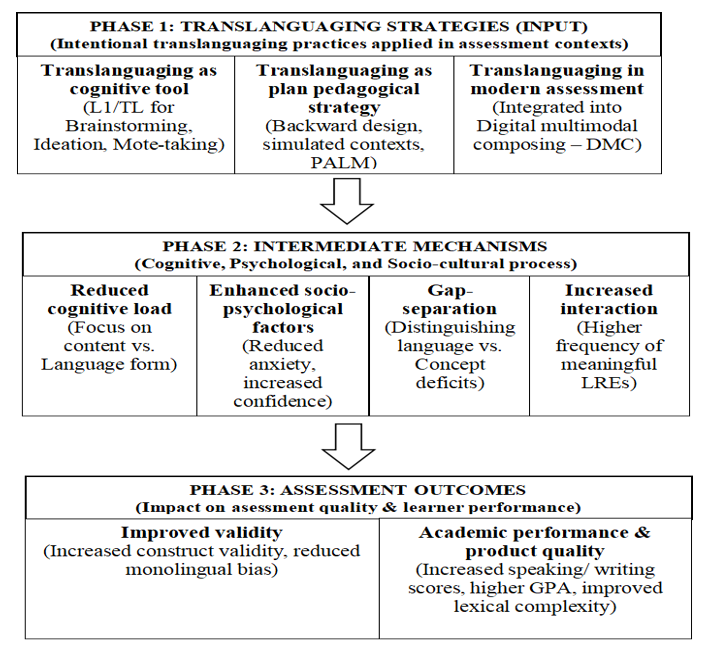
Traditional monolingual assessment methods fail to accurately measure the competence of multilingual learners because they focus more on language than content, leading to inequality in education. This review, conducted within the PRISMA 2020 and SPIDER frameworks, systematically analyzes studies on the impact of translanguaging (TL) on the assessment performance of multilingual learners. The study searched the primary databases ERIC, ProQuest, ScienceDirect, and two secondary databases, Google Scholar and ResearchGate, to ensure a comprehensive search. The search yielded 4910 documents, and the PRISMA screening process selected eight research papers published between 2014 and 2024. These studies primarily followed two main approaches: TL as a cognitive support tool for learners (e.g., using L1 for brainstorming) and TL as a planned pedagogical strategy in assessment design. The results show that TL helps learners gain confidence in expressing concepts, reduces language anxiety, and promotes fairness in assessment. Therefore, this study proposes a logical model linking TL strategies with assessment outcomes to foster a more equitable and effective multilingual educational environment.
References
1) Afitska, O. (2020). Translanguaging in diverse multilingual classrooms in England: Oasis or a mirage? The European Journal of Applied Linguistics and TEFL, 9(1), 153-181.
2) Black, P., & Wiliam, D. (1998). Assessment and classroom learning. Assessment in Education: Principles, Policy & Practice, 5(1), 7–74. doi:10.1080/0969595980050102
3) Brown, H., & Abeywickrama, P. (2019). Language assessment: Principles and classroom practices (3rd ed.). White Plains, NY: Pearson Education.
4) Canagarajah, S. (2011). Translanguaging in the classroom: Emerging issues for research and pedagogy. Applied Linguistics Review, 2(1), 1-28. doi:10.1515/9783110239331.1
5) Cots, J., Gallego-Balsà, L., & Llanes, À. (n.d.). Promoting translanguaging (or not) in the ESP classroom: An analysis of monoglossic and heteroglossic practices and discourses. System, 107, 102795. doi:10.1016/j.system.2022.102795
6) Creese, A., & Blackledge, A. (2010). Translanguaging in the bilingual classroom: A pedagogy for learning and teaching? The Modern Language Journal, 94(1), 103-115. doi:doi.org/10.1111/j.1540-4781.2009.00986.x
7) Charamba, E. (2023). Translanguaging as bona fide practice in a multilingual. International review of Education, 69.
doi:10.1007/s11159-023-09990-0
8) Dai, D., Vu, T., Knoch, U., Lim, A., Malone, D., & Mak, V. (2024). Expanding Kane's argument-based validity framework: What can validation practices in language assessment offer health professions education? Medical Education, 58(6), 588–600. doi:10.1111/medu.15452
9) García, O., & Kleyn, T. (2016). Translanguaging with multilingual students: Learning from classroom moments.
10) García, O., & Lin, A. (2017). Translanguaging in Bilingual Education. In O. García, A. Lin, & S. May, Bilingual and Multilingual Education (pp. 117–130). Springer . doi:10.1007/978-3-319-02258-1_9
11) García, O., & Wei, L. (2014). Translanguaging: Language, bilingualism and education. Palgrave Macmillan.
12) Hawkins, M. (2024). Validation practice in health: Where do we go from here? Quality of Life Research, 33, 2051–2052. doi:10.1007/s11136-024-03732-x
13) Hong, Q., Gonzalez-Reyes, A., & Pluye, P. (2018). The Mixed Methods Appraisal Tool (MMAT) version 2018 for systematic reviews of primary qualitative, quantitative and mixed methods studies. International Journal of Nursing Studies(86), 9-14.
14) Jiang, L., Li, Z., & Leung, J. (2024). Digital multimodal composing as translanguaging assessment in CLIL classrooms. Learning and Instruction, 92, 101900. doi:10.1016/j.learninstruc.2024.101900
15) Kareem, N., & Adams, R. (2024). Translanguaging and Collaboration in EFL Writing. Language Teaching Research Quarterly, 46, 325–345. doi:10.32038/ltrq.2024.46.20
16) Lei , J., & Hu, G. (2023). Research on English-medium instruction in the Asia Pacific: Trends, foci, challenges, and strategies. In W. O. Lee, P. Brown, A. L. Goodwin, & A. Green, International handbook on education development in Asia-Pacific (pp. 637–651). Singapore: Springer Nature Singapore. doi:10.1007/978-981-16-2327-1_23-1
17) Li, W. (2018). Translanguaging as a practical theory of language. Applied Linguistics, 39(1), 9-30. doi:10.1093/applin/amx039
18) Lin, A., & He, P. (2017). Translanguaging as dynamic activity flows in CLIL classrooms. Journal of Language, Identity and Education, 16(4), 228–244. doi:https://doi.org/10.1080/15348458.2017.1328283
19) Meletiadou, E. (2022). The Utilisation of Peer-Assisted Learning/Mentoring and Translanguaging in Higher Education. IAFOR Journal of Education: Language Learning in Education, 10(1), 135-154.
20) Nguyen, T. (2022). A review of studies on EFL teachers’ and students’ perceptions of translanguaging as a pedagogical approach. International Journal of TESOL & Education, 2(3), 324–331. doi:10.54855/ijte.222322
21) Otheguy, R., García, O., & Reid, W. (2015). Clarifying translanguaging and deconstructing named languages: A perspective from linguistics. Applied Linguistics Review, 6(3), 281–307. doi:10.1515/applirev-2015-0014
22) Parmegiani, A. (2014). Bridging literacy practices through storytelling, translanguaging, and an ethnographic partnership: A case study of Dominican students at Bronx Community College. Journal of Basic Writing, 33(1), 23–50. doi:10.37514/JBW-J.2014.33.1.03
23) Simatupang, E., & Supri, I. (2024). Fusing translanguaging with speaking technology in the hospitality industry: Improving English communicative competence. Social Sciences & Humanities Open, 10, 101166. doi:10.1016/j.ssaho.2024.101166
Downloads
Published
Issue
Section
License
Copyright (c) 2026 Phuong Bao Tran Nguyen, Tran Mong Huynh Nguyen (Author)

This work is licensed under a Creative Commons Attribution 4.0 International License.