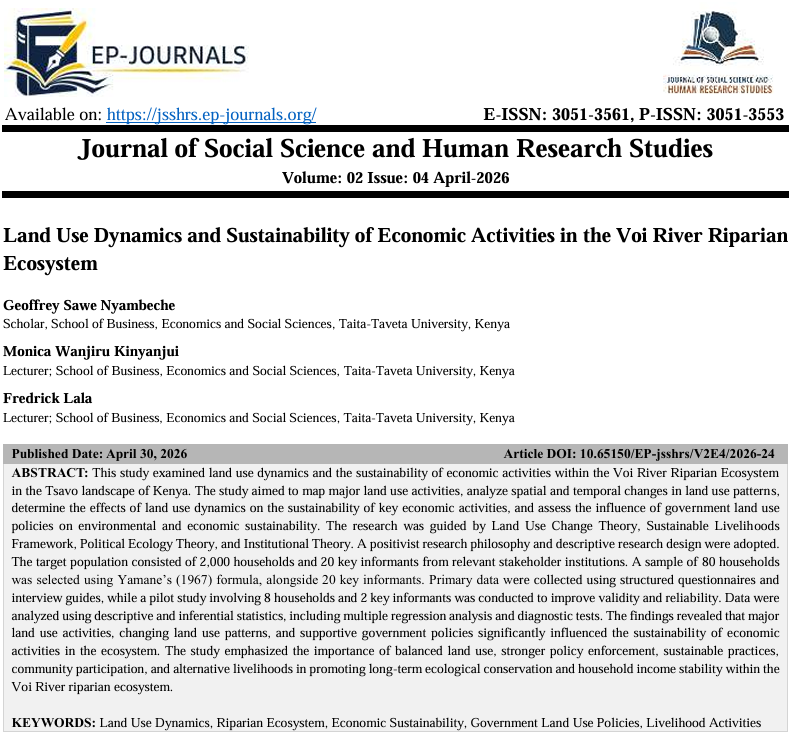
Land Use Dynamics and Sustainability of Economic Activities in the Voi River Riparian Ecosystem
DOI:
https://doi.org/10.65150/EP-jsshrs/V2E4/2026-24Keywords:
Land Use Dynamics, Riparian Ecosystem, Economic Sustainability, Government Land Use Policies, Livelihood ActivitiesAbstract
This study examined land use dynamics and the sustainability of economic activities within the Voi River Riparian Ecosystem in the Tsavo landscape of Kenya. The study aimed to map major land use activities, analyze spatial and temporal changes in land use patterns, determine the effects of land use dynamics on the sustainability of key economic activities, and assess the influence of government land use policies on environmental and economic sustainability. The research was guided by Land Use Change Theory, Sustainable Livelihoods Framework, Political Ecology Theory, and Institutional Theory. A positivist research philosophy and descriptive research design were adopted. The target population consisted of 2,000 households and 20 key informants from relevant stakeholder institutions. A sample of 80 households was selected using Yamane’s (1967) formula, alongside 20 key informants. Primary data were collected using structured questionnaires and interview guides, while a pilot study involving 8 households and 2 key informants was conducted to improve validity and reliability. Data were analyzed using descriptive and inferential statistics, including multiple regression analysis and diagnostic tests. The findings revealed that major land use activities, changing land use patterns, and supportive government policies significantly influenced the sustainability of economic activities in the ecosystem. The study emphasized the importance of balanced land use, stronger policy enforcement, sustainable practices, community participation, and alternative livelihoods in promoting long-term ecological conservation and household income stability within the Voi River riparian ecosystem.
References
1) Allan, J. D., Castillo, M. M., & Capps, K. A. (2021). Stream ecology: Structure and function of running waters (3rd ed.). Springer.
2) Babbie, E. (2013). The practice of social research (13th ed.). Cengage Learning.
3) Bekele, T., & Tesfaye, M. (2023). Land tenure reforms and environmental policy implementation in riparian zones of the Rift Valley region, Ethiopia. Journal of Environmental Policy and Governance, 33(2), 145–158.
4) Blaikie, P., & Brookfield, H. (1987). Land degradation and society. Methuen.
5) Bryant, R. L., & Bailey, S. (1997). Third world political ecology. Routledge.
6) Chambers, R., & Conway, G. (1992). Sustainable rural livelihoods: Practical concepts for the 21st century. IDS Discussion Paper 296. Institute of Development Studies.
7) Creswell, J. W., & Creswell, J. D. (2018). Research design: Qualitative, quantitative, and mixed methods approaches (5th ed.). Sage Publications.
8) Department for International Development (DFID). (1999). Sustainable livelihoods guidance sheets. DFID.
9) Field, A. (2018). Discovering statistics using IBM SPSS statistics (5th ed.). Sage Publications.
10) Foley, J. A., DeFries, R., Asner, G. P., Barford, C., Bonan, G., Carpenter, S. R., Chapin, F. S., Coe, M. T., Daily, G. C., Gibbs, H. K., Helkowski, J. H., Holloway, T., Howard, E. A., Kucharik, C. J., Monfreda, C., Patz, J. A., Prentice, I. C., Ramankutty, N., & Snyder, P. K. (2021). Global consequences of land use. Science, 309(5734), 570–574.
11) Geist, H. J., & Lambin, E. F. (2002). Proximate causes and underlying driving forces of tropical deforestation. BioScience, 52(2), 143–150.
12) Gujarati, D. N., & Porter, D. C. (2021). Basic econometrics (6th ed.). McGraw-Hill Education.
13) Hair, J. F., Black, W. C., Babin, B. J., & Anderson, R. E. (2020). Multivariate data analysis (8th ed.). Cengage Learning.
14) Kairu, E., Wekesa, P., & Mutua, J. (2023). Land use change and riparian ecosystem sustainability in Kenya: Implications for environmental management. African Journal of Environmental Studies, 15(1), 78–94.
15) Kimaku, P. M. (2021). Determinants of Strategic Change Implementation in State Corporations in Kenya (Doctoral dissertation, JKUAT-COHRED).
16) Kombo, D. K., & Tromp, D. L. A. (2016). Proposal and thesis writing: An introduction. Paulines Publications Africa.
17) Koskey, J., Kipkemboi, J., & Okeyo-Owuor, J. B. (2021). Riparian vegetation and riverbank stability in semi-arid river systems of Kenya. Journal of Arid Environments, 184, 104302.
18) Kothari, C. R. (2021). Research methodology: Methods and techniques (4th ed.). New Age International Publishers.
19) Lambin, E. F., & Geist, H. J. (2021). Land-use and land-cover change: Local processes and global impacts. Springer.
20) Lambin, E. F., Geist, H. J., & Lepers, E. (2021). Dynamics of land-use and land-cover change in tropical regions. Annual Review of Environment and Resources, 28, 205–241.
21) McCarthy, T. S., Ellery, W. N., & Bloem, A. (2021). Sustainable land use and wetland conservation in the Okavango Delta, Botswana. Wetlands Ecology and Management, 29(3), 311–327.
22) Mugenda, O. M., & Mugenda, A. G. (2019). Research methods: Quantitative and qualitative approaches. ACTS Press.
23) Mwakima, J. M., Kimaku, P., & Mwithiga, M. (2025). Public participation in strategic policy management and sustainable socio-economic development in Taita Taveta County, Kenya. International Academic Journal of Economics and Finance (IAJEF)| ISSN 2518-2366, 4(4), 137-187.
24) Mwangi, J., & Wekesa, P. (2022). Adaptive land management and sustainability of riparian livelihoods in Kenya. Journal of Sustainable Development in Africa, 24(3), 102–118.
25) Mwangi, P., Kamau, R., & Karanja, D. (2022). Land use pressures and livelihood sustainability in Kenyan riparian ecosystems. Environmental Management Review, 18(2), 55–73.
26) National Environment Management Authority. (2022). State of the environment report 2022. Government Printer.
27) Njue, N., Githaiga, J., Mutie, S., & Mungai, B. (2016). Human activities and hydrological changes in Kenyan riparian ecosystems. Ecohydrology & Hydrobiology, 16(4), 227–236.
28) North, D. C. (1990). Institutions, institutional change and economic performance. Cambridge University Press.
29) North, D. C. (2005). Understanding the process of economic change. Princeton University Press.
30) Omollo, P., & Ogendi, G. (2023). Sand harvesting, brickmaking and riparian degradation in semi-arid Kenya. Journal of Environmental Conservation, 19(1), 66–81.
31) Orodho, J. A. (2020). Elements of education and social science research methods. Kanezja Publishers.
32) Ostrom, E. (1990). Governing the commons: The evolution of institutions for collective action. Cambridge University Press.
33) Pahl-Wostl, C., Knieper, C., & Lukat, E. (2022). Land use change and water governance in river basins. Water Security, 16, 100113.
34) Pallant, J. (2020). SPSS survival manual: A step by step guide to data analysis using IBM SPSS (7th ed.). McGraw-Hill Education.
35) Patton, M. Q. (2015). Qualitative research and evaluation methods (4th ed.). Sage Publications.
36) Robbins, P. (2004). Political ecology: A critical introduction. Blackwell Publishing.
37) Saunders, M., Lewis, P., & Thornhill, A. (2020). Research methods for business students (8th ed.). Pearson Education.
38) Scoones, I. (2009). Livelihoods perspectives and rural development. The Journal of Peasant Studies, 36(1), 171–196.
39) Smajgl, A., Ward, J., & Pluschke, L. (2015). The water-food-energy nexus—Realising a new paradigm. Journal of Hydrology, 533, 533–540.
40) Tsavo Trust. (2023). Voi River ecosystem conservation status report. Tsavo Trust Publications.
41) Turner, B. L., Moss, R. H., & Skole, D. L. (1994). Relating land use and global land-cover change: A proposal for an IGBP-HDP core project. International Geosphere-Biosphere Programme.
42) Vörösmarty, C. J., McIntyre, P. B., Gessner, M. O., Dudgeon, D., Prusevich, A., Green, P., Glidden, S., Bunn, S. E., Sullivan, C. A., Reidy Liermann, C., & Davies, P. M. (2022). Global threats to human water security and river biodiversity. Nature, 467(7315), 555–561.
43) Wildlife Conservation Society Kenya. (2024). Riparian ecosystem health and wildlife corridor assessment in Tsavo landscape. WCS Kenya.
44) Yamane, T. (1967). Statistics: An introductory analysis (2nd ed.). Harper and Row.
Downloads
Published
Issue
Section
License
Copyright (c) 2026 Geoffrey Sawe Nyambeche, Monica Wanjiru Kinyanjui, Fredrick Lala (Author)

This work is licensed under a Creative Commons Attribution 4.0 International License.