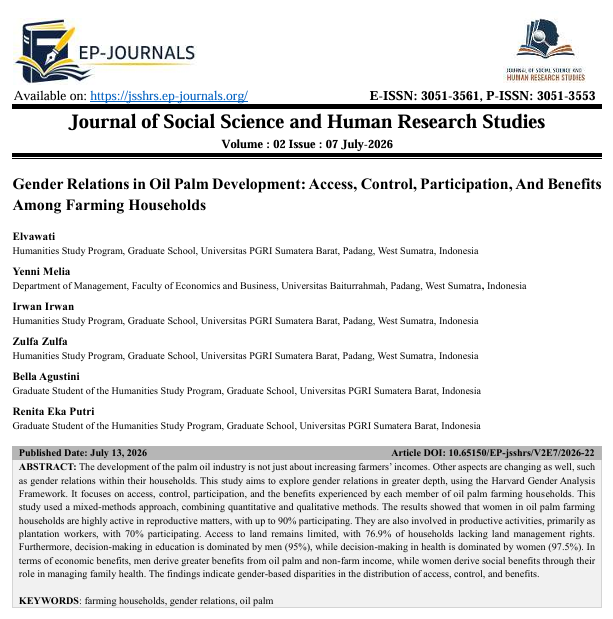
Gender Relations in Oil Palm Development: Access, Control, Participation, And Benefits Among Farming Households
DOI:
https://doi.org/10.65150/EP-jsshrs/V2E7/2026-22Keywords:
farming households, gender relations, oil palmAbstract
The development of the palm oil industry is not just about increasing farmers’ incomes. Other aspects are changing as well, such as gender relations within their households. This study aims to explore gender relations in greater depth, using the Harvard Gender Analysis Framework. It focuses on access, control, participation, and the benefits experienced by each member of oil palm farming households. This study used a mixed-methods approach, combining quantitative and qualitative methods. The results showed that women in oil palm farming households are highly active in reproductive matters, with up to 90% participating. They are also involved in productive activities, primarily as plantation workers, with 70% participating. Access to land remains limited, with 76.9% of households lacking land management rights. Furthermore, decision-making in education is dominated by men (95%), while decision-making in health is dominated by women (97.5%). In terms of economic benefits, men derive greater benefits from oil palm and non-farm income, while women derive social benefits through their role in managing family health. The findings indicate gender-based disparities in the distribution of access, control, and benefits.
References
1) Chrisendo, D., Krishna, V. V., Siregar, H., & Qaim, M. (2020). Land-use change, nutrition, and gender roles in Indonesian farm households. Forest Policy and Economics, 118, 102245.
2) Badan Pusat Statistik (2025) Statistik Tanaman Perkebunan Tahunan Indonesia 2024 (Indonesian Permanent Estate Crops Statistics 2024). Volume 1. Jakarta: Badan Pusat Statistik.
3) Creswell, J. W. (2016). Research Design: Pendekatan Metode Kualitatif, Kuantitatif, dan Campuran. Yogyakarta: Pustaka Pelajar.
4) Elvawati, Arya Hadi Dharmawan, Didin S. Damanhuri, Titik Sumarti. 2019. ‘Dari Karet Ke Sawit’: Transformasi Struktur Nafkah Rumah Tangga Petani Lokal Dan Petani Transmigran Di Minangkabau. Sodality: Jurnal Sosiologi Pedesaan , hal 86-94 .
5) Elvawati, E., Zulfa, Z., Melia, Y., Irwan, I., Yatim, Y., Putri, R. E., & Dewi, R. A. (2025). Oil Palm Expansion: Social Implications and Economic Growth of Oil Palm Farmers Households. International Journal of Social Science and Human Research, 8(6), 4643–4648.
6) Euler, M., Schwarze, S., Schall, N., Siregar, H., & Qaim, M. (2017). Oil palm expansion among smallholder farmers in Sumatra, Indonesia. Journal of Agricultural Economics, 68(1), 85–106.
7) Feintrenie, L., Chong, W. K., & Levang, P. (2010). Why do farmers prefer oil palm? Lessons learnt from Bungo District, Indonesia. Small-scale Forestry, 9(3), 379–396.
8) Kabeer, N. (1999). Resources, agency, achievements: Reflections on the measurement of women's empowerment. Development and Change, 30(3), 435–464.
9) Kubitza, C., Krishna, V. V., Klasen, S., Kopp, T., Nuryartono, N., & Qaim, M. (2024). Labor displacement in agriculture: Evidence from oil palm expansion in Indonesia. Land Economics, 100(3), 547–567.
10) March, Candida, Ines Smyth, and Maitrayee Mukhopadhya. 1999. A Guide to Gender-Analysis Frameworks. Oxford: Oxfam.
11) Moleong, L. J. (2018). Metodologi Penelitian Kualitatif. Bandung: PT Remaja Rosdakarya.
12) Moser, C. O. N. (1993). Gender Planning and Development: Theory, Practice and Training. Routledge.
13) Rathgeber, E. M. (1990). WID, WAD, GAD: Trends in research and practice. The Journal of Developing Areas, 24(4), 489–502.
14) Sugiyono. (2019). Metode Penelitian Kuantitatif, Kualitatif, dan R&D. Bandung: Alfabeta.
Downloads
Published
Issue
Section
License
Copyright (c) 2026 Elvawati, Yenni Melia, Irwan Irwan, Zulfa Zulfa, Bella Agustini, Renita Eka Putri (Author)

This work is licensed under a Creative Commons Attribution 4.0 International License.