The Boundary Terrarium: An Embodied WebAR Prototype for Children's Social Boundary Learning
DOI:
https://doi.org/10.65150/EP-jsshrs/V2E6/2026-01Keywords:
WebAR, social boundary, embodied cognition, child interaction design, cross-cultural communication, observation scaleAbstract
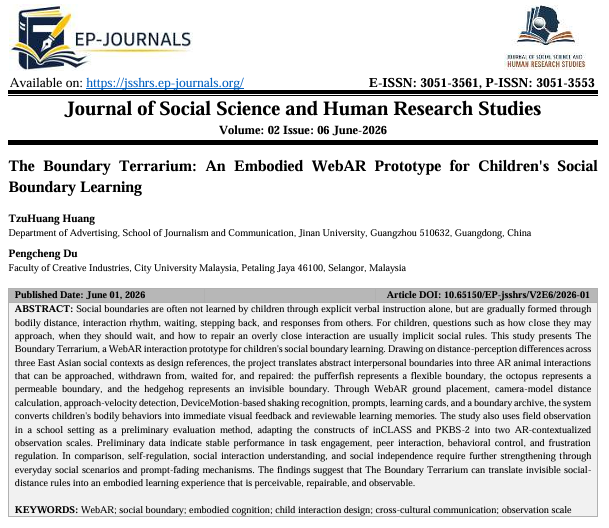
Social boundaries are often not learned by children through explicit verbal instruction alone, but are gradually formed through bodily distance, interaction rhythm, waiting, stepping back, and responses from others. For children, questions such as how close they may approach, when they should wait, and how to repair an overly close interaction are usually implicit social rules. This study presents The Boundary Terrarium, a WebAR interaction prototype for children's social boundary learning. Drawing on distance-perception differences across three East Asian social contexts as design references, the project translates abstract interpersonal boundaries into three AR animal interactions that can be approached, withdrawn from, waited for, and repaired: the pufferfish represents a flexible boundary, the octopus represents a permeable boundary, and the hedgehog represents an invisible boundary. Through WebAR ground placement, camera-model distance calculation, approach-velocity detection, DeviceMotion-based shaking recognition, prompts, learning cards, and a boundary archive, the system converts children's bodily behaviors into immediate visual feedback and reviewable learning memories. The study also uses field observation in a school setting as a preliminary evaluation method, adapting the constructs of inCLASS and PKBS-2 into two AR-contextualized observation scales. Preliminary data indicate stable performance in task engagement, peer interaction, behavioral control, and frustration regulation. In comparison, self-regulation, social interaction understanding, and social independence require further strengthening through everyday social scenarios and prompt-fading mechanisms. The findings suggest that The Boundary Terrarium can translate invisible social-distance rules into an embodied learning experience that is perceivable, repairable, and observable.
References
1) Ministry of Education, Culture, Sports, Science and Technology. (2017). Course of study for kindergarten (English version, tentative translation) [幼稚園教育要領(平成29年3月告示)]. MEXT.
2) K-12 Education Administration, Ministry of Education. (2017). Early childhood education and care curriculum framework [幼兒園教保活動課程大綱]. Ministry of Education, Taiwan.
3) Ministry of Education of the People's Republic of China. (2001). Guidelines for kindergarten education (trial implementation) [幼兒園教育指導綱要(試行)]. Ministry of Education of the People's Republic of China.
4) Hall, E. T. (1966). The hidden dimension. Doubleday.
5) Barsalou, L. W. (2008). Grounded cognition. Annual Review of Psychology, 59, 617-645.
https://doi.org/10.1146/annurev.psych.59.103006.093639
6) Burdelski, M. (2010). Socializing politeness routines: Action, other-orientation, and embodiment in a Japanese preschool. Journal of Pragmatics, 42(6), 1606-1621. https://doi.org/10.1016/j.pragma.2009.11.007
7) Sano, T. (1989). Methods of social control and socialization in Japanese day-care centers. Journal of Japanese Studies, 15(1), 125-138.
https://doi.org/10.2307/132410
8) 施喩琁, & 施又瑀. (2022). Guidance strategies for young children's social interaction problems [幼兒社會互動問題與輔導策略]. Taiwan Educational Review Monthly, 11(3), 111-116.
9) 陳岱瑤. (2022). Problems and solutions in young children's interpersonal interaction [幼兒人際互動的問題與解決之道]. Taiwan Educational Review Monthly, 11(7), 212-217.
10) Wang, X., & Jiang, J. (2021). On how to cultivate young children's interpersonal communication ability [淺談如何培養幼兒人際交往能力]. Advances in Social Sciences, 10(2), 247-251. https://doi.org/10.12677/ASS.2021.102037
11) Downer, J. T., Booren, L. M., Lima, O. K., Luckner, A. E., & Pianta, R. C. (2010). The Individualized Classroom Assessment Scoring System (inCLASS): Preliminary reliability and validity of a system for observing preschoolers' competence in classroom interactions. Early Childhood Research Quarterly, 25(1), 1-16. https://doi.org/10.1016/j.ecresq.2009.08.004
12) Merrell, K. W. (2002). Preschool and Kindergarten Behavior Scales (2nd ed.). PRO-ED.
13) 徐加, 蔡承值, 潘則佑, 吳宜儒, & 余能豪. (2025). VerbVenture: Design and evaluation of mixed reality and AI-assisted English collocation learning for children [VerbVenture-混合實境與人工智慧輔助兒童英語搭配詞學習之設計與評估]. Journal of Design, 30(4), 111-134.
14) 林玲伊, 劉萌容, 李易叡, & 莊宗嚴. (2022). Developing an augmented reality-based home training module to promote social interaction and behavioral self-regulation skills in children with autism spectrum disorder (II, III) [應用擴增實境技術開發居家訓練模組促進自閉症類群障礙症兒童社交互動與行為自我調節技巧(II、III)]. Ministry of Science and Technology Research Project Report.
15) Bai, Z., Blackwell, A. F., & Coulouris, G. (2015). Using augmented reality to elicit pretend play for children with autism. IEEE Transactions on Visualization and Computer Graphics, 21(5), 598-610. https://doi.org/10.1109/TVCG.2014.2385092
16) Dragomir, M., Manches, A., Fletcher-Watson, S., & Pain, H. (2018). Facilitating pretend play in autistic children: Results from an augmented reality app evaluation. Proceedings of the 20th International ACM SIGACCESS Conference on Computers and Accessibility, 407-409. https://doi.org/10.1145/3234695.3241020
17) Doulah, A. B. M. S. U., Rasheduzzaman, M., Arnob, F. A., Sarker, F., Roy, N., Ullah, M. A., & Mamun, K. A. (2023). Application of augmented reality interventions for children with autism spectrum disorder (ASD): A systematic review. Computers, 12(10), 215. https://doi.org/10.3390/computers12100215
18) Cheng, Y., & Bololia, L. (2024). The effects of augmented reality on social skills in children with an autism diagnosis: A preliminary systematic review. Journal of Autism and Developmental Disorders, 54, 1317-1331. https://doi.org/10.1007/s10803-022-05878-4
19) Roberts, R., Stacey, J., Jenner, S., & Maguire, E. (2023). Are extended reality interventions effective in helping autistic children to enhance their social skills? A systematic review. Review Journal of Autism and Developmental Disorders, 10, 729-748.
https://doi.org/10.1007/s40489-022-00320-y
20) Amaefule, C. O., Britzwein, J., Yip, J. C., & Brod, G. (2025). Children's perspectives on self-regulated learning: A co-design study on children's expectations towards educational technology. Education and Information Technologies, 30, 6117-6140.
Downloads
Published
Issue
Section
License
Copyright (c) 2026 TzuHuang Huang, Pengcheng Du (Author)

This work is licensed under a Creative Commons Attribution 4.0 International License.