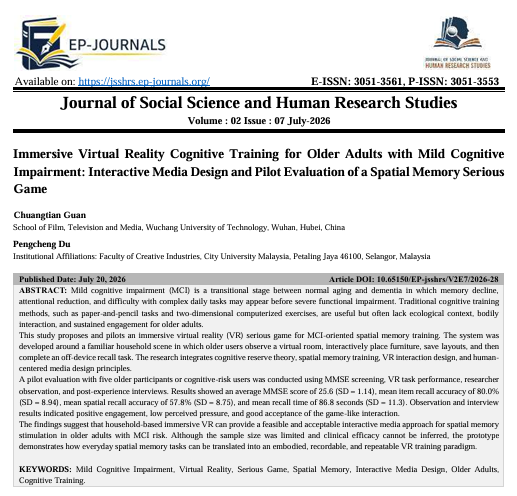
Immersive Virtual Reality Cognitive Training for Older Adults with Mild Cognitive Impairment: Interactive Media Design and Pilot Evaluation of a Spatial Memory Serious Game
DOI:
https://doi.org/10.65150/EP-jsshrs/V2E7/2026-28Keywords:
Mild Cognitive Impairment, Virtual Reality, Serious Game, Spatial Memory, Interactive Media Design, Older Adults, Cognitive Training.Abstract
Mild cognitive impairment (MCI) is a transitional stage between normal aging and dementia in which memory decline, attentional reduction, and difficulty with complex daily tasks may appear before severe functional impairment. Traditional cognitive training methods, such as paper-and-pencil tasks and two-dimensional computerized exercises, are useful but often lack ecological context, bodily interaction, and sustained engagement for older adults.
This study proposes and pilots an immersive virtual reality (VR) serious game for MCI-oriented spatial memory training. The system was developed around a familiar household scene in which older users observe a virtual room, interactively place furniture, save layouts, and then complete an off-device recall task. The research integrates cognitive reserve theory, spatial memory training, VR interaction design, and human-centered media design principles.
A pilot evaluation with five older participants or cognitive-risk users was conducted using MMSE screening, VR task performance, researcher observation, and post-experience interviews. Results showed an average MMSE score of 25.6 (SD = 1.14), mean item recall accuracy of 80.0% (SD = 8.94), mean spatial recall accuracy of 57.8% (SD = 8.75), and mean recall time of 86.8 seconds (SD = 11.3). Observation and interview results indicated positive engagement, low perceived pressure, and good acceptance of the game-like interaction.
The findings suggest that household-based immersive VR can provide a feasible and acceptable interactive media approach for spatial memory stimulation in older adults with MCI risk. Although the sample size was limited and clinical efficacy cannot be inferred, the prototype demonstrates how everyday spatial memory tasks can be translated into an embodied, recordable, and repeatable VR training paradigm.
References
1) Petersen, R. C., Smith, G. E., Waring, S. C., Ivnik, R. J., Tangalos, E. G., & Kokmen, E. (1999). Mild cognitive impairment: Clinical characterization and outcome. Archives of Neurology, 56(3), 303-308. https://doi.org/10.1001/archneur.56.3.303
2) Petersen, R. C. (2000). Mild cognitive impairment: Transition between aging and Alzheimer's disease. Neurologia, 15(3), 93-101.
3) Folstein, M. F., Folstein, S. E., & McHugh, P. R. (1975). Mini-mental state: A practical method for grading the cognitive state of patients for the clinician. Journal of Psychiatric Research, 12(3), 189-198. https://doi.org/10.1016/00223956(75)90026-6
4) Nasreddine, Z. S., Phillips, N. A., Bedirian, V., Charbonneau, S., Whitehead, V., Collin, I., Cummings, J. L., & Chertkow, H. (2005). The Montreal Cognitive Assessment, MoCA: A brief screening tool for mild cognitive impairment. Journal of the American Geriatrics Society, 53(4), 695-699. https://doi.org/10.1111/j.1532-5415.2005.53221.x
5) Stern, Y. (2002). What is cognitive reserve? Theory and research application of the reserve concept. Journal of the International Neuropsychological Society, 8(3), 448-460. https://doi.org/10.1017/S1355617702813248
6) Sisco, S. M., Marsiske, M., Gross, A. L., & Rebok, G. W. (2013). The influence of cognitive training on older adults' recall for short stories. Journal of Aging and Health, 25(8 Suppl), 230S-248S. https://doi.org/10.1177/0898264313501386
7) Belleville, S., Hudon, C., Bier, N., Brodeur, C., Gilbert, B., Grenier, S., Ouellet, M. C., Viscogliosi, C., & Gauthier, S. (2018). MEMO+: Efficacy, durability and effect of cognitive training and psychosocial intervention in individuals with mild cognitive impairment. Journal of the American Geriatrics Society, 66(4), 655-663. https://doi.org/10.1111/jgs.15192
8) Zhang, H., Huntley, J., Bhome, R., Holmes, B., Cahill, J., Gould, R. L., Wang, H., Yu, X., & Howard, R. (2019). Effect of computerised cognitive training on cognitive outcomes in mild cognitive impairment: A systematic review and metaanalysis. BMJ Open, 9(8), e027062. https://doi.org/10.1136/bmjopen-2018-027062
9) Tardif, S., & Simard, M. (2011). Cognitive stimulation programs in healthy elderly: A review. International Journal of Alzheimer's Disease, 2011, 378934. https://doi.org/10.4061/2011/378934
10) Burdea, G. C., & Coiffet, P. (2003). Virtual Reality Technology (2nd ed.). Wiley-Interscience.
11) Liao, Y. Y., Tseng, H. Y., Lin, Y. J., Wang, C. J., & Hsu, W. C. (2020). Using virtual reality-based training to improve cognitive function, instrumental activities of daily living and neural efficiency in older adults with mild cognitive impairment. European Journal of Physical and Rehabilitation Medicine, 56(1), 47-57. https://doi.org/10.23736/S19739087.19.05899-4
12) Yang, Q., Zhang, L., Chang, F., Yang, H., Chen, B., & Liu, Z. (2025). Virtual reality interventions for older adults with mild cognitive impairment: Systematic review and meta-analysis of randomized controlled trials. Journal of Medical Internet Research, 27, e59195. https://doi.org/10.2196/59195
13) Benge, J. F., & Scullin, M. K. (2025). A meta-analysis of technology use and cognitive aging. Nature Human Behaviour, 9, 1405-1419. https://doi.org/10.1038/s41562-025-02159-9
Downloads
Published
Issue
Section
License
Copyright (c) 2026 Chuangtian Guan , Pengcheng Du (Author)

This work is licensed under a Creative Commons Attribution 4.0 International License.